Math Terminology for incoming Uni students (OpenLearning)

Math Terminology for incoming Uni students (OpenLearning)

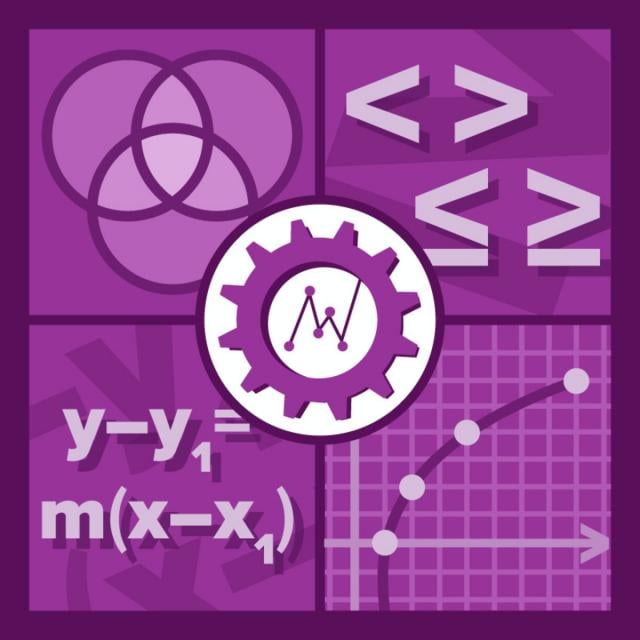
Entering university or college soon? Planning on taking some mathematics classes there--perhaps for your program in engineering, science or business? If you want a refresher on the most important terminology and notation for first year university mathematics, then this short course is just for you. The course will be especially useful if you are from a non-English speaking background.

The course is organized into 7 modules, each covering a different topic. Each module consists of a video about 30-45 minutes long, and also 15-30 minutes of activities.
Award winning teacher A/Prof N J Wildberger from the School of Mathematics and Statistics, Faculty of Science, UNSW, Australia will summarize key mathematical concepts and language, and give you important tips on how to write mathematics successfully.
As a bonus, you'll get a quick and useful review of essential high school mathematics. These are the ideas and facts that leading universities, such as UNSW, expect you to know as a first year maths student.
So sign up to openlearning, join the course, and roll up your sleaves for some fun and challenges that will boost your comprehesion of mathematics---and smooth your way into first year university or college.


Go to Class
MOOC List is learner-supported. When you buy through links on our site, we may earn an affiliate commission.

Related Courses

Basics of Inclusive Design for Online Education (Coursera) Coursera
University of Colorado Boulder

Basics of Inclusive Design for Online Education (Coursera)

This course provides instruction and strategies to support you in developing a course that is inclusive to students with a wide range of abilities, including students with disabilities. We cover effective practices to increase inclusion and avoid some of the common accessibility issues that can arise in an online course.

Jun 22nd 2026
5-12 Weeks
Critical Issues in Urban Education (Coursera) Coursera
University of Chicago

Critical Issues in Urban Education (Coursera)

Urban school reform in the United States is characterized by contentious, politicized debate. This course explores a set of critical issues in the education and educational reform space, with a focus on aspects of the field that have sparked controversy and polarized views. We will dig into these debates, situating them within the larger history of public education and school reform, and considering the viewpoints, the evidence, and translation of issues into educational policy.

Jun 22nd 2026
5-12 Weeks
English Whit #1 Using Sentence Connectors (OpenLearning) OpenLearning
UNSW Sydney - University of New South Wales

English Whit #1 Using Sentence Connectors (OpenLearning)

English Whit #1, Using Sentence Connectors, is the first in a series of online learning resources designed to demonstrate some of the learning and teaching styles at UNSW Foundation Studies. The learning sequence in this Whit is part of the Academic English curriculum in our Standard Foundation Program.

Self Paced
Self-Paced
Mathematical Foundations for Cryptography (Coursera) Coursera
University of Colorado System

Mathematical Foundations for Cryptography (Coursera)

Welcome to Course 2 of Introduction to Applied Cryptography. In this course, you will be introduced to basic mathematical principles and functions that form the foundation for cryptographic and cryptanalysis methods. These principles and functions will be helpful in understanding symmetric and asymmetric cryptographic methods examined in Course 3 and Course 4. These topics should prove especially useful to you if you are new to cybersecurity. It is recommended that you have a basic knowledge of computer science and basic math skills such as algebra and probability.

Jun 22nd 2026
4 Weeks
Mathematical Biostatistics Boot Camp 1 (Coursera) Coursera
Johns Hopkins University

Mathematical Biostatistics Boot Camp 1 (Coursera)

This class presents the fundamental probability and statistical concepts used in elementary data analysis. It will be taught at an introductory level for students with junior or senior college-level mathematical training including a working knowledge of calculus. A small amount of linear algebra and programming are useful for the class, but not required.

Jun 22nd 2026
4 Weeks
Expanding SEL (Coursera) Coursera
University of Colorado Boulder

Expanding SEL (Coursera)

Social and emotional learning, or SEL, programs have flourished in schools during the last decade. In this course the instructors (Emily Price and Ben Kirshner) introduce and help you examine community based and youth-empowerment approaches to social and emotional learning. Some of these approaches address the impact of social and political systems, such as immigration and structural racism, on children’s social and emotional experiences.

Jun 22nd 2026
5-12 Weeks
Discrete Mathematics (Coursera) Coursera
Shanghai Jiao Tong University

Discrete Mathematics (Coursera)

Discrete mathematics forms the mathematical foundation of computer and information science. It is also a fascinating subject in itself. Learners will become familiar with a broad range of mathematical objects like sets, functions, relations, graphs, that are omnipresent in computer science. Perhaps more importantly, they will reach a certain level of mathematical maturity - being able to understand formal statements and their proofs; coming up with rigorous proofs themselves; and coming up with interesting results.

Jun 22nd 2026
5-12 Weeks
Teaching Impacts of Technology: Global Society (Coursera) Coursera
University of California, San Diego

Teaching Impacts of Technology: Global Society (Coursera)

In this course you’ll focus on how technology-enabled communication is changing geopolitics and, more broadly, how technology is connecting our world and changing lives. This will be done through a series of paired teaching sections, exploring a specific “Impact of Computing” in your typical day and the “Technologies and Computing Concepts” that enable that impact, all at a K12-appropriate level.

Jun 25th 2026
4 Weeks
Introduction to Logic (Coursera) Coursera
Stanford University

Introduction to Logic (Coursera)

This course is an introduction to Logic from a computational perspective. It shows how to encode information in the form of logical sentences; it shows how to reason with information in this form; and it provides an overview of logic technology and its applications - in mathematics, science, engineering, business, law, and so forth.

Jun 22nd 2026
5-12 Weeks
Linear Regression and Modeling (Coursera) Coursera
Duke University

Linear Regression and Modeling (Coursera)

This course introduces simple and multiple linear regression models. These models allow you to assess the relationship between variables in a data set and a continuous response variable. Is there a relationship between the physical attractiveness of a professor and their student evaluation scores? Can we predict the test score for a child based on certain characteristics of his or her mother? In this course, you will learn the fundamental theory behind linear regression and, through data examples, learn to fit, examine, and utilize regression models to examine relationships between multiple variables, using the free statistical software R and RStudio.

Jun 22nd 2026
4 Weeks