Math for AI beginner part 1 Linear Algebra (Coursera)

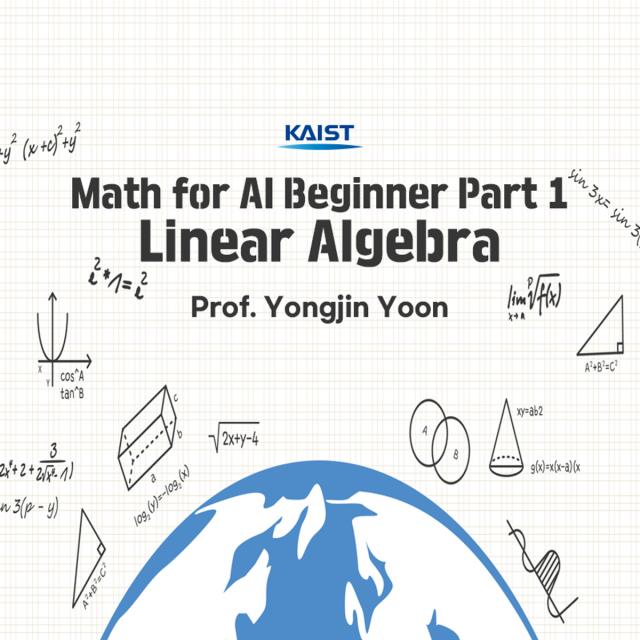
Math for AI beginner part 1 Linear Algebra (Coursera)

'Learn concept of AI such as machine learning, deep-learning, support vector machine which is related to linear algebra. Learn how to use linear algebra for AI algorithm. After completing this course, you are able to understand AI algorithm and basics of linear algebra for AI applications.

Class Deals by MOOC List - Click here and see Coursera's Active Discounts, Deals, and Promo Codes.

Syllabus

WEEK 1: Introduction to AI
WEEK 2: Introduction of Linear Algebra
WEEK 3: Low operation and linear combination
WEEK 4: Linearly independent and Inverse Matrix
WEEK 5: Determinant of Square Matrix and Eigenvalue Problem
WEEK 6: Diagonaliztion Problem and AI Applications

Go to Class
MOOC List is learner-supported. When you buy through links on our site, we may earn an affiliate commission.

Related Courses

Calculus: Single Variable Part 3 - Integration (Coursera) Coursera
University of Pennsylvania

Calculus: Single Variable Part 3 - Integration (Coursera)

Calculus is one of the grandest achievements of human thought, explaining everything from planetary orbits to the optimal size of a city to the periodicity of a heartbeat. This brisk course covers the core ideas of single-variable Calculus with emphases on conceptual understanding and applications. The course is ideal for students beginning in the engineering, physical, and social sciences.

Oct 26th 2026
4 Weeks
Geometría Analítica Preuniversitaria (Coursera) Coursera
Universidad Autónoma Metropolitana

Geometría Analítica Preuniversitaria (Coursera)

Líneas rectas, círculos, parábolas, elipses e hipérbolas son figuras geométricas que encontramos en nuestro derredor. Por ejemplo, mucha gente sabe que los planetas en nuestro sistema solar se mueven en órbitas elípticas teniendo al astro rey en un foco de esta figura. Sin embargo, pocos saben que la plaza de San Pedro en el Vaticano está construída sobre elipses donde sus focos se encuentran sobre las fuentes donde mucha gente se toma fotos. Estos son dos ejemplos que muestran la importancia de las figuras geométricas en nuestra vida.

Nov 2nd 2026
5-12 Weeks
Introduction to Mathematical Thinking (Coursera) Coursera
Stanford University

Introduction to Mathematical Thinking (Coursera)

Learn how to think the way mathematicians do - a powerful cognitive process developed over thousands of years. Mathematical thinking is not the same as doing mathematics – at least not as mathematics is typically presented in our school system. School math typically focuses on learning procedures to solve highly stereotyped problems. Professional mathematicians think a certain way to solve real problems, problems that can arise from the everyday world, or from science, or from within mathematics itself.

Nov 2nd 2026
5-12 Weeks
Artificial Intelligence for Breast Cancer Detection (Coursera) Coursera
Johns Hopkins University

Artificial Intelligence for Breast Cancer Detection (Coursera)

Through interactive lectures and module exercises, this course illustrates the potential of artificial intelligence in breast imaging. Topics include an introduction of breast cancer and breast imaging, introduction to artificial intelligence in image analysis and computer image processing of cancer detection. The course intends to provide students basic understanding of artificial intelligence approaches to breast cancer detection.

Nov 2nd 2026
4 Weeks
The Finite Element Method for Problems in Physics (Coursera) Coursera
University of Michigan

The Finite Element Method for Problems in Physics (Coursera)

This course is an introduction to the finite element method as applicable to a range of problems in physics and engineering sciences. The treatment is mathematical, but only for the purpose of clarifying the formulation. The emphasis is on coding up the formulations in a modern, open-source environment that can be expanded to other applications, subsequently.

Nov 2nd 2026
13-24 Weeks
Legal Tech and the Digital Transformation of Law (Coursera) Coursera
Universidad Austral

Legal Tech and the Digital Transformation of Law (Coursera)

The digital revolution changed the way we communicate and trade. Now, it is coming into the world of law. This program will give you a broad overview of the main trends that are affecting the legal industry: the birth of the legal tech market and the application of technology in law; the role of artificial intelligence in the automation of the work of lawyers; blockchain technology and its impact on the way we sign and execute contracts; initiatives to ensure access to justice through virtual courts and robot judges.

Nov 2nd 2026
5-12 Weeks
Business Implications of AI: A Nano-course (Coursera) Coursera
EIT Digital

Business Implications of AI: A Nano-course (Coursera)

In this course you will learn what Artificial Intelligence is, from a leaders point of view. How shall we, as leaders, understand it from a corporate strategy point of view? What is it and how can it be used? What are the crucial strategic decisions we have to make, and how to make them? What consequences can we expect if we decide on doing AI-projects and what kind of competences do we need? Where shall we start, and what could be a good second as well as third step? What implications for the organization can we expect? These are the questions answered in this course.

Nov 2nd 2026
4 Weeks
Image and video processing: From Mars to Hollywood with a stop at the hospital (Coursera) Coursera
Duke University

Image and video processing: From Mars to Hollywood with a stop at the hospital (Coursera)

In this course, you will learn the science behind how digital images and video are made, altered, stored, and used. We will look at the vast world of digital imaging, from how computers and digital cameras form images to how digital special effects are used in Hollywood movies to how the Mars Rover was able to send photographs across millions of miles of space.

Nov 2nd 2026
5-12 Weeks
Introduction à la théorie de Galois (Coursera) Coursera
École normale supérieure

Introduction à la théorie de Galois (Coursera)

Le cours expose la théorie de Galois, du classique critère de non-résolubilité des équations polynomiales aux méthodes plus avancées de calcul de groupes de Galois par réduction modulo un nombre premier. Le thème général de cette théorie est l'étude des racines d'un polynôme et concerne en particulier la possibilité de les exprimer à partir des coefficients de ce polynôme. Evariste Galois considère les symétries de ces racines et associe ainsi à ce polynôme un groupe de permutations de ses racines, que l'on appelle maintenant son groupe de Galois.

Oct 26th 2026
5-12 Weeks
AI, Business & the Future of Work (Coursera) Coursera
Lund University

AI, Business & the Future of Work (Coursera)

This course from Lunds university will help you understand and use AI so that you can transform your organisation to be more efficient, more sustainable and thus innovative. The lives of people all over the world are increasingly enhanced and shaped by artificial intelligence. To organisations there are tremendous opportunities, but also risks, so where do you start to plan for AI, business and the future of work?

Nov 2nd 2026
4 Weeks
Building Trust: Ethics for AI-powered Chatbots (Coursera) Coursera
Coursera Instructor Network

Building Trust: Ethics for AI-powered Chatbots (Coursera)

Many organizations with websites are using chatbots to engage with customers. While this strategy has proved profitable and efficient, there are ethical issues that can arise if users are unaware that their interaction is with an AI bot and not a human. This course will take the learner through the evolution of chatbots, so they are equipped with an appropriate sense of incremental improvements.

Nov 2nd 2026
1 Week
Responsible AI - Principles and Ethical Considerations (Coursera) Coursera
Fractal Analytics

Responsible AI - Principles and Ethical Considerations (Coursera)

Welcome to "Responsible AI – Principles and Ethical Considerations"! Dive deep into the very essence of Responsible AI with us. Uncover the significance of key principles shaping technology's future. From ethical considerations to fairness, transparency, and accountability, we discuss these principles with real-world examples, putting them into the context of data science.

Nov 2nd 2026
5-12 Weeks