Introduction à la programmation orientée objet (en Java) (Coursera)

Introduction à la programmation orientée objet (en Java) (Coursera)

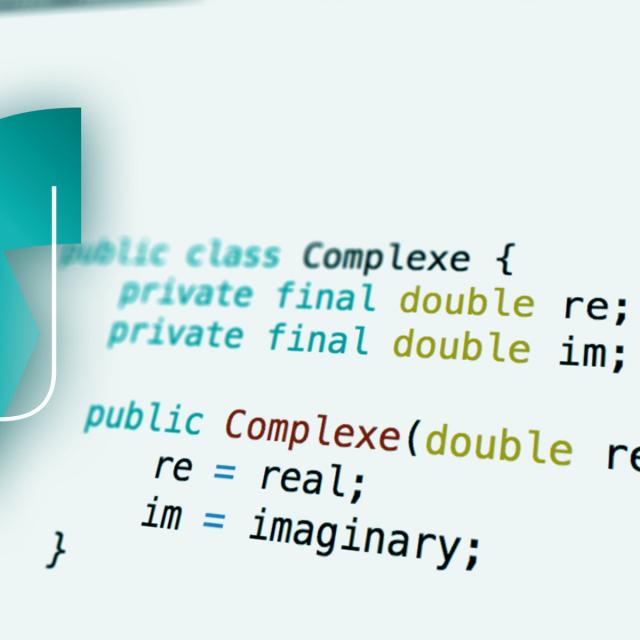
Ce cours introduit la programmation orientée objet (encapsulation, abstration, héritage, polymorphisme) en l'illustrant en langage Java. Il présuppose connues les bases de la programmation (variables, types, boucles, fonctions, ...). Il est conçu comme la suite du cours « Initiation à la programmation (en Java) ».

Class Deals by MOOC List - Click here and see Coursera's Active Discounts, Deals, and Promo Codes.

Comme son prédécesseur, ce cours s'appuie sur de nombreux éléments pédagogiques : vidéos sous-titrées, quizz dans et hors vidéos, exercices, devoirs notés automatiquement, notes de cours.

Syllabus

WEEK 1
Introduction à la Programmation Orientée Objet
Cette semaine vous accueille dans le cours et vous présente les premiers concepts de base de la programmation dite « orientée objet ».

WEEK 2
Constructeurs
Cette semaine aborde l'initialisation des objets (via ce qu'on appelle des « constructeurs »), ainsi que ce qui se passe lorsque l'on affiche, compare et affecte des objets en Java. La question de comment se passe la « fin de vie » des objets est aussi abordée.

WEEK 3
Héritage
Cette semaine nous abordons deux notions fondamentales de la programmation orientée objet : l'héritage et le polymorphisme.

WEEK 4
Polymorphisme (modificateur abstract) ; le modificateur final
Cette semaine nous étudions la notion de classe abstraite et approfondissons les notions d'héritage et de polymorphisme. Nous abordons aussi une notion complémentaire qui n'est pas directement liée à ces thèmes, le modificateur final.

WEEK 5
Le modificateur static ; Interfaces
Cette semaine nous abordons la notion importante d'interface qui va complémenter vos acquis sur l'orienté objet en Java. Nous étudions aussi le modificateur static.

WEEK 6
Gestion des exceptions
Nous étudions cette semaine comment gérer, au moyen du mécanisme des exceptions, des situations anormales pouvant survenir lors de l'exécution d'un programme.

WEEK 7
Etude de cas
Nous terminons notre cours par une étude de cas détaillée qui met en lumière les différents concepts rencontrés.

Go to Class
MOOC List is learner-supported. When you buy through links on our site, we may earn an affiliate commission.

Related Courses

Python for Data Science, AI & Development (Coursera) Coursera
IBM

Python for Data Science, AI & Development (Coursera)

Kickstart your learning of Python for data science, as well as programming in general, with this beginner-friendly introduction to Python. Python is one of the world’s most popular programming languages, and there has never been greater demand for professionals with the ability to apply Python fundamentals to drive business solutions across industries.

Jun 9th 2026
5-12 Weeks
Using Python to Interact with the Operating System (Coursera) Coursera
Google

Using Python to Interact with the Operating System (Coursera)

By the end of this course, you’ll be able to manipulate files and processes on your computer’s operating system. You’ll also have learned about regular expressions -- a very powerful tool for processing text files -- and you’ll get practice using the Linux command line on a virtual machine. And, this might feel like a stretch right now, but you’ll also write a program that processes a bunch of errors in an actual log file and then generates a summary file. That’s a super useful skill for IT Specialists to know.

Jun 9th 2026
5-12 Weeks
Crash Course on Python (Coursera) Coursera
Google

Crash Course on Python (Coursera)

This course is designed to teach you the foundations in order to write simple programs in Python using the most common structures. No previous exposure to programming is needed. By the end of this course, you'll understand the benefits of programming in IT roles; be able to write simple programs using Python; figure out how the building blocks of programming fit together; and combine all of this knowledge to solve a complex programming problem.

Jun 9th 2026
5-12 Weeks
Cloud Computing Concepts, Part 1 (Coursera) Coursera
University of Illinois at Urbana-Champaign

Cloud Computing Concepts, Part 1 (Coursera)

Cloud computing systems today, whether open-source or used inside companies, are built using a common set of core techniques, algorithms, and design philosophies—all centered around distributed systems. Learn about such fundamental distributed computing "concepts" for cloud computing. Some of these concepts include: clouds, MapReduce, key-value/NoSQL stores, classical distributed algorithms, widely-used distributed algorithms, scalability, trending areas, and much, much more!

Jun 8th 2026
5-12 Weeks
Code Yourself! An Introduction to Programming (Coursera) Coursera
University of Edinburgh,Universidad ORT Uruguay

Code Yourself! An Introduction to Programming (Coursera)

Have you ever wished you knew how to program, but had no idea where to start from? This course will teach you how to program in Scratch, an easy to use visual programming language. More importantly, it will introduce you to the fundamental principles of computing and it will help you think like a software engineer.

Jun 8th 2026
5-12 Weeks
Advanced Data Structures in Java (Coursera) Coursera
University of California, San Diego

Advanced Data Structures in Java (Coursera)

How does Google Maps plan the best route for getting around town given current traffic conditions? How does an internet router forward packets of network traffic to minimize delay? How does an aid group allocate resources to its affiliated local partners? To solve such problems, we first represent the key pieces of data in a complex data structure. In this course, you’ll learn about data structures, like graphs, that are fundamental for working with structured real world data.

Jun 8th 2026
5-12 Weeks
Programming Mobile Applications for Android Handheld Systems: Part 1 (Coursera) Coursera
University of Maryland, College Park

Programming Mobile Applications for Android Handheld Systems: Part 1 (Coursera)

This course introduces you to the design and implementation of Android applications for mobile devices. You will develop an app from scratch, assuming a basic knowledge of Java, and learn how to set up Android Studio, work with various Activities and create simple user interfaces to make your apps run smoothly.

Jun 8th 2026
5-12 Weeks
Functional Programming Principles in Scala (Coursera) Coursera
École Polytechnique Fédérale de Lausanne

Functional Programming Principles in Scala (Coursera)

Functional programming is becoming increasingly widespread in industry. This trend is driven by the adoption of Scala as the main programming language for many applications. Scala fuses functional and object-oriented programming in a practical package. It interoperates seamlessly with both Java and Javascript. Scala is the implementation language of many important frameworks, including Apache Spark, Kafka, and Akka. It provides the core infrastructure for sites such as Twitter, Tumblr and also Coursera.

Jun 8th 2026
5-12 Weeks
Data Structures and Performance (Coursera) Coursera
University of California, San Diego

Data Structures and Performance (Coursera)

How do Java programs deal with vast quantities of data? Many of the data structures and algorithms that work with introductory toy examples break when applications process real, large data sets. Efficiency is critical, but how do we achieve it, and how do we even measure it? This is an intermediate Java course. We recommend this course to learners who have previous experience in software development or a background in computer science, and in particular, we recommend that you have taken the first course in this specialization (which also requires some previous experience with Java).

Jun 8th 2026
5-12 Weeks
The Unix Workbench (Coursera) Coursera
Johns Hopkins University

The Unix Workbench (Coursera)

Unix forms a foundation that is often very helpful for accomplishing other goals you might have for you and your computer, whether that goal is running a business, writing a book, curing disease, or creating the next great app. The means to these goals are sometimes carried out by writing software. Software can’t be mined out of the ground, nor can software seeds be planted in spring to harvest by autumn. Software isn’t produced in factories on an assembly line. Software is a hand-made, often bespoke good. If a software developer is an artisan, then Unix is their workbench.

Jun 8th 2026
4 Weeks
Introduction to CSS3 (Coursera) Coursera
University of Michigan

Introduction to CSS3 (Coursera)

The web today is almost unrecognizable from the early days of white pages with lists of blue links. Now, sites are designed with complex layouts, unique fonts, and customized color schemes. This course will show you the basics of Cascading Style Sheets (CSS3). The emphasis will be on learning how to write CSS rules, how to test code, and how to establish good programming habits.

Jun 8th 2026
4 Weeks