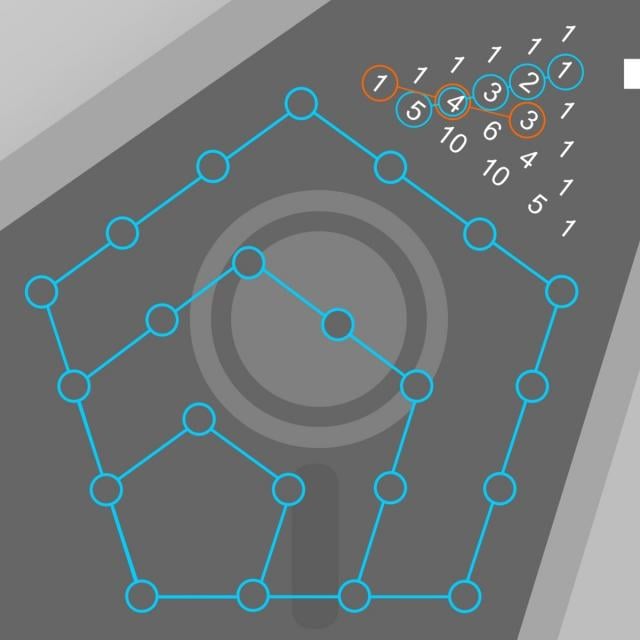
Introduction to Enumerative Combinatorics (Coursera)

Introduction to Enumerative Combinatorics (Coursera)

Enumerative combinatorics deals with finite sets and their cardinalities. In other words, a typical problem of enumerative combinatorics is to find the number of ways a certain pattern can be formed. In the first part of our course we will be dealing with elementary combinatorial objects and notions: permutations, combinations, compositions, Fibonacci and Catalan numbers etc. In the second part of the course we introduce the notion of generating functions and use it to study recurrence relations and partition numbers.

Class Deals by MOOC List - Click here and see Coursera's Active Discounts, Deals, and Promo Codes.

The course is mostly self-contained. However, some acquaintance with basic linear algebra and analysis (including Taylor series expansion) may be very helpful.

Syllabus

WEEK 1
Introduction
Permutations and binomial coefficients
In this introductory lecture we discuss fundamental combinatorial constructions: we will see how to compute the number of words of fixed length in a given alphabet, the number of permutations of a finite set and the number of subsets with a given number of elements in a finite set. The latter numbers are called binomial coefficients; we will see how they appear in various combinatorial problems in this and forthcoming lectures. As an application of combinatorial methods, we also give a combinatorial proof of Fermat's little theorem.

WEEK 2
Binomial coefficients, continued. Inclusion and exclusion formula.
In the first part of this lecture we will see more applications of binomial coefficients, in particular, their appearance in counting multisets. The second part is devoted to the principle of inclusion and exclusion: a technique which allows us to find the number of elements in the union of several sets, given the cardinalities of all of their intersections. We discuss its applications to various combinatorial problem, including the computation of the number of permutations without fixed points (the derangement problem).

WEEK 3
Linear recurrences. The Fibonacci sequence
We start with a well-known "rabbit problem", which dates back to Fibonacci. Using the Fibonacci sequence as our main example, we discuss a general method of solving linear recurrences with constant coefficients.

WEEK 4
A nonlinear recurrence: many faces of Catalan numbers
In this lecture we introduce Catalan numbers and discuss several ways to define them: via triangulations of a polygon, Dyck paths and binary trees. We also prove an explicit formula for Catalan numbers.

WEEK 5
Generating functions: a unified approach to combinatorial problems. Solving linear recurrences
We introduce the central notion of our course, the notion of a generating function. We start with studying properties of formal power series and then apply the machinery of generating functions to solving linear recurrence relations.

WEEK 6
Generating functions, continued. Generating function of the Catalan sequence
In this lecture we discuss further properties of formal power series. In particular, we prove an analogue of the binomial theorem for an arbitrary rational exponent. We apply this technique to computing the generating function of the sequence of Catalan numbers.

WEEK 7
Partitions. Euler’s generating function for partitions and pentagonal formula
In this lecture we introduce partitions, i.e. the number of ways to present a given integer as a sum of ordered integer summands. There is no closed formula for the number of partitions; however, it is possible to compute their generating function. We study the properties of this generating function, including the famous Pentagonal theorem, due to Leonhard Euler.

WEEK 8
Gaussian binomial coefficients. “Quantum” versions of combinatorial identities
Our final lecture is devoted to the so-called "q-analogues" of various combinatorial notions and identities. As a general principle, we replace identities with numbers by identities with polynomials in a certain variable, usually denoted by q, that return the original statement as q tends to 1. This approach turns out to be extremely useful in various branches of mathematics, from number theory to representation theory.

Go to Class
MOOC List is learner-supported. When you buy through links on our site, we may earn an affiliate commission.

Related Courses

Identifying Patient Populations (Coursera) Coursera
University of Colorado System

Identifying Patient Populations (Coursera)

This course teaches you the fundamentals of computational phenotyping, a biomedical informatics method for identifying patient populations. In this course you will learn how different clinical data types perform when trying to identify patients with a particular disease or trait. You will also learn how to program different data manipulations and combinations to increase the complexity and improve the performance of your algorithms.

Jun 22nd 2026
5-12 Weeks
Conceptos y Herramientas para la Física Universitaria (Coursera) Coursera
Tecnológico de Monterrey

Conceptos y Herramientas para la Física Universitaria (Coursera)

Este curso provee al estudiante con conceptos y herramientas matemáticas para modelar problemas en física, que al aplicar podrá enfrentar con éxito los cursos de física universitarios. Así pues, la filosofía de este curso consiste en cubrir temas conceptuales relativos a la Física y desarrollar tu capacidad de aprender y aplicarlos en tu vida profesional.

Jun 22nd 2026
5-12 Weeks
Algebra: Elementary to Advanced - Functions & Applications (Coursera) Coursera
Johns Hopkins University

Algebra: Elementary to Advanced - Functions & Applications (Coursera)

After completing this course, students will learn how to successfully apply functions to model different data and real world occurrences. This course reviews the concept of a function and then provide multiple examples of common and uncommon types of functions used in a variety of disciplines. Formulas, domains, ranges, graphs, intercepts, and fundamental behavior are all analyzed using both algebraic and analytic techniques. From this core set of functions, new functions are created by arithmetic operations and function composition.

Jun 22nd 2026
3 Weeks
Aprendizaje de las matemáticas de primaria (Coursera) Coursera
Universidad de los Andes

Aprendizaje de las matemáticas de primaria (Coursera)

En este segundo curso de acceso gratuito* del programa especializado Educación Matemática para profesores de primaria, conocerás las cuestiones particulares sobre el aprendizaje de las matemáticas y las dificultades y los errores más frecuentes que tienen que enfrentar los estudiantes al aprenderlas. El curso tiene una duración aproximada de seis semanas, con una dedicación promedio de 4 horas semanales. Todas las evaluaciones tienen retroalimentación y podrás descargar la mayoría de los recursos del curso.

Jun 22nd 2026
5-12 Weeks
Matrix Methods (Coursera) Coursera
University of Minnesota

Matrix Methods (Coursera)

Mathematical Matrix Methods lie at the root of most methods of machine learning and data analysis of tabular data. Learn the basics of Matrix Methods, including matrix-matrix multiplication, solving linear equations, orthogonality, and best least squares approximation. Discover the Singular Value Decomposition that plays a fundamental role in dimensionality reduction, Principal Component Analysis, and noise reduction.

Jun 22nd 2026
5-12 Weeks
Mathematical Foundations for Cryptography (Coursera) Coursera
University of Colorado System

Mathematical Foundations for Cryptography (Coursera)

Welcome to Course 2 of Introduction to Applied Cryptography. In this course, you will be introduced to basic mathematical principles and functions that form the foundation for cryptographic and cryptanalysis methods. These principles and functions will be helpful in understanding symmetric and asymmetric cryptographic methods examined in Course 3 and Course 4. These topics should prove especially useful to you if you are new to cybersecurity. It is recommended that you have a basic knowledge of computer science and basic math skills such as algebra and probability.

Jun 22nd 2026
4 Weeks
Pre-MBA Quantitative Skills: Data Analysis (Coursera) Coursera
Rice University

Pre-MBA Quantitative Skills: Data Analysis (Coursera)

This course will equip students with the quantitative skills needed to begin any Masters of Business Administration program. The goal is not to build foundational skills or expert mastery but rather, to provide some middle ground to “shake the rust off” skills that a typical MBA student probably knows, but may not have thought about for quite some time.

Jun 22nd 2026
4 Weeks
English for Science, Technology, Engineering, and Mathematics (Coursera) Coursera
University of Pennsylvania

English for Science, Technology, Engineering, and Mathematics (Coursera)

Welcome to English for Science, Technology, Engineering, and Mathematics, a course created by the University of Pennsylvania, and funded by the U.S. Department of State Bureau of Educational and Cultural Affairs, Office of English Language Programs. This course is designed for non-native English speakers who are interested in improving their English skills in the sciences. In this course, you will explore some of the most innovative areas of scientific study, while expanding your vocabulary and the language skills needed to share scientific information within your community.

Jun 15th 2026
5-12 Weeks
Fundamentals of Engineering Exam Review (Coursera) Coursera
Georgia Institute of Technology

Fundamentals of Engineering Exam Review (Coursera)

The purpose of this course is to review the material covered in the Fundamentals of Engineering (FE) exam to enable the student to pass it. It will be presented in modules corresponding to the FE topics, particularly those in Civil and Mechanical Engineering. Each module will review main concepts, illustrate them with examples, and provide extensive practice problems.

Jun 15th 2026
5-12 Weeks
Mathematical Biostatistics Boot Camp 1 (Coursera) Coursera
Johns Hopkins University

Mathematical Biostatistics Boot Camp 1 (Coursera)

This class presents the fundamental probability and statistical concepts used in elementary data analysis. It will be taught at an introductory level for students with junior or senior college-level mathematical training including a working knowledge of calculus. A small amount of linear algebra and programming are useful for the class, but not required.

Jun 22nd 2026
4 Weeks
Introduction to Mathematical Thinking (Coursera) Coursera
Stanford University

Introduction to Mathematical Thinking (Coursera)

Learn how to think the way mathematicians do - a powerful cognitive process developed over thousands of years. Mathematical thinking is not the same as doing mathematics – at least not as mathematics is typically presented in our school system. School math typically focuses on learning procedures to solve highly stereotyped problems. Professional mathematicians think a certain way to solve real problems, problems that can arise from the everyday world, or from science, or from within mathematics itself.

Jun 15th 2026
5-12 Weeks
Enseñanza de las matemáticas de primaria (Coursera) Coursera
Universidad de los Andes

Enseñanza de las matemáticas de primaria (Coursera)

En este tercer curso de acceso gratuito* del programa especializado Educación Matemática para profesores de primaria, conocerás los conceptos y técnicas para planificar e implementar tus clases. El curso tiene una duración aproximada de seis semanas, con una dedicación promedio de 4 horas semanales. Todas las evaluaciones tienen retroalimentación y podrás descargar la mayoría de los recursos del curso.

Jun 22nd 2026
5-12 Weeks