EdX

Introduction to Computational Science and Engineering (edX)

Offered by MIT, MITx,
Introduction to Computational Science and Engineering (edX)

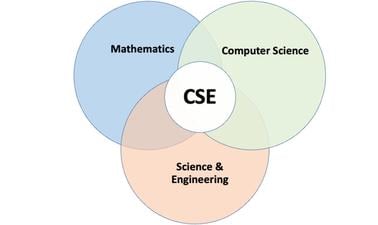
CSE.0002x is an introduction to using computing to solve problems in engineering and science including simulation of time-dependent phenomena; optimization of systems; and quantification of uncertainty.

Class Deals by MOOC List - Click here and see EdX's Active Discounts, Deals, and Promo Codes.

CSE.0002x will teach you how to use to solve problems in engineering and science including simulation of time-dependent phenomena; optimization of systems; and quantification of uncertainty. This course is primarily for learners with some prior programming experience in Python and an introductory knowledge of calculus and mechanics (typical of a first-year college course in these topics). You will spend a considerable amount of time writing programs to implement the concepts covered in the course. For example, you will write programs that will: simulate the descent of a lander in the Martian atmosphere; optimize the placement of cellular towers on the MIT campus; and quantify the likelihood of significant climate temperature rise under different scenarios.
Topics covered include:

  • Advanced programming in Python 3 and NumPy
  • Plotting with Matplotlib
  • Initial value problems
  • Discretization with explicit and implicit methods
  • Solution of linear and nonlinear systems of equations
  • Unconstrained optimization and gradient descent
  • Probability, distributions
  • Monte Carlo simulations

What you'll learn

  • Python 3, NumPy, and Matplotlib
  • Numerical methods to solve initial value problems
  • Solution of linear and nonlinear systems of equations
  • Unconstrained optimization and gradient descent
  • Monte Carlo simulations

Prerequisites:

Go to Class
MOOC List is learner-supported. When you buy through links on our site, we may earn an affiliate commission.

Related Courses

Probability and Statistics in Data Science using Python (edX) EdX
University of California, San Diego,UC San DiegoX

Probability and Statistics in Data Science using Python (edX)

Using Python, learn statistical and probabilistic approaches to understand and gain insights from data. The job of a data scientist is to glean knowledge from complex and noisy datasets. Reasoning about uncertainty is inherent in the analysis of noisy data. Probability and Statistics provide the mathematical foundation for such reasoning.

Self Paced
Self-Paced
Technology Entrepreneurship: Lab to Market (edX) EdX
HarvardX,Harvard University

Technology Entrepreneurship: Lab to Market (edX)

Explore how entrepreneurs build successful businesses by moving technology from lab to market. In this introductory course, developed in collaboration with the Laboratory for Innovation Science at Harvard and the University of California San Diego, you’ll explore how entrepreneurs match promising technology with customer needs to launch successful new businesses.

Self Paced
Self-Paced
Fundamentos de Mecánica para Ingeniería (edX) EdX
Universitat Politècnica de València,UPValenciaX

Fundamentos de Mecánica para Ingeniería (edX)

Estudiaremos la cinemática y la dinámica del punto, los conceptos de trabajo y potencia y la energía mecánica. Se aborda el estudio del universo físico analizando objetos en movimiento. Se definen y analizan todas las magnitudes y leyes físicas que permiten describir geométrica y causalmente el movimiento de cuerpos representados por un punto.

Self Paced
Self-Paced
Solar Energy: Photovoltaic (PV) Technologies (edX) EdX
Delft University of Technology,DelftX

Solar Energy: Photovoltaic (PV) Technologies (edX)

Explore the main PV technologies in the current market. Get in-depth knowledge on the design and processing methods of solar cells. The technologies used to produce solar cells and photovoltaic modules are advancing to deliver highly efficient and flexible solar panels. In this course you will explore the main PV technologies in the current market.

Self Paced
5-12 Weeks
Software Engineering: Introduction (edX) EdX
The University of British Columbia,UBCx

Software Engineering: Introduction (edX)

Learn how to apply engineering principles, such as Agile, to build a full-stack software system. You will learn software engineering principles that are applicable to the breadth of large-scale software systems. The course explores topics such as agile development, REST and Async programming, software specification, design, refactoring, information security, and more.

Self Paced
Self-Paced
Fundamentals of Statistics (edX) EdX
MIT,MITx

Fundamentals of Statistics (edX)

Develop a deep understanding of the principles that underpin statistical inference: estimation, hypothesis testing and prediction. Statistics is the science of turning data into insights and ultimately decisions. Behind recent advances in machine learning, data science and artificial intelligence are fundamental statistical principles. The purpose of this class is to develop and understand these core ideas on firm mathematical grounds starting from the construction of estimators and tests, as well as an analysis of their asymptotic performance.

Aug 26th 2026
13-24 Weeks
Modeling and Simulation of Multibody Systems - Part II (edX) EdX
LouvainX,Université Catholique de Louvain - UCL

Modeling and Simulation of Multibody Systems - Part II (edX)

90% of daily life multibody systems contain loops of bodies, e.g. vehicle or bike suspensions, parallel manipulators or robots, and musculoskeletal systems. They can also include joint constraints. In this second course about multibody systems, learn how to model them and how to deal with more advanced numerical analyses.

Self Paced
Self-Paced
Data Science: R Basics (edX) EdX
HarvardX,Harvard University

Data Science: R Basics (edX)

Build a foundation in R and learn how to wrangle, analyze, and visualize data. This course will introduce you to the basics of R programming. You can better retain R when you learn it to solve a specific problem, so you’ll use a real-world dataset about crime in the United States. You will learn the R skills needed to answer essential questions about differences in crime across the different states.

Self Paced
Self-Paced
Decision-Making for Autonomous Systems (edX) EdX
Chalmers University of Technology,ChalmersX

Decision-Making for Autonomous Systems (edX)

Learn effective tactics for making key decisions when working with autonomous, self-driving vehicles. In autonomous vehicles such as self-driving cars, we find a number of interesting and challenging decision-making problems. Starting from the autonomous driving of a single vehicle, to the coordination among multiple vehicles. This course will teach you the fundamental mathematical model for many of these real-world problems.

Self Paced
Self-Paced
Data Science: Probability (edX) EdX
HarvardX,Harvard University

Data Science: Probability (edX)

Learn probability theory — essential for a data scientist — using a case study on the financial crisis of 2007–2008. In this course, you will learn valuable concepts in probability theory. The motivation for this course is the circumstances surrounding the financial crisis of 2007–2008. Part of what caused this financial crisis was that the risk of some securities sold by financial institutions was underestimated. To begin to understand this very complicated event, we need to understand the basics of probability.

Self Paced
Self-Paced
A Hands-on Introduction to Engineering Simulations (edX) EdX
CornellX,Cornell University

A Hands-on Introduction to Engineering Simulations (edX)

Learn how to analyze real-world engineering problems using ANSYS simulation software and gain important professional skills sought by employers. In this hands-on course, you’ll learn how to perform engineering simulations using a powerful tool from ANSYS, Inc. This is a problem-based course where you’ll learn by doing. The focus will be on understanding what’s under the blackbox so as to move beyond garbage-in, garbage-out. You’ll practice using a common solution approach to problems involving different physics: structural mechanics, fluid dynamics and heat transfer.

Self Paced
Self-Paced
The Basics of Transport Phenomena (edX) EdX
Delft University of Technology,DelftX

The Basics of Transport Phenomena (edX)

Learn the basic framework to work on a broad spectrum of engineering problems concerning transfer of heat, mass and momentum. Learn through examples of everyday processes at home, in the lab and in industry. Have you ever wondered why ventilation helps to cool down your hot chocolate? Do you know why a surfing suit keeps you warm? Why iron feels cold, while wood feels warm at room temperature? Or how air is transferred into aqueous liquids in a water treatment plant? How can we sterilize milk with the least amount of energy? How does medicine spread in our tissue? Or how do we design a new cooling tower of a power plant? All these are phenomena that involve heat transfer, mass transfer or fluid flow.

Self Paced
Self-Paced