Introduction to Complex Analysis (Coursera)

Offered by Wesleyan University,
Introduction to Complex Analysis (Coursera)

This course provides an introduction to complex analysis which is the theory of complex functions of a complex variable. We will start by introducing the complex plane, along with the algebra and geometry of complex numbers, and then we will make our way via differentiation, integration, complex dynamics, power series representation and Laurent series into territories at the edge of what is known today.

Class Deals by MOOC List - Click here and see Coursera's Active Discounts, Deals, and Promo Codes.

Each module consists of five video lectures with embedded quizzes, followed by an electronically graded homework assignment. Additionally, modules 1, 3, and 5 also contain a peer assessment.
The homework assignments will require time to think through and practice the concepts discussed in the lectures. In fact, a significant amount of your learning will happen while completing the homework assignments. These assignments are not meant to be completed quickly; rather you'll need paper and pen with you to work through the questions. In total, we expect that the course will take 6-12 hours of work per module, depending on your background.

Syllabus

WEEK 1
Introduction to Complex Numbers
We’ll begin this module by briefly learning about the history of complex numbers: When and why were they invented? In particular, we’ll look at the rather surprising fact that the original need for complex numbers did not arise from the study of quadratic equations (such as solving the equation z^2+1 = 0), but rather from the study of cubic equations! Next we’ll cover some algebra and geometry in the complex plane to learn how to compute with and visualize complex numbers. To that end we’ll also learn about the polar representation of complex numbers, which will lend itself nicely to finding roots of complex numbers. We’ll finish this module by looking at some topology in the complex plane.

WEEK 2
Complex Functions and Iteration
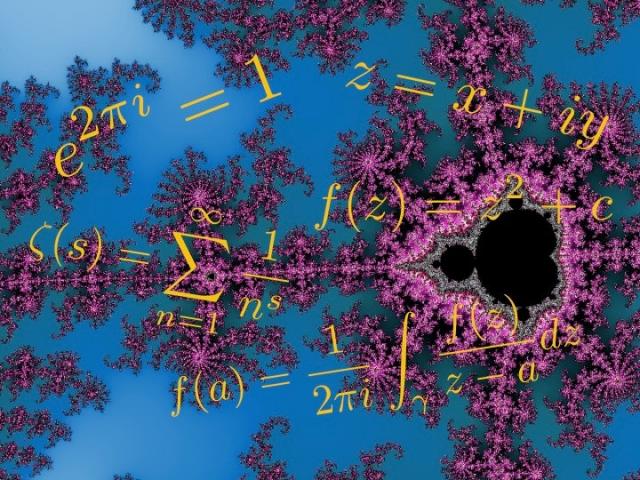
Complex analysis is the study of functions that live in the complex plane, that is, functions that have complex arguments and complex outputs. The main goal of this module is to familiarize ourselves with such functions. Ultimately we’ll want to study their smoothness properties (that is, we’ll want to differentiate complex functions of complex variables), and we therefore need to understand sequences of complex numbers as well as limits in the complex plane. We’ll use quadratic polynomials as an example in the study of complex functions and take an excursion into the beautiful field of complex dynamics by looking at the iterates of certain quadratic polynomials. This allows us to learn about the basics of the construction of Julia sets of quadratic polynomials. You'll learn everything you need to know to create your own beautiful fractal images, if you so desire. We’ll finish this module by defining and looking at the Mandelbrot set and one of the biggest outstanding conjectures in the field of complex dynamics.

WEEK 3
Analytic Functions
When studying functions we are often interested in their local behavior, more specifically, in how functions change as their argument changes. This leads us to studying complex differentiation – a more powerful concept than that which we learned in calculus. We’ll begin this module by reviewing some facts from calculus and then learn about complex differentiation and the Cauchy-Riemann equations in order to meet the main players: analytic functions. These are functions that possess complex derivatives in lots of places; a fact, which endows them with some of the most beautiful properties mathematics has to offer. We’ll finish this module with the study of some functions that are complex differentiable, such as the complex exponential function and complex trigonometric functions. These functions agree with their well-known real-valued counterparts on the real axis!

WEEK 4
Conformal Mappings
We’ll begin this module by studying inverse functions of analytic functions such as the complex logarithm (inverse of the exponential) and complex roots (inverses of power) functions. In order to possess a (local) inverse, an analytic function needs to have a non-zero derivative, and we’ll discover the powerful fact that at any such place an analytic function preserves angles between curves and is therefore a conformal mapping! We'll spend two lectures talking about very special conformal mappings, namely Möbius transformations; these are some of the most fundamental mappings in geometric analysis. We'll finish this module with the famous and stunning Riemann mapping theorem. This theorem allows us to study arbitrary simply connected sub-regions of the complex plane by transporting geometry and complex analysis from the unit disk to those domains via conformal mappings, the existence of which is guaranteed via the Riemann Mapping Theorem.

WEEK 5
Complex Integration
Now that we are familiar with complex differentiation and analytic functions we are ready to tackle integration. But we are in the complex plane, so what are the objects we’ll integrate over? Curves! We’ll begin this module by studying curves (“paths”) and next get acquainted with the complex path integral. Then we’ll learn about Cauchy’s beautiful and all encompassing integral theorem and formula. Next we’ll study some of the powerful consequences of these theorems, such as Liouville’s Theorem, the Maximum Principle and, believe it or not, we’ll be able to prove the Fundamental Theorem of Algebra using Complex Analysis. It's going to be a week filled with many amazing results!

WEEK 6
Power Series
In this module we’ll learn about power series representations of analytic functions. We’ll begin by studying infinite series of complex numbers and complex functions as well as their convergence properties. Power series are especially easy to understand, well behaved and easy to work with. We’ll learn that every analytic function can be locally represented as a power series, which makes it possible to approximate analytic functions locally via polynomials. As a special treat, we'll explore the Riemann zeta function, and we’ll make our way into territories at the edge of what is known today such as the Riemann hypothesis and its relation to prime numbers.

WEEK 7
Laurent Series and the Residue Theorem
Laurent series are a powerful tool to understand analytic functions near their singularities. Whereas power series with non-negative exponents can be used to represent analytic functions in disks, Laurent series (which can have negative exponents) serve a similar purpose in annuli. We’ll begin this module by introducing Laurent series and their relation to analytic functions and then continue on to the study and classification of isolated singularities of analytic functions. We’ll encounter some powerful and famous theorems such as the Theorem of Casorati-Weierstraß and Picard’s Theorem, both of which serve to better understand the behavior of an analytic function near an essential singularity. Finally we’ll be ready to tackle the Residue Theorem, which has many important applications. We’ll learn how to find residues and evaluate some integrals (even some real integrals on the real line!) via this important theorem.

WEEK 8
Final Exam
This module contains the final exam for the course. The exam is cumulative and covers the topics discussed in Weeks 1-7. The exam has 20 questions and is designed to be a two-hour exam. You have one attempt only, but you do not have to complete the exam within two hours. The discussion forum will stay open during the exam. It is against the honor code to discuss answers to any exam question on the forum. The forum should only be used to discuss questions on other material or to alert staff of technical issues with the exam.

Go to Class
MOOC List is learner-supported. When you buy through links on our site, we may earn an affiliate commission.

Related Courses

Calculus: Single Variable Part 2 - Differentiation (Coursera) Coursera
University of Pennsylvania

Calculus: Single Variable Part 2 - Differentiation (Coursera)

Calculus is one of the grandest achievements of human thought, explaining everything from planetary orbits to the optimal size of a city to the periodicity of a heartbeat. This brisk course covers the core ideas of single-variable Calculus with emphases on conceptual understanding and applications. The course is ideal for students beginning in the engineering, physical, and social sciences.

Aug 3rd 2026
3 Weeks
Algebra: Elementary to Advanced - Equations & Inequalities (Coursera) Coursera
Johns Hopkins University

Algebra: Elementary to Advanced - Equations & Inequalities (Coursera)

This course is intended for students looking to create a solid algebraic foundation of fundamental mathematical concepts from which to take more advanced courses that use concepts from precalculus, calculus, probability, and statistics. This course will help solidify your computational methods, review algebraic formulas and properties, and apply these concepts model real world situations.

Jul 20th 2026
4 Weeks
Data Manipulation at Scale: Systems and Algorithms (Coursera) Coursera
University of Washington

Data Manipulation at Scale: Systems and Algorithms (Coursera)

Data analysis has replaced data acquisition as the bottleneck to evidence-based decision making --- we are drowning in it. Extracting knowledge from large, heterogeneous, and noisy datasets requires not only powerful computing resources, but the programming abstractions to use them effectively. The abstractions that emerged in the last decade blend ideas from parallel databases, distributed systems, and programming languages to create a new class of scalable data analytics platforms that form the foundation for data science at realistic scales.

Jul 20th 2026
4 Weeks
Analytic Combinatorics (Coursera) Coursera
Princeton University

Analytic Combinatorics (Coursera)

Analytic Combinatorics teaches a calculus that enables precise quantitative predictions of large combinatorial structures. This course introduces the symbolic method to derive functional relations among ordinary, exponential, and multivariate generating functions, and methods in complex analysis for deriving accurate asymptotics from the GF equations. All the features of this course are available for free. It does not offer a certificate upon completion.

Aug 10th 2026
5-12 Weeks
Positioning: What you need for a successful Marketing Strategy (Coursera) Coursera
IE Business School

Positioning: What you need for a successful Marketing Strategy (Coursera)

Positioning, the must have for a successful Marketing Strategy Positioning is the heart of any Marketing Strategy, the core that you must get right. It does not matter whether you start with a clearly defined target group or with a differential value proposition: You are going to end up with a clear Positioning upon which we build our Marketing Plan. In this course - the second in our Marketing Strategy Specialization - IE professor Ignacio Gafo will guide you through the essential stages of this key marketing process, starting with the basic elements that you will require and deciding on the market segmentation and marketing.

Jul 27th 2026
4 Weeks
GIS, Mapping, and Spatial Analysis Capstone (Coursera) Coursera
University of Toronto

GIS, Mapping, and Spatial Analysis Capstone (Coursera)

In this capstone course, you will apply everything you have learned by designing and then completing your own GIS project. You will plan out your project by writing a brief proposal that explains what you plan to do and why. You will then find data for a topic and location of your choice, and perform analysis and create maps that allow you to try out different tools and data sets. The results of your work will be assembled into an Esri story map, which is a web site with maps, images, text, and video. The goal is for you to have a finished product that you can share, and that demonstrates what you have learned.

Jul 27th 2026
5-12 Weeks
Design and innovation of business model (Coursera) Coursera
Tecnológico de Monterrey

Design and innovation of business model (Coursera)

The core of Business Model Design lies in skills and leadership of the entrepreneurial manager. It requires a disciplined approach to seeking opportunities, as well as gathering and aligning resources to achieve important goals. In this course, students will strengthen two important skills: intuition and visual thinking, while applying quantitative methods learned in other courses, such as Finance, Economics and Financial Intelligence.

Jul 20th 2026
4 Weeks
Strategies for Effective Engagement (Coursera) Coursera
University of Colorado Boulder

Strategies for Effective Engagement (Coursera)

Being a successful professional requires creative, innovative, and entrepreneurial thinking, and to continually have a problem-solving mindset. As a systems thinker, you are expected to engage complex problems from multiple perspectives and different angles, viewing them holistically. This course exposes the student to a variety of tools used to engage stakeholders, collect data, and more deeply understand the community.

Jul 20th 2026
3 Weeks
Numerical Methods for Engineers (Coursera) Coursera
The Hong Kong University of Science and Technology - HKUST

Numerical Methods for Engineers (Coursera)

Numerical Methods for Engineers covers the most important numerical methods that an engineer should know. We derive basic algorithms in root finding, matrix algebra, integration and interpolation, ordinary and partial differential equations. We learn how to use MATLAB to solve numerical problems. Access to MATLAB online and the MATLAB grader is given to all students who enroll. We assume students are already familiar with the basics of matrix algebra, differential equations, and vector calculus. Students should have already studied a programming language, and be willing to learn MATLAB.

Jul 27th 2026
5-12 Weeks
Enseñanza de las matemáticas de primaria (Coursera) Coursera
Universidad de los Andes

Enseñanza de las matemáticas de primaria (Coursera)

En este tercer curso de acceso gratuito* del programa especializado Educación Matemática para profesores de primaria, conocerás los conceptos y técnicas para planificar e implementar tus clases. El curso tiene una duración aproximada de seis semanas, con una dedicación promedio de 4 horas semanales. Todas las evaluaciones tienen retroalimentación y podrás descargar la mayoría de los recursos del curso.

Jul 20th 2026
5-12 Weeks
Visual Analytics with Tableau (Coursera) Coursera
University of California, Davis

Visual Analytics with Tableau (Coursera)

In this third course of the specialization, we’ll drill deeper into the tools Tableau offers in the areas of charting, dates, table calculations and mapping. We’ll explore the best choices for charts, based on the type of data you are using. We’ll look at specific types of charts including scatter plots, Gantt charts, histograms, bullet charts and several others, and we’ll address charting guidelines.

Jul 27th 2026
4 Weeks
Analysis of Algorithms (Coursera) Coursera
Princeton University

Analysis of Algorithms (Coursera)

This course teaches a calculus that enables precise quantitative predictions of large combinatorial structures. In addition, this course covers generating functions and real asymptotics and then introduces the symbolic method in the context of applications in the analysis of algorithms and basic structures such as permutations, trees, strings, words, and mappings.

Aug 3rd 2026
5-12 Weeks