Data Science Math Skills (Coursera)

Offered by Duke University,
Data Science Math Skills (Coursera)

Data science courses contain math—no avoiding that! This course is designed to teach learners the basic math you will need in order to be successful in almost any data science math course and was created for learners who have basic math skills but may not have taken algebra or pre-calculus. Data Science Math Skills introduces the core math that data science is built upon, with no extra complexity, introducing unfamiliar ideas and math symbols one-at-a-time.

Class Deals by MOOC List - Click here and see Coursera's Active Discounts, Deals, and Promo Codes.

Learners who complete this course will master the vocabulary, notation, concepts, and algebra rules that all data scientists must know before moving on to more advanced material.
Topics include:
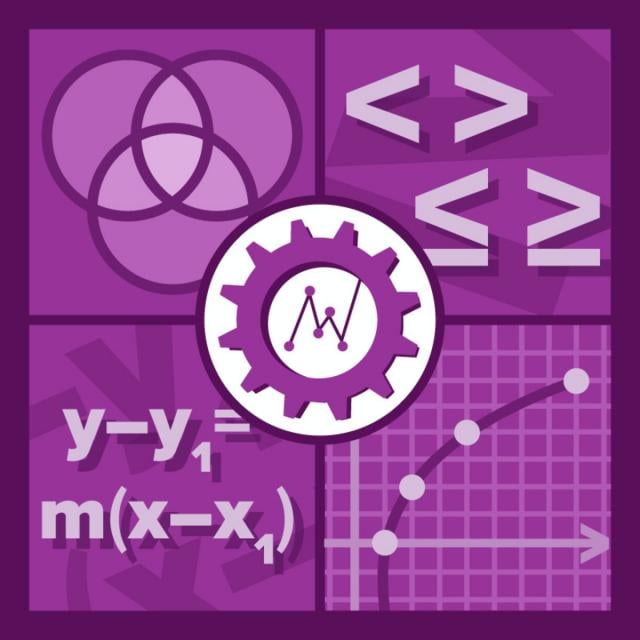
~Set theory, including Venn diagrams
~Properties of the real number line
~Interval notation and algebra with inequalities
~Uses for summation and Sigma notation
~Math on the Cartesian (x,y) plane, slope and distance formulas
~Graphing and describing functions and their inverses on the x-y plane,
~The concept of instantaneous rate of change and tangent lines to a curve
~Exponents, logarithms, and the natural log function.
~Probability theory, including Bayes’ theorem.
While this course is intended as a general introduction to the math skills needed for data science, it can be considered a prerequisite for learners interested in the course, "Mastering Data Analysis in Excel," which is part of the Excel to MySQL Data Science Specialization. Learners who master Data Science Math Skills will be fully prepared for success with the more advanced math concepts introduced in "Mastering Data Analysis in Excel."

Syllabus

WEEK 1
Welcome to Data Science Math Skills
This short module includes an overview of the course's structure, working process, and information about course certificates, quizzes, video lectures, and other important course details. Make sure to read it right away and refer back to it whenever needed
Building Blocks for Problem Solving
This module contains three lessons that are build to basic math vocabulary. The first lesson, "Sets and What They’re Good For," walks you through the basic notions of set theory, including unions, intersections, and cardinality. It also gives a real-world application to medical testing. The second lesson, "The Infinite World of Real Numbers," explains notation we use to discuss intervals on the real number line. The module concludes with the third lesson, "That Jagged S Symbol," where you will learn how to compactly express a long series of additions and use this skill to define statistical quantities like mean and variance.

WEEK 2
Functions and Graphs
This module builds vocabulary for graphing functions in the plane. In the first lesson, "Descartes Was Really Smart," you will get to know the Cartesian Plane, measure distance in it, and find the equations of lines. The second lesson introduces the idea of a function as an input-output machine, shows you how to graph functions in the Cartesian Plane, and goes over important vocabulary.

WEEK 3
Measuring Rates of Change
This module begins a very gentle introduction to the calculus concept of the derivative. The first lesson, "This is About the Derivative Stuff," will give basic definitions, work a few examples, and show you how to apply these concepts to the real-world problem of optimization. We then turn to exponents and logarithms, and explain the rules and notation for these math tools. Finally we learn about the rate of change of continuous growth, and the special constant known as “e” that captures this concept in a single number—near 2.718.

WEEK 4
Introduction to Probability Theory
This module introduces the vocabulary and notation of probability theory – mathematics for the study of outcomes that are uncertain but have predictable rates of occurrence. We start with the basic definitions and rules of probability, including the probability of two or more events both occurring, the sum rule and the product rule, and then proceed to Bayes’ Theorem and how it is used in practical problems.

Go to Class
MOOC List is learner-supported. When you buy through links on our site, we may earn an affiliate commission.

Related Courses

Algorithms on Graphs (Coursera) Coursera
University of California, San Diego,Higher School of Economics - HSE University

Algorithms on Graphs (Coursera)

If you have ever used a navigation service to find optimal route and estimate time to destination, you've used algorithms on graphs. Graphs arise in various real-world situations as there are road networks, computer networks and, most recently, social networks! If you're looking for the fastest time to get to work, cheapest way to connect set of computers into a network or efficient algorithm to automatically find communities and opinion leaders in Facebook, you're going to work with graphs and algorithms on graphs.

Jun 22nd 2026
5-12 Weeks
Interactivity with JavaScript (Coursera) Coursera
University of Michigan

Interactivity with JavaScript (Coursera)

If you want to take your website to the next level, the ability to incorporate interactivity is a must. But adding some of these types of capabilities requires a stronger programming language than HTML5 or CSS3, and JavaScript can provide just what you need. With just a basic understanding of the language, you can create a page that will react to common events such as page loads, mouse clicks & movements, and even keyboard input.

Jun 22nd 2026
4 Weeks
Mathematical Biostatistics Boot Camp 1 (Coursera) Coursera
Johns Hopkins University

Mathematical Biostatistics Boot Camp 1 (Coursera)

This class presents the fundamental probability and statistical concepts used in elementary data analysis. It will be taught at an introductory level for students with junior or senior college-level mathematical training including a working knowledge of calculus. A small amount of linear algebra and programming are useful for the class, but not required.

Jun 22nd 2026
4 Weeks
Practical Predictive Analytics: Models and Methods (Coursera) Coursera
University of Washington

Practical Predictive Analytics: Models and Methods (Coursera)

Statistical experiment design and analytics are at the heart of data science. In this course you will design statistical experiments and analyze the results using modern methods. You will also explore the common pitfalls in interpreting statistical arguments, especially those associated with big data. Collectively, this course will help you internalize a core set of practical and effective machine learning methods and concepts, and apply them to solve some real world problems.

Jun 22nd 2026
4 Weeks
Experimentation for Improvement (Coursera) Coursera
McMaster University

Experimentation for Improvement (Coursera)

We are always using experiments to improve our lives, our community, and our work. Are you doing it efficiently? Or are you (incorrectly) changing one thing at a time and hoping for the best? In this course, you will learn how to plan efficient experiments - testing with many variables. Our goal is to find the best results using only a few experiments. A key part of the course is how to optimize a system.

Jun 22nd 2026
5-12 Weeks
Introduction to Probability and Data with R (Coursera) Coursera
Duke University

Introduction to Probability and Data with R (Coursera)

This course introduces you to sampling and exploring data, as well as basic probability theory and Bayes' rule. You will examine various types of sampling methods, and discuss how such methods can impact the scope of inference. A variety of exploratory data analysis techniques will be covered, including numeric summary statistics and basic data visualization.

Jun 22nd 2026
5-12 Weeks
Introduction to Machine Learning (Coursera) Coursera
Duke University

Introduction to Machine Learning (Coursera)

This course will provide you a foundational understanding of machine learning models (logistic regression, multilayer perceptrons, convolutional neural networks, natural language processing, etc.) as well as demonstrate how these models can solve complex problems in a variety of industries, from medical diagnostics to image recognition to text prediction.

Jun 26th 2026
5-12 Weeks
Exploratory Data Analysis (Coursera) Coursera
Johns Hopkins University

Exploratory Data Analysis (Coursera)

This course covers the essential exploratory techniques for summarizing data. These techniques are typically applied before formal modeling commences and can help inform the development of more complex statistical models. Exploratory techniques are also important for eliminating or sharpening potential hypotheses about the world that can be addressed by the data.

Jun 22nd 2026
4 Weeks
Reproducible Research (Coursera) Coursera
Johns Hopkins University

Reproducible Research (Coursera)

This course focuses on the concepts and tools behind reporting modern data analyses in a reproducible manner. Reproducible research is the idea that data analyses, and more generally, scientific claims, are published with their data and software code so that others may verify the findings and build upon them. The need for reproducibility is increasing dramatically as data analyses become more complex, involving larger datasets and more sophisticated computations.

Jun 22nd 2026
4 Weeks
Algorithms, Part II (Coursera) Coursera
Princeton University

Algorithms, Part II (Coursera)

This course covers the essential information that every serious programmer needs to know about algorithms and data structures, with emphasis on applications and scientific performance analysis of Java implementations. Part I covers elementary data structures, sorting, and searching algorithms. Part II focuses on graph- and string-processing algorithms.

Jun 22nd 2026
5-12 Weeks