Introducing Robotics: Build a Robot Arm (FutureLearn)

Introducing Robotics: Build a Robot Arm (FutureLearn)

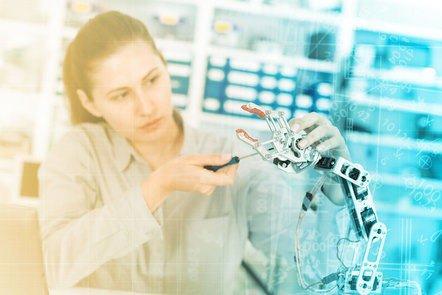
Design, build and program a simple robot and share it with other learners. Here’s your chance to build a simple robot. Robotics is all about integrating hardware and software. In this course, you’ll design, build and program a simple robot, with at least two joints, that can carry a pen or pencil and draw a coordinated line on a sheet of a paper.

Class Deals by MOOC List - Click here and see FutureLearn's Active Discounts, Deals, and Promo Codes.

There are lots of ways you could actually build such a robot and that will depend on your skill level, your budget, or what equipment you can source.
You may find the project challenging. You’ll need to bring together a number of skills, such as mechanical design and software development. The software needs to implement kinematic algorithms as well as communicate with sensors and motors. You will need to generate a trajectory of points for the robot to move on the worksheet and test and adjust the software to improve your robot’s performance. At the end of the course, you’ll be invited to submit a video of your completed robot for peer review.

What topics will you cover?

  • Build your robot arm:

Sourcing the equipment
Connecting to the brick
Moving the motors
Braking modes

-Configuration and design:
Joint types
Key design decisions
Connecting structure and gears

-Move and test your robot arm:
Robot design tips
Developing kinematics equations in MATLAB
Moving your robot to a point
Joint movement
Improving movement performance

  • Assess your robot (optional):

Filming your robot arm
Submitting your video for peer assessment
Assessing other learners’ videos

What will you achieve?
By the end of the course, you'll be able to...

  • Apply mathematical, algorithmic and control principles of robot arm manipulators
  • Produce a working robot through physical construction and software development
Go to Class
MOOC List is learner-supported. When you buy through links on our site, we may earn an affiliate commission.

Related Courses

Building a Future with Robots (FutureLearn) FutureLearn
The University of Sheffield

Building a Future with Robots (FutureLearn)

Explore the role of robots and autonomous systems in the factories, homes, hospitals, schools and cars of our near future. In the near future, many of us will work alongside robots. Knowledge of robotics and autonomous systems will be a helpful skill for a surprising number of today’s careers. On this course, we’ll look at current and future developments in the field of robotics that could shape many different aspects of our daily lives.

Available now
3 Weeks
Introducing Robotics: Robotics and Society (FutureLearn) FutureLearn
Queensland University of Technology

Introducing Robotics: Robotics and Society (FutureLearn)

How do you feel about robots? Learn how robotics is used today and explore how it might help solve the big issues of our time. Once only found in fiction, robots are being applied in an increasing array of ways in society, from mechanisation of industrial tasks to exploring places humans can’t go. This course starts with your perceptions of robotics, describes different types of robots, and leads into a discussion of the future: knowing we can use robots, should we?

No sessions available
3 Weeks
Ethical Issues in Computing Applications (Coursera) Coursera
University of Colorado Boulder

Ethical Issues in Computing Applications (Coursera)

Computing systems and technologies fundamentally impact the lives of most people in the world, including how we communicate, get information, socialize, and receive healthcare. This course is the third of a three course sequence that examines ethical issues in the design and implementation of computing systems and technologies, and reflects upon the broad implication of computing on our society. It covers medical applications, uses of robotics, autonomous vehicles, and the future of work.

Jun 1st 2026
5-12 Weeks
Basic Robotic Behaviors and Odometry (Coursera) Coursera
University of Colorado Boulder

Basic Robotic Behaviors and Odometry (Coursera)

"Basic Robotic Behaviors and Odometry" provides you with an introduction to autonomous mobile robots, including forward kinematics (“odometry”), basic sensors and actuators, and simple reactive behavior. This course is centered around exercises in the realistic, physics-based simulator, “Webots”, where you will experiment in a hands-on manner with simple reactive behaviors for collision avoidance and line following, state machines, and basic forward kinematics of non-holonomic systems.

Jun 1st 2026
5-12 Weeks
Artificial Intelligence (AI) (edX) EdX
Columbia University,ColumbiaX

Artificial Intelligence (AI) (edX)

Learn the fundamentals of Artificial Intelligence (AI), and apply them. Design intelligent agents to solve real-world problems including, search, games, machine learning, logic, and constraint satisfaction problems. What do self-driving cars, face recognition, web search, industrial robots, missile guidance, and tumor detection have in common? They are all complex real world problems being solved with applications of intelligence (AI).

This course is archived
5-12 Weeks
Robotics: Aerial Robotics (Coursera) Coursera
University of Pennsylvania

Robotics: Aerial Robotics (Coursera)

How can we create agile micro aerial vehicles that are able to operate autonomously in cluttered indoor and outdoor environments? You will gain an introduction to the mechanics of flight and the design of quadrotor flying robots and will be able to develop dynamic models, derive controllers, and synthesize planners for operating in three dimensional environments.

Jan 6th 2025
4 Weeks
Robotics: Perception (Coursera) Coursera
University of Pennsylvania

Robotics: Perception (Coursera)

How can robots perceive the world and their own movements so that they accomplish navigation and manipulation tasks? In this module, we will study how images and videos acquired by cameras mounted on robots are transformed into representations like features and optical flow. Such 2D representations allow us then to extract 3D information about where the camera is and in which direction the robot moves. You will come to understand how grasping objects is facilitated by the computation of 3D posing of objects and navigation can be accomplished by visual odometry and landmark-based localization.

Jan 13th 2025
4 Weeks
Robotics: Mobility (Coursera) Coursera
University of Pennsylvania

Robotics: Mobility (Coursera)

How can robots use their motors and sensors to move around in an unstructured environment? You will understand how to design robot bodies and behaviors that recruit limbs and more general appendages to apply physical forces that confer reliable mobility in a complex and dynamic world. We develop an approach to composing simple dynamical abstractions that partially automate the generation of complicated sensorimotor programs.

Jan 6th 2025
4 Weeks
Modern Robotics, Course 3: Robot Dynamics (Coursera) Coursera
Northwestern University

Modern Robotics, Course 3: Robot Dynamics (Coursera)

Do you want to know how robots work? Are you interested in robotics as a career? Are you willing to invest the effort to learn fundamental mathematical modeling techniques that are used in all subfields of robotics? If so, then the "Modern Robotics: Mechanics, Planning, and Control" specialization may be for you. This specialization, consisting of six short courses, is serious preparation for serious students who hope to work in the field of robotics or to undertake advanced study. It is not a sampler.

Jun 1st 2026
4 Weeks