Robotic Mapping and Trajectory Generation (Coursera)

Robotic Mapping and Trajectory Generation (Coursera)

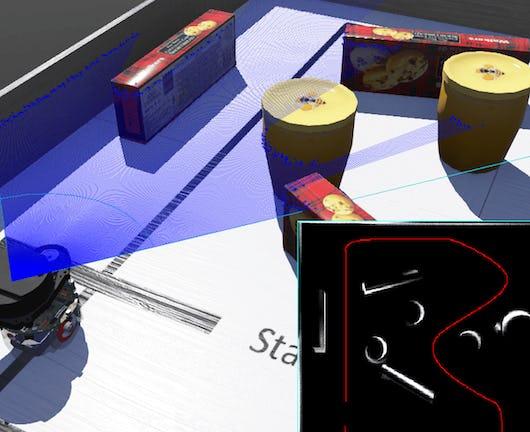
In this second course of the Introduction to Robotics specialization, "Robotic Mapping and Trajectory Generation", you will learn how to perform basic inverse kinematics of (non-)holonomic systems using a feedback control approach. You will also learn how to process multi-dimensional sensor signals such as laser range scanners for mapping. Additionally, you will apply the overarching focus of mechanisms and sensors as sources of uncertainty and gain techniques to how to model and control them.

Class Deals by MOOC List - Click here and see Coursera's Active Discounts, Deals, and Promo Codes.

It is recommended that you complete the first course of this specialization, “Introduction to Robotics: Basic Behaviors”, before beginning this one.
This course is part of the Introduction to Robotics with Webots Specialization.

What you'll learn

  • Use basic feedback control techniques for inverse kinematics of (non-)Holonomic mechanisms.

Apply coordinate transforms to multi-dimensional sensor signals.
Understand basic probabilistic representations to deal with uncertainty from measurement noise.

Syllabus

Advanced Sensor: Range finders and Homogeneous transforms
Module 1
Welcome to Week 1 of the course. You will get started by being introduced to the class of "range finder" devices, which have important applications in mapping, as well as the concept of homogeneous transforms to perform coordinate transformations.

Mapping: Basic Representations
Module 2
In this week, you will begin to understand basic discrete map representations and their implementation.

Mapping: Probabilistic Representations and Configuration Space
Module 3
This week introduces simple ways to encode obstacles in terms of probability, the concept of "configuration space", and a simple algorithm for collision checking.

Inverse Kinematics: Trajectory Following
Module 4
In this week you will learn to define a robot trajectory based on a series of waypoints and implement a basic proportional controller in Webots to navigate in a 2D environment.

Implementing Mapping and Trajectory Generation
Module 5
In this module you will transfer your mapping and trajectory following skills to a commercial robotic platform in a kitchen environment, introducing you to additional constraints of sensor integration on a real robotic platform.
Go to Class
MOOC List is learner-supported. When you buy through links on our site, we may earn an affiliate commission.

Related Courses

Programación en Python (Coursera) Coursera
Universidad de los Andes

Programación en Python (Coursera)

¡Te damos la bienvenida al curso de Programación en Python de la Universidad de los Andes! El propósito de este curso es ofrecerte un ambiente interactivo para que desarrolles tus habilidades de pensamiento computacional, aprendas a programar en el lenguaje Python y te entrenes en la resolución de problemas utilizando un computador. La estrategia pedagógica empleada es el aprendizaje activo basado en casos.

Aug 3rd 2026
4 Weeks
Python Data Visualization (Coursera) Coursera
Rice University

Python Data Visualization (Coursera)

This if the final course in the specialization which builds upon the knowledge learned in Python Programming Essentials, Python Data Representations, and Python Data Analysis. We will learn how to install external packages for use within Python, acquire data from sources on the Web, and then we will clean, process, analyze, and visualize that data. This course will combine the skills learned throughout the specialization to enable you to write interesting, practical, and useful programs.

Aug 7th 2026
4 Weeks
Advanced Linear Models for Data Science 2: Statistical Linear Models (Coursera) Coursera
Johns Hopkins University

Advanced Linear Models for Data Science 2: Statistical Linear Models (Coursera)

Welcome to the Advanced Linear Models for Data Science Class 2: Statistical Linear Models. This class is an introduction to least squares from a linear algebraic and mathematical perspective. Before beginning the class make sure that you have the following: a basic understanding of linear algebra and multivariate calculus; a basic understanding of statistics and regression models; at least a little familiarity with proof based mathematics; basic knowledge of the R programming language.

Aug 3rd 2026
4 Weeks
Build LLM Apps with LangChain.js (Coursera) Coursera
DeepLearning.AI

Build LLM Apps with LangChain.js (Coursera)

JavaScript is the world’s most popular programming language, and now developers can program in JavaScript to build powerful LLM apps. This course will show webdevs how to expand their toolkits with LangChain.js, a popular JavaScript framework for building with LLMs, and will cover useful concepts for creating powerful, context-aware applications.

Aug 10th 2026
1 Week
Build a Data Warehouse Using BigQuery (Coursera) Coursera
Starweaver

Build a Data Warehouse Using BigQuery (Coursera)

Unlock the power of Google BigQuery as you embark on a journey to become proficient in data warehouse building and advanced querying. In this comprehensive course, you'll learn to harness the capabilities of BigQuery, from setting up and accessing the platform to creating data warehouses using both the user interface and Python. Through hands-on lessons and practical applications, you'll develop the fundamental skills needed to manage, query, and optimize your data in this powerful cloud-based platform.

Aug 3rd 2026
1 Week
Estruturas de dados Python (Coursera) Coursera
University of Michigan

Estruturas de dados Python (Coursera)

Este curso apresentará as estruturas de dados centrais da linguagem de programação Python. Vamos superar os fundamentos da programação de procedimentos e explorar como podemos usar as estruturas de dados integradas do Python, como listas, dicionários e tuplas, para realizar análises de dados cada vez mais complexas. Este curso cobrirá os capítulos 6 a 10 do livro “Python para Todos”. Este curso aborda o Python 3.

Aug 10th 2026
5-12 Weeks
Introducción a la programación en Python I: Aprendiendo a programar con Python (Coursera) Coursera
Pontificia Universidad Católica de Chile

Introducción a la programación en Python I: Aprendiendo a programar con Python (Coursera)

Decía Steve Jobs que “todo el mundo debería aprender a programar un ordenador porque esto te ayuda a pensar”. Hoy en día la programación es una herramienta fundamental para el desarrollo de la tecnología moderna. Este curso te introduce en el mundo de la programación en el lenguaje Python.

Aug 10th 2026
5-12 Weeks