Internet of Things & Augmented Reality Emerging Technologies (Coursera)

Offered by Yonsei University,
Internet of Things & Augmented Reality Emerging Technologies (Coursera)

What is the Internet of Things? What is augmented reality? This course deals with the new emerging technologies of IoT (Internet of Things) and AR (Augmented Reality).

Class Deals by MOOC List - Click here and see Coursera's Active Discounts, Deals, and Promo Codes.

A newer version of this course is available here:
AR (Augmented Reality) & Video Streaming Services Emerging Technologies

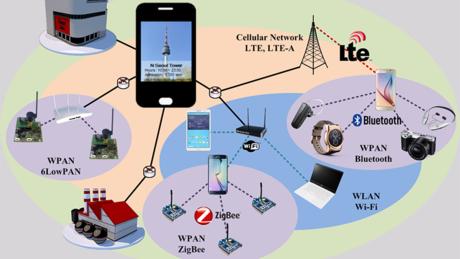
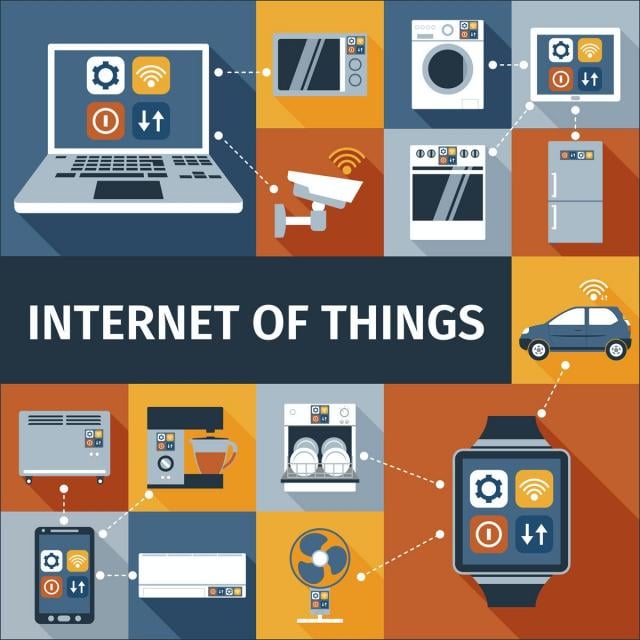
IoT is a new emerging technology domain which will be used to connect all objects through the Internet for remote sensing and control. IoT uses a combination of WSN (Wireless Sensor Network), M2M (Machine to Machine), robotics, wireless networking, Internet technologies, and Smart Devices.
AR is the most effective technology in providing real-time and real-world view information to users, where advancements in Smart Devices are expected to trigger various new AR services.
Currently, IoT and AR technologies already exist and available services can be found. However, there is so much more to come in IoT and AR technologies, which is why it is so important to understand what can be provided through these technologies and how these technologies work.

Syllabus

WEEK 1
IoT (Internet of Things)
The lectures cover the services and essential functions of IoT (Internet of Things), which will be used to connect all objects through the Internet for remote sensing and control. The lectures first focus on IoT Service Support and Economic Impact, and then explain IoT Applications and the IoT & M2M Ecosystem. In order to describe the IoT Architecture, details on the Application Layer, Management Service Layer, Gateway & Network Layer, and Sensor Layer are explained. Next, IoT Technologies and R&D (Research & Development) topics are presented. Finally, details on IoT supportive wireless networking technologies are explained.

WEEK 2
AR (Augmented Reality)
The lectures cover the services and essential functions of AR (Augmented Reality). First, the characteristics and a little on the history of VR (Virtual Reality) and AR (Augmented Reality) are presented, and some definitions of AR are presented. Next, AR Classifications based on Sensor, Vision, and Hybrid Tracking are described. Then the lecture focuses on AR Technology and describes the AR Process, which is composed of the stages of Image Acquisition, Feature Extraction, Feature Matching, Geometric Verification, and Associated Information Retrieval. Then further details on the AR Feature Extraction Process and Feature Extraction Techniques (e.g., SIFT and SURF) are explained.

Go to Class
MOOC List is learner-supported. When you buy through links on our site, we may earn an affiliate commission.

Related Courses

Big Data Science with the BD2K-LINCS Data Coordination and Integration Center (Coursera) Coursera
Icahn School of Medicine at Mount Sinai

Big Data Science with the BD2K-LINCS Data Coordination and Integration Center (Coursera)

In this course we briefly introduce the DCIC and the various Centers that collect data for LINCS. We then cover metadata and how metadata is linked to ontologies. We then present data processing and normalization methods to clean and harmonize LINCS data. This follow discussions about how data is served as RESTful APIs. Most importantly, the course covers computational methods including: data clustering, gene-set enrichment analysis, interactive data visualization, and supervised learning. Finally, we introduce crowdsourcing/citizen-science projects where students can work together in teams to extract expression signatures from public databases and then query such collections of signatures against LINCS data for predicting small molecules as potential therapeutics.

Sep 21st 2026
5-12 Weeks
Internet of Things Capstone: Build a Mobile Surveillance System (Coursera) Coursera
University of California, San Diego

Internet of Things Capstone: Build a Mobile Surveillance System (Coursera)

In the Capstone project for the Internet of Things specialization, you will design and build your own system that uses at least 2 sensors, at least 1 communication protocol and at least 1 actuator. You will have a chance to revisit and apply what you have learned in our courses to achieve a robust, practical and/or fun-filled project. We absolutely encourage you to design whatever you can think up! This is your chance to be creative or to explore an idea that you have had. But if you don’t have your own idea, we provide the description of a surveillance system, for you to build.

Sep 14th 2026
4 Weeks
Data Science for Business Innovation (Coursera) Coursera
Politecnico di Milano,EIT Digital

Data Science for Business Innovation (Coursera)

The course is a compendium of the must-have expertise in data science for executive and middle-management to foster data-driven innovation. It consists of introductory lectures spanning big data, machine learning, data valorization and communication. Topics cover the essential concepts and intuitions on data needs, data analysis, machine learning methods, respective pros and cons, and practical applicability issues.

Sep 21st 2026
4 Weeks
Real-Time Big Data Access using HBase: Boosting Performance (Coursera) Coursera
LearnQuest

Real-Time Big Data Access using HBase: Boosting Performance (Coursera)

In the world of big data, the significant growth in both the sheer volume and variety of data has presented significant challenges. Apache HBase has emerged as a robust and scalable solution. HBase is a powerful, distributed, and scalable NoSQL database designed to handle large amounts of data while maintaining high performance.

Sep 14th 2026
3 Weeks
Big Data Analysis with Scala and Spark (Coursera) Coursera
École Polytechnique Fédérale de Lausanne

Big Data Analysis with Scala and Spark (Coursera)

Manipulating big data distributed over a cluster using functional concepts is rampant in industry, and is arguably one of the first widespread industrial uses of functional ideas. This is evidenced by the popularity of MapReduce and Hadoop, and most recently Apache Spark, a fast, in-memory distributed collections framework written in Scala. In this course, we'll see how the data parallel paradigm can be extended to the distributed case, using Spark throughout.

Sep 14th 2026
4 Weeks
Digital Governance (Coursera) Coursera
Erasmus University Rotterdam

Digital Governance (Coursera)

Big data, artificial intelligence, machine learning, autonomous cars, chatbots, just a few terms that have become a part of our professional legal and political vocabulary. Emerging technologies and technological advancement have confronted us in our daily practice and will continue to do so in the future. Whether we’re buying something online, taking part in an election, or chatting with friends across the globe. Technology is here and it is here to stay.

Sep 21st 2026
5-12 Weeks
Programming with Cloud IoT Platforms (Coursera) Coursera
Pohang University of Science and Technology - POSTECH

Programming with Cloud IoT Platforms (Coursera)

Internet of Things (IoT) is an emerging area of information and communications technology (ICT) involving many disciplines of computer science and engineering including sensors/actuators, communications networking, server platforms, data analytics and smart applications. IoT is considered to be an essential part of the 4th Industrial Revolution along with AI and Big Data.

Sep 21st 2026
5-12 Weeks
Technologies and platforms for Artificial Intelligence (Coursera) Coursera
Politecnico di Milano

Technologies and platforms for Artificial Intelligence (Coursera)

This course will address the hardware technologies for machine and deep learning (from the units of an Internet-of-Things system to a large-scale data centers) and will explore the families of machine and deep learning platforms (libraries and frameworks) for the design and development of smart applications and systems.

Sep 14th 2026
4 Weeks
Foundations of marketing analytics (Coursera) Coursera
ESSEC Business School

Foundations of marketing analytics (Coursera)

Who is this course for? This course is designed for students, business analysts, and data scientists who want to apply statistical knowledge and techniques to business contexts. For example, it may be suited to experienced statisticians, analysts, engineers who want to move more into a business role, in particular in marketing. You will find this course exciting and rewarding if you already have a background in statistics, can use R or another programming language and are familiar with databases and data analysis techniques such as regression, classification, and clustering. However, it contains a number of recitals and R Studio tutorials which will consolidate your competences, enable you to play more freely with data and explore new features and statistical functions in R.

Sep 7th 2026
5-12 Weeks
Infonomics II: Business Information Management and Measurement (Coursera) Coursera
University of Illinois at Urbana-Champaign

Infonomics II: Business Information Management and Measurement (Coursera)

Even decades into the Information Age, accounting practices yet fail to recognize the financial value of information. Moreover, traditional asset management practices fail to recognize information as an asset to be managed with earnest discipline. This has led to a business culture of complacence, and the inability for most organizations to fully leverage available information assets. This second course in the two-part Infonomics series explores how and why to adapt well-honed asset management principles and practices to information, and how to apply accepted and new valuation models to gauge information’s potential and realized economic benefits.

Sep 14th 2026
4 Weeks
Introduction to PySpark (Coursera) Coursera
Edureka

Introduction to PySpark (Coursera)

Welcome to Introduction to PySpark, a short course strategically crafted to empower you with the skills needed to assess the concepts of Big Data Management and efficiently perform data analysis using PySpark. Throughout this short course, you will acquire the expertise to perform data processing with PySpark, enabling you to efficiently handle large-scale datasets, conduct advanced analytics, and derive valuable insights from diverse data sources.

Sep 14th 2026
1 Week