Internet Emerging Technologies (Coursera)

Offered by Yonsei University,
Internet Emerging Technologies (Coursera)

Every information service is connected through the Internet. If your work is any bit related to information, there is no excuse, you have to know what the Internet is and how it works! The relation of information and the Internet is equivalent to the blood and blood vessels of our body, which we have been using and will be using every day of our lives.

Class Deals by MOOC List - Click here and see Coursera's Active Discounts, Deals, and Promo Codes.

A newer version of this course is available here:
IoT (Internet of Things) Wireless & Cloud Computing Emerging Technologies

This course will enlighten your understanding of what the Internet is and how it works. IP (Internet Protocol) IPv4 and IPv6 keep the Internet alive by enabling remote computers to communicate through various inter-connected networks through “inter-networking” technology, which is where the name “Internet” came from. TCP and UDP are used by the end devices (e.g., computers, smartphones, servers, clouds) that are communicating to connect applications/services across the Internet. The details of IPv4, IPv6, TCP, UDP, and Internet operations are covered in this course.

Syllabus

WEEK 1
Internet Operations
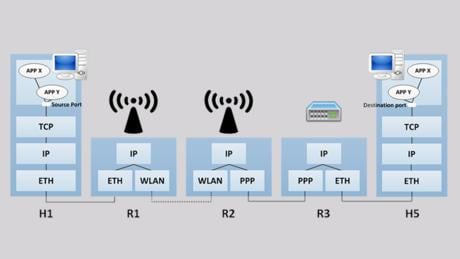
The lectures first cover Internet Operations based on an example of using IPv4, TCP, Ethernet, PPP, and Wi-Fi. The lectures then explain the TCP/IP 5 layer model, which includes the layer 5: Application layer, layer 4: Transport layer, layer 3: IP (Internet Protocol) layer, layer 2: Network Access layer, and layer 1: Physical layer.

WEEK 2
TCP & UDP
You have been using TCP (Transmission Control Protocol) and UDP (User Datagram Protocol) your entire life, and now it is time to know what it is and how it works. First, the lectures cover TCP, starting with the TCP Header, and covers the fields Source Port, Destination Port, Checksum, Data Offset, Push function, and Urgent Flag & Urgent Pointer. The TCP lectures also include details on TCP Network Operations, TCP Connection Establishment, Window Flow Control, and Congestion Control. Next, the details on UDP (User Datagram Protocol) are presented, which include UDP Header, Source Port, Destination Port, Length, and Checksum fields.

WEEK 3
IP
The lectures cover the essential functions of IPv4 and IPv6, which are used in the Internet today. The lectures first focus on IPv4 inter-networking functions and then provide details on the IPv4 Header, which include the fields of DS (Differentiated Services), ECN (Explicit Congestion Notification), Total Length, Identification, Packet Fragmentation, TTL (Time to Live), and Source & Destination IPv4 Addresses. Next, details on the IPv6 protocol are provided, which include the IPv6 Packet Header fields of DS, ECN, Flow Label, Hop Limit, IPv6 Address Types & Address Format, and IPv6 Jumbogram Extension Header. Then IPv6 PMTUD (Path MTU Discovery) techniques are presented.

Go to Class
MOOC List is learner-supported. When you buy through links on our site, we may earn an affiliate commission.

Related Courses

Excel Power Tools for Data Analysis (Coursera) Coursera
Macquarie University

Excel Power Tools for Data Analysis (Coursera)

Welcome to Excel Power Tools for Data Analysis. In this four-week course, we introduce Power Query, Power Pivot and Power BI, three power tools for transforming, analysing and presenting data. Excel's ease and flexibility have long made it a tool of choice for doing data analysis, but it does have some inherent limitations: for one, truly "big" data simply does not fit in a spreadsheet and for another, the process of importing and cleaning data can be a repetitive, time-consuming and error-prone.

Jun 22nd 2026
4 Weeks
Cybersecurity and the Internet of Things (Coursera) Coursera
University System of Georgia

Cybersecurity and the Internet of Things (Coursera)

Welcome to “Cybersecurity and the Internet of Things”! This course is for you if you are curious about the most recent trends and activities in the internet capabilities and concerns about programmed devices. There are complexities and areas of necessary awareness when the industrial sector becomes connected to your home.

Jun 22nd 2026
4 Weeks
Web3 and Blockchain Transformations in Global Supply Chains (Coursera) Coursera
INSEAD

Web3 and Blockchain Transformations in Global Supply Chains (Coursera)

The global supply chain is a $50 trillion industry and is the foundation of our global economy. While information technology has improved the flow of goods globally over the last few decades, as the COVID-19 crisis revealed there is still critical work to do. Today’s supply chains are complex, with parties conducting their transactions through a Byzantine network of computer systems with disparate applications like e-mail, phone, and fax.

Jun 28th 2026
5-12 Weeks
The Raspberry Pi Platform and Python Programming for the Raspberry Pi (Coursera) Coursera
University of California, Irvine

The Raspberry Pi Platform and Python Programming for the Raspberry Pi (Coursera)

The Raspberry Pi is a small, affordable single-board computer that you will use to design and develop fun and practical IoT devices while learning programming and computer hardware. In addition, you will learn how to set up up the Raspberry Pi environment, get a Linux operating system running, and write and execute some basic Python code on the Raspberry Pi. You will also learn how to use Python-based IDE (integrated development environments) for the Raspberry Pi and how to trace and debug Python code on the device.

Jun 22nd 2026
4 Weeks
Healthcare Data Quality and Governance (Coursera) Coursera
University of California, Davis

Healthcare Data Quality and Governance (Coursera)

Career prospects are bright for those qualified to work with healthcare data or as Health Information Management (HIM) professionals. Perhaps you work in data analytics but are considering a move into healthcare, or you work in healthcare but are considering a transition into a new role. In either case, Healthcare Data Quality and Governance will provide insight into how valuable data assets are protected to maintain data quality. This serves care providers, patients, doctors, clinicians, and those who carry out the business of improving health outcomes.

Jun 22nd 2026
4 Weeks
Relational Database Support for Data Warehouses (Coursera) Coursera
University of Colorado System

Relational Database Support for Data Warehouses (Coursera)

Relational Database Support for Data Warehouses is the third course in the Data Warehousing for Business Intelligence specialization. In this course, you'll use analytical elements of SQL for answering business intelligence questions. You'll learn features of relational database management systems for managing summary data commonly used in business intelligence reporting. Because of the importance and difficulty of managing implementations of data warehouses, we'll also delve into storage architectures, scalable parallel processing, data governance, and big data impacts. In the assignments in this course, you can use either Oracle or PostgreSQL.

Jun 22nd 2026
5-12 Weeks
Internet of Things Capstone: Build a Mobile Surveillance System (Coursera) Coursera
University of California, San Diego

Internet of Things Capstone: Build a Mobile Surveillance System (Coursera)

In the Capstone project for the Internet of Things specialization, you will design and build your own system that uses at least 2 sensors, at least 1 communication protocol and at least 1 actuator. You will have a chance to revisit and apply what you have learned in our courses to achieve a robust, practical and/or fun-filled project. We absolutely encourage you to design whatever you can think up! This is your chance to be creative or to explore an idea that you have had. But if you don’t have your own idea, we provide the description of a surveillance system, for you to build.

Jun 22nd 2026
4 Weeks
Managing Big Data with MySQL (Coursera) Coursera
Duke University

Managing Big Data with MySQL (Coursera)

This course is an introduction to how to use relational databases in business analysis. You will learn how relational databases work, and how to use entity-relationship diagrams to display the structure of the data held within them. This knowledge will help you understand how data needs to be collected in business contexts, and help you identify features you want to consider if you are involved in implementing new data collection efforts.

Jun 22nd 2026
5-12 Weeks
Internet of Things: Multimedia Technologies (Coursera) Coursera
University of California, San Diego

Internet of Things: Multimedia Technologies (Coursera)

Content is an eminent example of the features that contributed to the success of wireless Internet. Mobile platforms such as the Snapdragon™ processor have special hardware and software capabilities to make acquisition, processing and rendering of multimedia content efficient and cost-effective.

Jun 22nd 2026
3 Weeks
AR (Augmented Reality) & Video Streaming Services Emerging Technologies (Coursera) Coursera
Yonsei University

AR (Augmented Reality) & Video Streaming Services Emerging Technologies (Coursera)

Welcome to the course “Augmented Reality & Video Service Emerging Technologies.” The level of AR (Augmented Reality) and advanced video & multimedia technology included in a product is what determines the level of value and luxury. The objective of this course is to teach all important technologies that are used in state-of-the-art AR, Skype, and YouTube video and multimedia products and services.

Jun 22nd 2026
5-12 Weeks