FUN

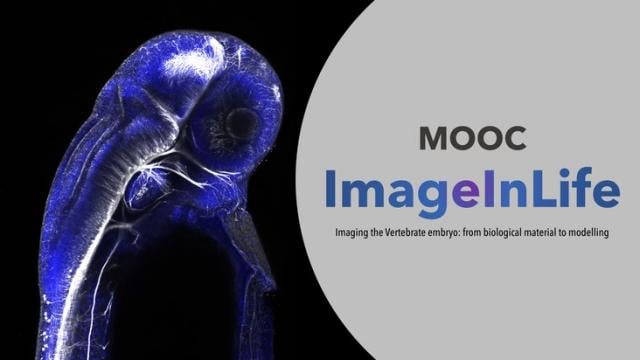
ImageInLife - Imaging the Vertebrate embryo: from biological material to modelling (FUN)

ImageInLife - Imaging the Vertebrate embryo: from biological material to modelling (FUN)

Microscopy technologies have progressed to such a point that it is now possible to image a developing vertebrate at the single cell resolution. Two main model species are being used for such studies, the zebrafish and the mouse. The present MOOC introduces the trainees to these two animal models, to the most modern microscopy technologies, to the use of high volume of data (images) and to the modelling of the studied processes. Trainees will also be introduced to the intravital study of viral infections.

The MOOC gives both a general introduction and introduces to more specialized tools and concepts.

At the end of the MOOC, you will know:

  • How to get vertebrate embryos to be imaged
  • How to label embryos and larvae for imaging
  • How to choose the right microscope for your purpose
  • How to deal with both the type of data generated and with the large amount of images/data generated by your microscope
  • How to choose the right modeling tools and what modelling could bring to the experimental plans and to the understanding of the underlying biological processes.

Course format
The MOOC is made of 5 weeks of electronic lessons, and you will be offered quizzes to evaluate your performances

Prerequisites
The target audience are :
Students in their first years at the University, before graduating a Bachelor, in order for them to be introduced to the challenges of intravital imaging in vertebrates before their first laboratory internship.
Master students interested in these disciplines or graduated students and researchers that want to implement research projects in these disciplines.
Prerequisite : Basic knowledge in biology

Course outline

Week 1 : Preparing embryos for imaging
Week 2 : What to image; Labelling techniques
Week 3 : How to image, Microscopes
Week 4 : From images to data
Week 5 : Modelling
Go to Class
MOOC List is learner-supported. When you buy through links on our site, we may earn an affiliate commission.

Related Courses

Introduction to Biology: Ecology (Coursera) Coursera
Rice University

Introduction to Biology: Ecology (Coursera)

Ecology is all about connections. In this course, we’ll see how interdependent every living thing is and how people are impacting the natural world. Like all sciences, ecology isn’t just a list of known facts– it’s also a process. I love telling stories, and I’ve included many stories about how we’ve come to know what we know about ecology through observations and experiments.

Jun 8th 2026
4 Weeks
Modelo de Ecossistema com Insight Maker (Coursera) Coursera
Coursera Project Network

Modelo de Ecossistema com Insight Maker (Coursera)

Neste curso baseado em projeto de 1 hora de duração, você criará um modelo que simula a dinâmica de três populações de espécies diferentes em um ambiente: formigas, tamanduás-bandeira e lobos-guará. Durante a criação de tal modelo você será apresentado ao Insight Maker, um ambiente de simulação online gratuito que permite diferentes tipos de modelagem como modelagem de sistemas dinâmicos e baseada em agente.

Jun 8th 2026
Self-Paced
Voyage au cœur du vivant avec les rayons X : la cristallographie (FUN) FUN
Université Paris-Saclay

Voyage au cœur du vivant avec les rayons X : la cristallographie (FUN)

L’utilisation des structures tridimensionnelles de macromolécules biologiques fait partie du quotidien d’un grand nombre de biologistes. Ces structures permettent de comprendre leur fonctionnement, de dessiner des mutants pour étudier leur fonction, de dessiner des molécules pour les bloquer ou les activer. L’approche majeure pour résoudre la structure tridimensionnelle de macromolécules biologiques est la cristallographie aux rayons X. Ce MOOC est une initiation complète à la cristallographie biologique : depuis l'histoire de la méthode jusqu'à ses outils concrets.Nous vous transmettons nos connaissances et notre expérience par le biais de vidéos théoriques et en situation.

No sessions available
5-12 Weeks
Bioinformatique : algorithmes et génomes (FUN) FUN
INRIA

Bioinformatique : algorithmes et génomes (FUN)

Dans ce cours, nous verrons **comment l’informatique permet d’interpréter le texte des génomes**. Doté d’algorithmes adaptés, mis en œuvre sous forme de programmes efficaces, l’ordinateur produit des prédictions quant à la localisation des milliers de gènes d’un organisme vivant et les fonctions que remplissent les protéines qu’ils codent.

No sessions available
5-12 Weeks
Modeling and Control of Single-Phase Rectifiers and Inverters (Coursera) Coursera
University of Colorado Boulder

Modeling and Control of Single-Phase Rectifiers and Inverters (Coursera)

This is Course #5 in the Modeling and Control of Power Electronics Specialization. The course is focused on modeling and control of grid-tied power electronics. Upon completion of the course, you will be able to understand, analyze, model, and design low-harmonic rectifiers and inverters interfacing dc loads or dc power sources, such as photovoltaic arrays, to the single-phase ac power grid.

Jun 8th 2026
3 Weeks
Specialty Topics: Biology Across Disciplines (Coursera) Coursera
University of Colorado Boulder

Specialty Topics: Biology Across Disciplines (Coursera)

In this course, we will explore the applicability and relationship of biology to the arts, business, and psychology. First, we’ll discuss art as a foundational practice to biology and how biology as a science can explain how we interact with the arts, in particular, our experiences making and listening to music. Next, we will discuss the business of biology and how research is funded and the process of clinical trials and human subjects research.

Jun 8th 2026
5-12 Weeks
Introduction to advanced tomography (Coursera) Coursera
Technical University of Denmark - DTU

Introduction to advanced tomography (Coursera)

In this course you get the chance to get teaching and hands-on experience with the complete workflow of high-resolution tomography analysis. You will get introduced to data acquisition, 3D reconstruction, segmentation and meshing and, finally, 3D modelling of data to extract physical parameters describing mechanical and flow properties. The teaching and the exercises will take place in close interaction with top experts in the field. Exercises will require some basic programming skills, and will be carried out in a common python environment.

Jun 8th 2026
4 Weeks
Introduction to the Biology of Cancer (Coursera) Coursera
Johns Hopkins University

Introduction to the Biology of Cancer (Coursera)

Over 500,000 people in the United States and over 8 million people worldwide are dying every year from cancer. As people live longer, the incidence of cancer is rising worldwide and the disease is expected to strike over 20 million people annually by 2030. This open course is designed for people who would like to develop an understanding of cancer and how it is prevented, diagnosed, and treated.

Jun 8th 2026
5-12 Weeks
Soul Beliefs: Causes and Consequences - Unit 2: Belief Systems (Coursera) Coursera
Rutgers University

Soul Beliefs: Causes and Consequences - Unit 2: Belief Systems (Coursera)

Throughout history, the vast majority of people around the globe have believed they have, however defined, a “soul.” While the question of whether the soul exists cannot be answered by science, what we can study are the causes and consequences of various beliefs about the soul and its prospects of surviving the death of the body. Why are soul and afterlife beliefs so common in human history? Are there adaptive advantages to assuming souls exist?

Jun 8th 2026
5-12 Weeks
Current-Mode Control (Coursera) Coursera
University of Colorado Boulder

Current-Mode Control (Coursera)

This is Course #4 in the Modeling and Control of Power Electronics course sequence. The course is focused on current-mode control techniques, which are very frequently applied in practical realizations of switched-mode. Practical advantages of peak current mode control are discussed, including built-in overcurrent protection, simpler and more robust dynamic responses, as well as abilities to ensure current sharing in parallel connected converter modules.

Jun 8th 2026
4 Weeks
Modeling Time Series and Sequential Data (Coursera) Coursera
SAS

Modeling Time Series and Sequential Data (Coursera)

In this course you learn to build, refine, extrapolate, and, in some cases, interpret models designed for a single, sequential series. There are three modeling approaches presented. The traditional, Box-Jenkins approach for modeling time series is covered in the first part of the course. This presentation moves students from models for stationary data, or ARMA, to models for trend and seasonality, ARIMA, and concludes with information about specifying transfer function components in an ARIMAX, or time series regression, model. A Bayesian approach to modeling time series is considered next.

Jun 8th 2026
5-12 Weeks
Genomics: Decoding the Universal Language of Life (Coursera) Coursera
University of Illinois at Urbana-Champaign

Genomics: Decoding the Universal Language of Life (Coursera)

What is a genome? A genome contains all of the information that a cell needs to develop, function, and reproduce itself, and all the information needed for those cells to come together to form a person, plant, or animal. Genomes contain an organism’s complete set of genes, and also the even tinier genetic structures that help regulate when and how those genes are used. The ability to regrow a torn ligament, the clues that might predict the onset of mental illness, the nutritional potential of crops, and even the history of life itself, are all encoded in genomes. By taking this course, you will discover how scientists are deciphering the language of genomes to learn how to develop sustainable food and fuel supplies, improve disease treatment and prevention, and protect our environment.

Jun 8th 2026
5-12 Weeks