Hydrogen for Mobility (IFP School)

Offered by IFP School,
Hydrogen for Mobility (IFP School)

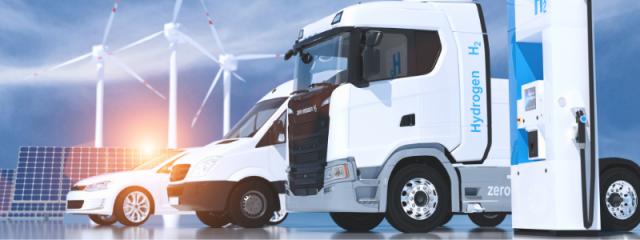
Hydrogen is a hot topic nowadays. Why? Because society must find solutions to reduce its impact on climate change and because there is now a political will (in Europe) to develop a hydrogen economy. The mobility sector, and in particular the heavy mobility, is concerned by this transformation. After some general information about hydrogen production and the hydrogen economy, you will gain a deep understanding of the hydrogen solution for mobility. We will explore both the fuel cells and the hydrogen thermal engine solutions as a mean to reduce the environmental footprint of heavy mobility.

Our focus is mostly technical and aims at three objectives. At the end of this module, you will be able to:

  • describe the working principle of a fuel cell, from the reaction to the fuel stack and the fuel cell vehicle.
  • explain the chemical characteristics of hydrogen that influence combustion, how they impact performances and the technical developments needed to improve hydrogen combustion engines
  • compare solutions and identify the main development constraints.

Chapters:

  1. General Hydrogen & Hydrogen for mobility context
  2. Hydrogen Internal combustion engine
  3. Fuel Cell Vehicles
Go to Class
MOOC List is learner-supported. When you buy through links on our site, we may earn an affiliate commission.

Related Courses

Ferrous Technology II (Coursera) Coursera
Pohang University of Science and Technology - POSTECH

Ferrous Technology II (Coursera)

Steel, ever-evolving material, has been the most preeminent of all materials since it can provide wide range of properties that can meet ever-changing requirements. In this course, we explore both fundamental and technical issues related to steels, including iron and steelmaking, microstructure and phase transformation, and their properties and applications.

Aug 31st 2026
5-12 Weeks
Energy Transition Selection (IFP School) Other Providers
IFP School

Energy Transition Selection (IFP School)

This module is intended either for students and professionals interested in the energy transition challenges and innovative solutions to reduce CO2 emissions. But more specifically it is intended for those willing to gain knowledge about developing a decarbonized energy mix based on both renewables and natural gas, underground CO2 and energy storage, energy efficiency and CO2 abatements in processes, biofuels. In general, for those who are convinced that climate change is really a challenge that can also be sustained through concrete solutions and societal awareness. **ENERGY TRANSITION SELECTION WILL BE AVAILABLE UNTIL MARCH 31ST.**

Available Now
1 Week
Engineering Practices for Building Quality Software (Coursera) Coursera
University of Minnesota

Engineering Practices for Building Quality Software (Coursera)

Agile embraces change which means that team should be able to effectively make changes to the system as team learns about users and market. To be good at effectively making changes to the system, teams need to have engineering rigor and excellence else embracing change becomes very painful and expensive. In this course, you will learn about engineering practices and processes that agile and traditional teams use to make sure the team is prepared for change. In additional, you will also learn about practices, techniques and processes that can help team build high quality software. You will also learn how to calculate a variety of quantitative metrics related to software quality.

Aug 31st 2026
4 Weeks
Engineering Maintainable Android Apps (Coursera) Coursera
Vanderbilt University

Engineering Maintainable Android Apps (Coursera)

Engineering Maintainable Android Apps, which is a 4 week MOOC that shows by example various methods for engineering maintainable Android apps, including test-driven development methods and how to develop/run unit tests using JUnit and Robotium (or equivalent automated testing frameworks for Android), as well as how to successfully apply common Java/Android software patterns to improve the extensibility and clarity of Android apps.

Aug 31st 2026
4 Weeks
Nanotechnology and Nanosensors, Part 2 (Coursera) Coursera
Technion - Israel Institute of Technology

Nanotechnology and Nanosensors, Part 2 (Coursera)

Learn about novel sensing tools that make use of nanotechnology to screen, detect and monitor various events in personal or professional life. Together, we will lay the groundwork for infinite innovative applications, starting from diagnosis and treatments of diseases, continuing with quality control of goods and environmental aspects, and ending with monitoring security issues.

Sep 7th 2026
5-12 Weeks
Applications in Engineering Mechanics (Coursera) Coursera
Georgia Institute of Technology

Applications in Engineering Mechanics (Coursera)

This course applies principles learned in my course “Introduction to Engineering Mechanics” to analyze real world engineering structures. You will need to have mastered the engineering fundamentals from that class in order to be successful in this course offering. This course addresses the modeling and analysis of static equilibrium problems with an emphasis on real world engineering systems and problem solving.

Sep 7th 2026
5-12 Weeks
Ferrous Technology I (Coursera) Coursera
Pohang University of Science and Technology - POSTECH

Ferrous Technology I (Coursera)

Steel, ever-evolving material, has been the most preeminent of all materials since it can provide wide range of properties that can meet ever-changing requirements. In this course, we explore both fundamental and technical issues related to steels, including iron and steelmaking, microstructure and phase transformation, and their properties and applications.

Aug 31st 2026
5-12 Weeks
MBSE: Model-Based Systems Engineering (Coursera) Coursera
University at Buffalo,The State University of New York

MBSE: Model-Based Systems Engineering (Coursera)

This Model-Based Systems Engineering (MBSE) course and the Digital Thread courses featured earlier in this specialization bring together the concepts from across digital manufacturing and design, forming a vision in which the geometry of a product is just one way of describing it. MBSE is where the model resulting from the evolution of system requirements, design, analysis, verification and validation activities is the focus of design and manufacturing.

Aug 31st 2026
4 Weeks
Nanotechnology: A Maker’s Course (Coursera) Coursera
Duke University,University of North Carolina,North Carolina State University

Nanotechnology: A Maker’s Course (Coursera)

How can we create nano-structures that are 10,000 times smaller than the diameter of a human hair? How can we “see” at the nano-scale? Through instruction and lab demonstrations, in this course you will obtain a rich understanding of the capabilities of nanotechnology tools, and how to use this equipment for nano-scale fabrication and characterization.

Sep 7th 2026
5-12 Weeks
Materials Science: 10 Things Every Engineer Should Know (Coursera) Coursera
University of California, Davis

Materials Science: 10 Things Every Engineer Should Know (Coursera)

We explore “10 things” that range from the menu of materials available to engineers in their profession to the many mechanical and electrical properties of materials important to their use in various engineering fields. We also discuss the principles behind the manufacturing of those materials. By the end of the course, you will be able to: recognize the important aspects of the materials used in modern engineering applications; explain the underlying principle of materials science: “structure leads to properties,”; identify the role of thermally activated processes in many of these important “things” – as illustrated by the Arrhenius relationship; relate each of these topics to issues that have arisen (or potentially could arise) in your life and work.

Aug 31st 2026
5-12 Weeks
Exploring Light: Hands-on Activities and Strategies for Teachers (Coursera) Coursera
Exploratorium

Exploring Light: Hands-on Activities and Strategies for Teachers (Coursera)

This is an Exploratorium teacher professional development course taught by Teacher Institute staff, open to any science teacher (particularly middle or high school level) and science enthusiast. This is a hands-on workshop that explores topics and strategies teachers can use to help their students become active investigators of light.

Sep 6th 2026
4 Weeks