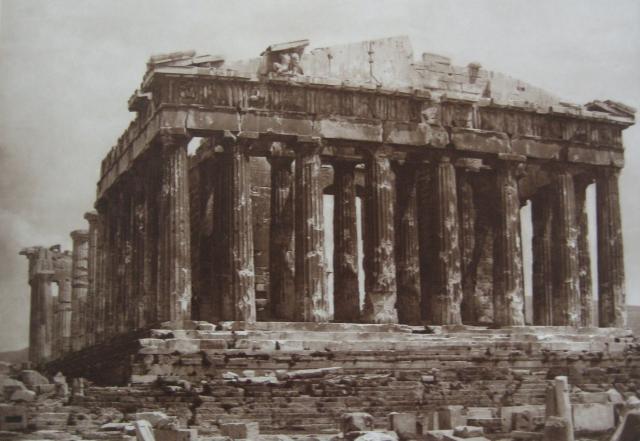
Greece, the Roman Republic, and the Roman Empire (saylor.org)

Offered by Saylor.org,
Greece, the Roman Republic, and the Roman Empire (saylor.org)

This course will focus on the history of Greek and Roman civilizations beginning with the origins of ancient Greek culture in the Aegean Bronze Age (c. 3000–1100 BCE) through the period of the Roman Empire at the height of its greatest extent and prosperity (c. 31 BCE–235 CE).

We will focus on the political, economic, and social factors that shaped the development and maturation of these two influential Mediterranean civilizations. The course will be structured chronologically. Each unit will include representative primary source documents that illustrate important overarching themes, such as the emergence and development of Greek civilization from the Aegean Bronze Age through the Greek Archaic period (c.700–500 BCE), the contrast between democratic and oligarchic forms of government in Greek city-states of the classical era (c. 500–350 BCE), the decline of the Greek city-states, the rise of Macedon and the spread of Greek culture to the eastern Mediterranean and western Asia in the Hellenistic period (c. 350–31 BCE), the evolution of the Roman Republic (c. 508–287 BCE), and the transformation of this Roman Republic into a vast Roman Empire encompassing all the lands bordering the Mediterranean Sea (c. 133 BCE–235 CE). By the end of the course, you will understand how these ancient Mediterranean civilizations developed and recognize their lasting influences on European culture.

Go to Class
MOOC List is learner-supported. When you buy through links on our site, we may earn an affiliate commission.

Related Courses

The Holocaust - An Introduction (II): The Final Solution (Coursera) Coursera
Tel Aviv University,Yad Vashem

The Holocaust - An Introduction (II): The Final Solution (Coursera)

The Holocaust was an inconceivable historical event, which forever robbed Western culture of its innocence. As civilized human beings, we fail to understand how events of such horror could have taken place, and how an idea so inhumanly warped could have spread like wildfire through an entire continent, instigating the systematic annihilation of millions of Jews.

Jun 15th 2026
3 Weeks
Early Globalizations: East Meets West (1200s-1600s) (saylor.org) Saylor Academy
Saylor.org

Early Globalizations: East Meets West (1200s-1600s) (saylor.org)

This course will introduce you to the history of the world’s major civilizations from medieval times to the early modern era. You will learn about the pivotal political, economic, and social changes that took place in Asia, Africa, the Americas, and Europe during this period. The course will be structured chronologically, with each unit focusing on the expansion or decline of a particular civilization or the interactions and exchanges between civilizations.

Legacy Course
Self-Paced
Transmedia Writing (Coursera) Coursera
Michigan State University

Transmedia Writing (Coursera)

Do you have a desire to write a novel, write a screenplay, design a video game? In this project-centered course you will develop your own, original, intellectual property (IP) into a transmedia project containing written versions of your IP on various platforms. You will begin your novel, adapt the first chapters of your novel into the opening scenes of a film or TV show and create a game design concept of your IP.

Jun 15th 2026
5-12 Weeks
The Emergence of the Modern Middle East - Part II (Coursera) Coursera
Tel Aviv University

The Emergence of the Modern Middle East - Part II (Coursera)

This course will discuss the developments in the Middle East from the early 20th century to the present. It will discuss the rise and retreat of Arab nationalism, the problems of internal cohesion of the Arab states, issues of religion and state, and the evolution of Islamist politics. It will also focus on the evolution of the Arab-Israeli conflict and its impact on the region and will conclude with an in depth analysis of the “Arab Spring” by placing these contemporary revolutionary events in their historical context.

Jun 15th 2026
5-12 Weeks