Get Started with a Voice Assistant: Developing Alexa Skills (FutureLearn)

Offered by Labdox,
Get Started with a Voice Assistant: Developing Alexa Skills (FutureLearn)

Learn how to create an Alexa Skill and delve into the technology of a voice assistant with this practical online course. Discover the skills needed to design Voice Applications
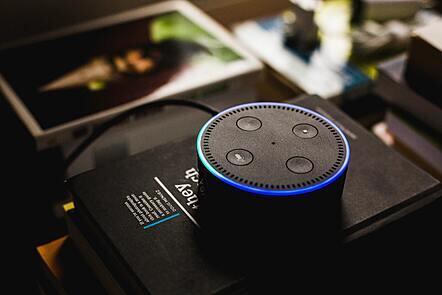
Statistics show that over 40% of adults use voice search at least once per day. There are over 300 million smart speaker units, such as Alexa, currently installed in homes – and the number looks set to double by 2024.

Class Deals by MOOC List - Click here and see FutureLearn's Active Discounts, Deals, and Promo Codes.

This means learning this new technology in the initial stage will give you an extra edge in the industry, as demand for voice UI developers continues to grow.
This three-week course will help you kickstart your voice developer journey and give you a strong foundation of knowledge in Alexa Skills.
Learning from the experts at Labdox, you’ll be introduced to voice technology, and Alexa, before learning about the future of how we will communicate with technology.

Get hands-on VUI experience
You’ll gain practical experience using the Alexa Skills Kits (ASK) and learn to design an engaging voice user interface (VUI) as you create a voice UI and build a custom Alexa Skill from scratch.
Delving into the Alexa technology, you’ll create your own Alexa Skill with code and learn how to publish it to the skill store.

Explore the history of a voice assistant
To deepen your understanding of voice assistants, you’ll explore the evolution of a voicer user interface.
You’ll also delve into the concepts of voice assistants and identify the differences between voice UI and screen UI.
By the end of the course, you will be ready to create Alexa Skills that your customers or friends will love.

What topics will you cover?

  • About Voice Assistants
  • Concepts of Voice Assistants
  • About Alexa Skills
  • Conversational Design
  • Voice User Interface
  • Alexa Skills Design
  • Interaction Models
  • Alexa Backend Creation – how to create the backend, how to connect the interaction model with the backend, and testing an Alexa Skill to finally publishing it to the Alexa Skill Store.

Learning on this course
You can take this self-guided course and learn at your own pace. On every step of the course you can meet other learners, share your ideas and join in with active discussions in the comments.

What will you achieve?
By the end of the course, you‘ll be able to...

  • Create your first voice conversation
  • Compare Voice User Interface and User Interface
  • Create Alexa Skills from scratch
  • Classify intents and intent handlers
  • Perform publishing of Alexa Skills
  • Develop coding skills for Alexa
  • The difference between Voice User Interface and Video User Interface

Who is the course for?
This course is designed for developers interested in Alexa Skills.
It is an introductory course for people who want to add custom skills to their Amazon Alexa device.

Go to Class
MOOC List is learner-supported. When you buy through links on our site, we may earn an affiliate commission.

Related Courses

Evaluating User Interfaces (Coursera) Coursera
University of Minnesota

Evaluating User Interfaces (Coursera)

In this course you will learn and practice several techniques for user interface evaluation. First we start with techniques that can be applied alone or in a design team, including action analysis, walkthroughs, and heuristic evaluation. Then we move on to user testing, including learning from a series of usability tests carried out in a real usability lab, and techniques to carry out your own tests even without a lab.

Aug 31st 2026
4 Weeks
Human-Computer Interaction II: Cognition, Context & Culture (edX) EdX
Georgia Institute of Technology,GTx

Human-Computer Interaction II: Cognition, Context & Culture (edX)

Get into the user’s mind and understand the role of mental models and representations, then investigate how to design interfaces that integrate with and influence the world around us. This course takes you through lessons 9 through 13 of CS6750: Human-Computer Interaction as taught in the Georgia Tech Online Master of Science in Computer Science program.

Self Paced
Self-Paced
Contact Center AI: Conversational Design Fundamentals (Coursera) Coursera
Google Cloud

Contact Center AI: Conversational Design Fundamentals (Coursera)

Welcome to "Contact Center AI Conversational Design with Dialogflow", the first course in the "Customer Experiences with Contact Center AI" specialization. In this course, learn how to design, develop, and deploy customer conversational solutions using Contact Center Artificial Intelligence (CCAI). You will be introduced to Contact Center AI and its three pillars, Dialogflow, Agent Assist, and Insights, the concept of conversational experiences and how the study of them influences the design of your virtual agent, the objects, tools, and methods to get your basic virtual agent up and running, and using context so that you can take your virtual agent to the next level of intelligent conversation.

Jun 17th 2024
3 Weeks
Building Mobile Applications with SAP Screen Personas (openSAP) OpenSAP
SAP

Building Mobile Applications with SAP Screen Personas (openSAP)

Join this free open online course to learn the skills required to create a mobile application with SAP Screen Personas. SAP Screen Personas allows you to simplify classic ERP screens in SAP S/4HANA, SAP Business Suite on HANA, or SAP ERP, and on mobile devices. The latest release of SAP Screen Personas includes the Slipstream Engine, a component that allows SAP Screen Personas flavors to render on mobile devices.

Self Paced
Self-Paced
Introduction to 3D Modeling (FutureLearn) FutureLearn
University of Michigan

Introduction to 3D Modeling (FutureLearn)

Build your design skills and learn how to use Rhino software to create, edit, and render amazing 3D models. Grow your knowledge of design and 3D modeling. On this four-week practical course from the University of Michigan, you’ll not only learn how to use the Rhino software to create your 3D models, but you’ll also gain basic design skills to help bring your imagination to life.

Jun 28th 2021
4 Weeks
App Design and Development for iOS (Coursera) Coursera
University of Toronto

App Design and Development for iOS (Coursera)

In App Design and Development for iOS, the third course of the iOS App Development with Swift specialization, you will be developing foundational programming skills to support graphical element presentation and data manipulation from basic functions through to advanced processing. You will continue to build your skill set to use and apply core graphics, touch handling and gestures, animations and transitions, alerts and actions as well as advanced algorithms, threading and more. By the end of this course you will be able to develop a more advanced, fully functioning app.

Aug 31st 2026
5-12 Weeks
Programming Mobile Applications for Android Handheld Systems: Part 1 (Coursera) Coursera
University of Maryland, College Park

Programming Mobile Applications for Android Handheld Systems: Part 1 (Coursera)

This course introduces you to the design and implementation of Android applications for mobile devices. You will develop an app from scratch, assuming a basic knowledge of Java, and learn how to set up Android Studio, work with various Activities and create simple user interfaces to make your apps run smoothly.

Aug 31st 2026
5-12 Weeks
Web Design: Wireframes to Prototypes (Coursera) Coursera
California Institute of the Arts

Web Design: Wireframes to Prototypes (Coursera)

This course is focused on the application of the early UX research to actual user interfaces: the creation of wireframes, high-fidelity mockups, and clickable prototypes. This course is the continuation of the course Web Design: Strategy and Information Architecture, in which students completed the first half of a large scale project—developing a comprehensive plan for a complex website.

Sep 7th 2026
4 Weeks
Web Application Development: Basic Concepts (Coursera) Coursera
University of New Mexico

Web Application Development: Basic Concepts (Coursera)

This is the first course in a Coursera Specialization track involving Web Application Architectures. This course will give you the basic background, terminology and fundamental concepts that you need to understand in order to build modern full stack web applications. A full stack web developer is familiar with each "layer" of the software technologies involved in a web application, including data modeling and database technologies, the web server environment and middleware components, network protocols, the user interface and basic visual design and user interaction concepts.

Sep 14th 2026
5-12 Weeks