Fundamentals of Rehearsing Music Ensembles (Coursera)

Fundamentals of Rehearsing Music Ensembles (Coursera)

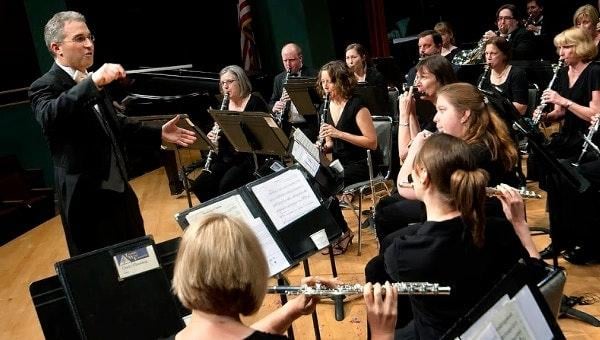
Learn and practice the basic principles of running an effective music ensemble rehearsal. Techniques and strategies are applicable to a variety of ensembles, including bands, orchestras, choirs, and chamber groups.

Class Deals by MOOC List - Click here and see Coursera's Active Discounts, Deals, and Promo Codes.

Syllabus

WEEK 1
An Introduction to Rehearsing
This week, Module 1, we’ll discuss basic philosophical issues such as: What we do in rehearsals, what skills are needed, and the idea of the conductor as “the composer’s advocate.” I will also introduce the concept of Macro-Micro-Macro, which serves as the overarching principle of rehearsals. Then we will move on to basic conducting technique.

WEEK 2
Communicating with the Ensemble
Module 2 begins with a discussion about repertoire: how to define quality music and how to choose a balanced, musically nourishing program. Building on the topics of Module 1, this week’s conducting technique videos focus on the grammar for starting and stopping pieces. In the rehearsal technique videos, the overarching topic is how to communicate with the ensemble to convey musical intent. Essentially, the idea is to give musical instruction, but there are a range of strategies we must master to be effective in all situations.This week introduces those strategies and organizes them according to modes of instruction, including performance technique, adjectives, analogy, and modeling.

WEEK 3
Introducing the Rehearsal Toolkit
Week 3’s material begins with more left hand technique, expanding on the concepts introduced in Module 2 and continuing with gestures to show dynamics. The section on rehearsal technique begins with an explanation of the ‘Rehearsal Toolkit,” a collection of ideas, or “tools,” each designed to fix a musical issue. Rehearsal tools are meant to supplement the modes of instruction that were discussed last week. In other words, in addition to using direct vocabulary, modeling, and metaphor and analogy, these tools can elicit musical responses when gesture and words fail. A caveat: all of these approaches depend on the musicians having the technique required to perform the repertoire. This may seem obvious, but the fanciest baton twirl and colorful analogy are meaningless to help, say, a trumpeter, perform staccato if he does not tongue properly and employ good embouchure. Fundamentals must be taught, either in or out of the rehearsal, and the appropriate method depends on the level and age of the musician in the ensemble.Module 3 concludes with multi-purpose tools, including singing and “bopping.” These are the Swiss-Army knives of rehearsal technique, each useful for a variety of issues, from articulation to balance to rhythm. As you acquire the tools discussed in this module, also consider what else you can put in your toolbox. What techniques do you currently use? What tools can you borrow from other musicians? The more options we have in rehearsal the more likely we will be to solve a musical problem.

WEEK 4
Articulation, Balance, and Tone
Module 4 begins with perhaps the most crucial task a conductor undertakes: score study. Score study is the umbrella term for the process of thoroughly learning a score-- not just knowing how to sing the melody or memorizing phrases and meters--but learning every aspect of the music that may come to bear on our ability to interpret, conduct, rehearse, and perform it. Unlike many grammatical aspects of conducting, score study is a time-consuming, immersive activity for which it is normal to develop one’s own process, assuming the end result is a deep understanding of the work.
After score study, Module 4 moves back to the grammar of conducting, particularly technique for conducting articulations. Please note that this week also contains a very brief introduction to the three types of fermatas. In Module 5 we’ll cover them in detail. These are topics for which regular practice and self-evaluation will be necessary to develop gestures that are clear to the ensemble and second-nature to the conductor. Finally, we will return to “The Rehearsal Toolkit” and explore strategies for rehearsing articulation, balance, and tone. This final topic includes a video on using the piano to demonstrate harmonies and other musical features to the ensemble. Particularly in educational settings, it is important for the conductor to do more than treat the ensemble as his personal musical instrument. Instead, find opportunities to lead ensembles to an understanding of the music it is performing, a goal that only score study makes possible.

WEEK 5
Phrasing
Module 5 begins with a discussion about score marking, a topic that is controversial by some ways of thinking. One school of thought suggests that scores should never be marked with cues and other information, since doing so reflects a deficit in score study on the piece. Another school believes that judicious marking enhances our efficiency in rehearsal and allows for better connection with the ensemble. This module also includes detailed explanations of the three types of fermatas that were introduced in Module 4: caesura, release-in-tempo, and continuation. It is worth spending extra time on these techniques, as the skills involved in preparing, sustaining, and releasing each one apply to a variety of conducting situations, including cues, rubato, and accompanimental conducting. For rehearsal strategies and the rehearsal toolkit our topics are phrasing and dynamics. As with many other topics in this class we can only touch the surface in terms of depth, but I hope there will be a few ideas to begin filling your rehearsal toolkit.

WEEK 6
Accompanimental Conducting and Intonation
Module 6 (our final week!) begins with a brief discussion about planning rehearsals, moves to techniques for accompanimental conducting, and then dips into the Rehearsal Toolkit for intonation strategies. The intonation section includes an introduction to overtones, harmonics, and temperaments. These are acoustic concepts for which at least a basic understanding is useful for knowing how to achieve good pitch. It’s a fascinating topic, and a great example of how we can apply science to art. The final few videos cover a miscellanea of rehearsal topics, including protecting one’s ears, the use of a podium, and set-up issues.

Go to Class
MOOC List is learner-supported. When you buy through links on our site, we may earn an affiliate commission.

Related Courses

Developing Your Musicianship (Coursera) Coursera
Berklee College of Music

Developing Your Musicianship (Coursera)

Learn the basic concepts and approaches needed to understand, create, and perform contemporary music. If you have a passion for music and are curious about how it works, or if you are a musician who learned to play by ear without formal study, this course will provide you with an engaging introduction to key concepts and approaches needed to understand, create, and perform contemporary music. Taught by Berklee College of Music professor George W. Russell, Jr., the course includes six lessons that delve into harmony and ear training—two areas of intensive focus for every entering Berklee student.

Oct 5th 2026
5-12 Weeks
The Art of Music Production (Coursera) Coursera
Berklee College of Music

The Art of Music Production (Coursera)

Explore the art of record production and how to make recordings that other people will love listening to. This course will teach you how to make emotionally moving recordings on almost any recording equipment, including your phone or laptop. The emphasis is on mastering tangible artistic concepts; the gear you use is up to you. You will learn to develop the most important tool in the recording studio: your ears. You will learn to enhance every aspect of your own productions, both sonically and musically, by employing deeper listening skills.

Sep 21st 2026
4 Weeks
Teoria Musical (Coursera) Coursera
Berklee College of Music

Teoria Musical (Coursera)

Explore os elementos básicos que compoem a música, desenvolva sua percepção, tire músicas de ouvido, e aprenda a ler e escrever usando notação musical. Procuramos criar um curso que unisse a cultura e música brasileira com técnicas de aprendizado de solfejo e leitura rítmica. Você fará parte de uma aula de Percepção Musical ("Ear Training") na Berklee College of Music, cantando e praticando com outros alunos e interagindo com os vídeos. Além disso, você terá acesso a material para praticar, como faixas de acompanhamento e partituras.

Oct 5th 2026
5-12 Weeks
Exploring Beethoven's Piano Sonatas (Coursera) Coursera
Curtis Institute of Music

Exploring Beethoven's Piano Sonatas (Coursera)

Our relationship to Beethoven is a deep and paradoxical one. For many musicians, he represents a kind of holy grail: His music has an intensity, rigor, and profundity which keep us in its thrall, and it is perhaps unequalled in the interpretive, technical, and even spiritual challenges it poses to performers. At the same time, Beethoven’s music is casually familiar to millions of people who do not attend concerts or consider themselves musically inclined. Two hundred years after his death, he is everywhere in the culture, yet still represents its summit. This course takes an inside-out look at the 32 piano sonatas from the point of view of a performer.

Sep 28th 2026
5-12 Weeks
History of Rock, Part One (Coursera) Coursera
University of Rochester

History of Rock, Part One (Coursera)

This course, part 1 of a 2-course sequence, examines the history of rock, primarily as it unfolded in the United States, from the days before rock (pre-1955) to the end of the 1960s. This course covers the music of Elvis Presley, Chuck Berry, Phil Spector, Bob Dylan, the Beatles, the Rolling Stones, Jimi Hendrix, Cream, and many more artists, with an emphasis both on cultural context and on the music itself. We will also explore how developments in the music business and in technology helped shape the ways in which styles developed.

Sep 28th 2026
5-12 Weeks
Teaching the Violin and Viola: Creating a Healthy Foundation (Coursera) Coursera
Northwestern University

Teaching the Violin and Viola: Creating a Healthy Foundation (Coursera)

Join us as we explore the fundamental principles and early stages of teaching violin and viola through a series of engaging video lectures and lesson demonstrations, including: 1) Master classes with some of the world’s top string pedagogues, 2) Individual lesson demos of teaching violin/viola set up, left and right hand technique and pieces from the early violin/viola repertoire, 3) Group lesson demos of teaching music theory, ear training and fun activities that encourage good playing habits, and 4) A “field trip” to the violin shop, where we will outfit a new beginning student with a proper instrument and bow.

Sep 28th 2026
5-12 Weeks
In the Studio: Postwar Abstract Painting (Coursera) Coursera
The Museum of Modern Art

In the Studio: Postwar Abstract Painting (Coursera)

Want to know how some of the 20th century’s most celebrated artists made abstract paintings? This course offers an in-depth, hands-on look at the materials, techniques, and thinking of seven New York School artists, including Willem de Kooning, Yayoi Kusama, Agnes Martin, Barnett Newman, Jackson Pollock, Ad Reinhardt, and Mark Rothko. Through studio demonstrations and gallery walkthroughs, you’ll form a deeper understanding of what a studio practice means and how ideas develop from close looking, and you’ll gain a sensitivity to the physical qualities of paint.

Sep 28th 2026
5-12 Weeks
So You Think You Know Tango? (Coursera) Coursera
Emory University

So You Think You Know Tango? (Coursera)

How well do you think you know tango? This two-week mini-course is designed for music lovers, musicians, and dancers who are interested in learning more about the Argentine Tango. It will explore the many dimensions of the Argentine Tango music, including its origins, popularization during the Golden Age, dissemination abroad, evolution into an artistic music-dance form, and adoption by Argentine and international art-music composers to date.

Sep 28th 2026
2 Weeks
Arranging for Songwriters (Coursera) Coursera
Berklee College of Music

Arranging for Songwriters (Coursera)

You've created a song. You wrote the lyrics, decided on the melody, and maybe even recorded a simple demo. Now what? If you have a basic knowledge of how to use a digital audio workstation (DAW) and are passionate about being a songwriter, this course will help you take your song from a simple recording on your phone to a fully arranged song ready for the recording studio.

Oct 5th 2026
4 Weeks
Exploring Beethoven’s Piano Sonatas Part 2 (Coursera) Coursera
Curtis Institute of Music

Exploring Beethoven’s Piano Sonatas Part 2 (Coursera)

Welcome to Part 2 of Exploring Beethoven's Piano Sonatas! I'm delighted to launch another set of new lectures of this course as Part 2. As before, this class is meant for people of all levels of experience with Beethoven's music (including no experience at all!). Remember that you are able to watch the lectures as many times as you like, at whatever pace is comfortable for you.

Oct 5th 2026
5-12 Weeks
Fundamentals of Music Theory (Coursera) Coursera
University of Edinburgh

Fundamentals of Music Theory (Coursera)

This course will introduce students to the theory of music, providing them with the skills needed to read and write Western music notation, as well as to understand, analyse, and listen informedly. It will cover material such as pitEli Appleby-Donaldches and scales, intervals, clefs, rhythm, form, meter, phrases and cadences, and basic harmony.

Sep 28th 2026
5-12 Weeks