FPGA Capstone: Building FPGA Projects (Coursera)

FPGA Capstone: Building FPGA Projects (Coursera)

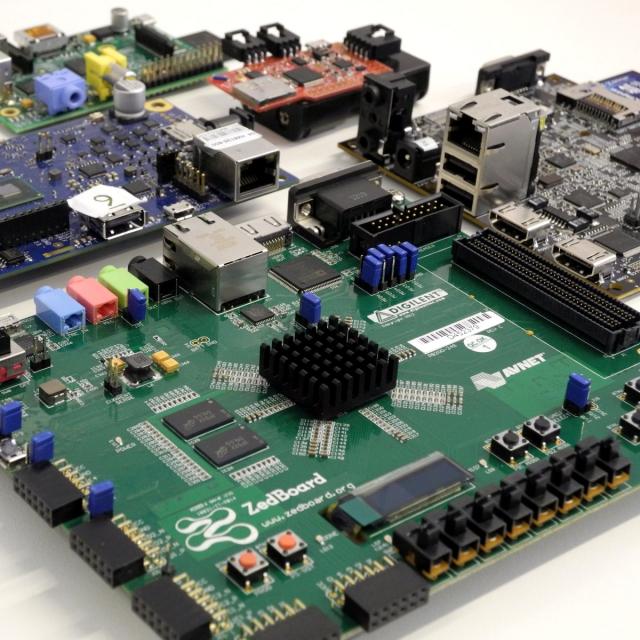
This course will give you hands-on FPGA design experience that uses all the concepts and skills you have developed up to now. You will need to purchase a DE10-Lite development kit. You will setup and test the MAX10 DE10-Lite board using the FPGA design tool Quartus Prime and the System Builder.

Class Deals by MOOC List - Click here and see Coursera's Active Discounts, Deals, and Promo Codes.

You will:

  • Design and test a Binary Coded Decimal Adder.
  • Design and test a PWM Circuit, with verification by simulation.
  • Design and test an ADC circuit, using Quartus Prime built-in tools to verify your circuit design.
  • Create hardware for the NIOS II soft processor, including many interfaces, using Qsys (Platform Designer). Instantiate this design into a top-level DE10-Lite HDL file.
  • Compile your completed hardware using Quartus Prime.
  • Enhance and test a working design, using most aspects of the Quartus Prime Design Flow and the NIOS II Software Build Tools (SBT) for Eclipse.
  • Create software for the NIOS II soft processor, including many interfaces, using Qsys (Platform Designer) and the SBT.
  • Compile your completed software using the SBT.
  • Use Quartus Prime to program both the FPGA hardware configuration and software code in you DE10-Lite development kit.

Record all your observations in a lab notebook pdf.
Submit your project files and lab notebook for grading.
This course consists of 4 modules, approximately 1 per week for 4 weeks. Each module will include an hour or less of video lectures, plus reading assignments, discussion prompts, and project assignment that involves creating hardware and/or software in the FPGA.
Course 3 of 3 in the FPGA Design for Embedded Systems Specialization.

What You Will Learn

  • Create a working FPGA design using Quartus Prime and run it on an evaluation board
  • Understand and practice all aspects of FPGA development, including conception, design, implementation, and debugging.
  • Create in the FPGA a working system on a chip design with Nios II soft processor, RAM and FLASH memory, and several peripherals.
  • Become familiar with the FGPA development flow, particularly in the case of a SoC with software development flow included.

Syllabus

WEEK 1
Hands on: Altera MAX10 Hardware Setup
In this module you will begin your hands-on exploration of FPGA design by setting up a target board, the DE10-Lite based on the MAX10 Intel Altera FPGA. In this module you will:

  • Setup and test the MAX10 board using the FPGA design tool Quartus Prime and the System Builder. - Design and test a Binary Coded Decimal Adder.
  • Record all your observations in a lab notebook pdf.
  • Submit your project files and lab notebook for grading. Completing this module will help prepare you for the work to be done in the modules that follow.

WEEK 2
Develop a Mixed Signal System
The goal of this module is to develop a mixed-signal system. You will construct hardware that uses the Analog to Digital Converter (ADC) inputs and Pulse Width Modulate (PWM) outputs to make a voltage measuring instrument. In this module you will:

  • Create a working design, using most aspects of the Quartus Prime Design Flow. Design and test a PWM Circuit, with verification by simulation.
  • Design and test an ADC circuit, using Quartus Prime built-in tools to verify your circuit design. - Record all your observations in a lab notebook pdf.
  • Submit your project files and lab notebook for grading. Completing this module will help prepare you for the work to be done in the modules that follow.

WEEK 3
Create a System on a Chip with NIOS II
The goal of this module is to develop the hardware for a System on a Chip (SoC). You will construct hardware that creates a NIOS II soft processor along with several interfaces to devices on the DE10-Lite development kit. In this module you will:

  • Create a working design, using most aspects of the Quartus Prime Design Flow.
  • Create hardware for the NIOS II soft processor, including many interfaces, using Qsys (Platform Builder). Instantiate this design into a top-level DE10-Lite HDL file.
  • Compile your completed hardware using Quartus Prime.
  • Record all your observations in a lab notebook.
  • Submit your project files and lab notebook for grading. Completing this module will provide a platform for the work to be done in the module that follows.

WEEK 4
Software for a System on a Chip
The goal of this module is to develop the software for a System on a Chip (SoC). You will build software for a NIOS II soft processor you built in Module 3, using several interfaces to devices on the DE10-Lite development kit as well. In this module you will


Go to Class
MOOC List is learner-supported. When you buy through links on our site, we may earn an affiliate commission.

Related Courses

Advanced Modeling for Discrete Optimization (Coursera) Coursera
University of Melbourne,The Chinese University of Hong Kong

Advanced Modeling for Discrete Optimization (Coursera)

Optimization is a common form of decision making, and is ubiquitous in our society. Its applications range from solving Sudoku puzzles to arranging seating in a wedding banquet. The same technology can schedule planes and their crews, coordinate the production of steel, and organize the transportation of iron ore from the mines to the ports. Good decisions in manpower and material resources management also allow corporations to improve profit by millions of dollars.

Jun 22nd 2026
5-12 Weeks
App Deployment, Debugging, and Performance en Français (Coursera) Coursera
Google Cloud

App Deployment, Debugging, and Performance en Français (Coursera)

Dans ce cours, les développeurs d'applications apprennent à concevoir et développer des applications cloud natives qui intègrent parfaitement les services gérés de Google Cloud. À travers un ensemble de présentations, de démonstrations et d'ateliers pratiques, ils découvrent comment appliquer les bonnes pratiques de développement d'applications et comment utiliser les services de stockage Google Cloud appropriés pour le stockage d'objets, les données relationnelles, la mise en cache et l'analyse. Les participants peuvent choisir d'effectuer les ateliers dans leur langage préféré (Node.js, Java ou Python).

Jun 22nd 2026
1 Week
APIs (Coursera) Coursera
Meta

APIs (Coursera)

Delve deeper into the processes and concepts behind APIs and their infrastructure. Explore the key concepts that underpin API development and the principles of representational state transfer architectural style (REST) architecture. Build basic API and REST data backbones for web apps using Django. Discover emerging API technology and practice other ways to build and work with APIs. Finally, you will test, optimize and develop documentation for an API.

Jun 22nd 2026
4 Weeks
Electrónica Digital Bit a Bit: Aprendiendo fundamentos (Coursera) Coursera
Pontificia Universidad Católica de Chile

Electrónica Digital Bit a Bit: Aprendiendo fundamentos (Coursera)

Es desafiante y hasta atemorizante entender un circuito digital cuando observamos la cantidad de transistores que puede contener, y aún más difícil diseñarlo eficientemente para su implementación en un circuito integrado o una FPGA. Sin embargo, saber diseñar circuitos digitales simples nos abre las puertas para diseñar sistemas digitales más complejos a partir de estos.

Jun 22nd 2026
5-12 Weeks
Introduction to Hardware and Operating Systems (Coursera) Coursera
IBM

Introduction to Hardware and Operating Systems (Coursera)

Organizations need workers who can help others with computer hardware, software, and connectivity issues. Healthcare organizations are still converting to digitized systems, requiring more IT support. Workers are retiring, and organizations are contracting workers through IT consultancies rather than in-house IT technicians. With remote and hybrid work here to stay, organizations must provide employees with the devices and support they need to remain connected and productive. Additionally, IT support roles are often a steppingstone that enables employees to grow into higher-paying IT careers.

Jun 22nd 2026
5-12 Weeks
Technical Support Fundamentals (Coursera) Coursera
Google

Technical Support Fundamentals (Coursera)

This course is the first of a series that aims to prepare you for a role as an entry-level IT Support Specialist. In this course, you’ll be introduced to the world of Information Technology, or IT. You’ll learn about the different facets of Information Technology, like computer hardware, the Internet, computer software, troubleshooting, and customer service. This course covers a wide variety of topics in IT that are designed to give you an overview of what’s to come in this certificate program.

Jun 22nd 2026
5-12 Weeks
Designing Hardware for Raspberry Pi Projects (Coursera) Coursera
Johns Hopkins University

Designing Hardware for Raspberry Pi Projects (Coursera)

This is course 4 of this specialization (although it can be taken out of order) and focuses on applying experience and knowledge gained in the first three courses to build physical electronics hardware. Specifically, this course focuses on four areas: circuit simulation, schematic entry, PCB layout, and 3D CAD modeling. There are many excellent commercial applications available in these areas, however to give everyone access we'll be using all free and open-source software.

Jun 22nd 2026
4 Weeks
Aspectos básicos de la asistencia técnica (Coursera) Coursera
Google

Aspectos básicos de la asistencia técnica (Coursera)

Este curso es el primero de una serie que tiene como objetivo prepararte para un rol como especialista de soporte de TI de nivel inicial. En este curso, serás introducido en el mundo de la tecnología de la información, o TI. Aprenderás sobre las diferentes facetas de la tecnología de la información como hardware y software informático, Internet, solución de problemas y servicio al cliente.

Jun 23rd 2026
5-12 Weeks
Python Programming Essentials (Coursera) Coursera
Rice University

Python Programming Essentials (Coursera)

This course will introduce you to the wonderful world of Python programming! We'll learn about the essential elements of programming and how to construct basic Python programs. We will cover expressions, variables, functions, logic, and conditionals, which are foundational concepts in computer programming. We will also teach you how to use Python modules, which enable you to benefit from the vast array of functionality that is already a part of the Python language. These concepts and skills will help you to begin to think like a computer programmer and to understand how to go about writing Python programs.

Jun 15th 2026
4 Weeks
Algorithmic Toolbox (Coursera) Coursera
University of California, San Diego,Higher School of Economics - HSE University

Algorithmic Toolbox (Coursera)

The course covers basic algorithmic techniques and ideas for computational problems arising frequently in practical applications: sorting and searching, divide and conquer, greedy algorithms, dynamic programming. We will learn a lot of theory: how to sort data and how it helps for searching; how to break a large problem into pieces and solve them recursively; when it makes sense to proceed greedily; how dynamic programming is used in genomic studies. You will practice solving computational problems, designing new algorithms, and implementing solutions efficiently (so that they run in less than a second).

Jun 22nd 2026
5-12 Weeks