Foundations of Quantum Mechanics (Coursera)

Foundations of Quantum Mechanics (Coursera)

This course covers the fundamental concepts and topics of quantum mechanics which include basic concepts, 1D potential problems, time evolution of quantum states, and essential linear algebra. It provides undergraduate level foundational knowledge and build on them more advanced topics.

Class Deals by MOOC List - Click here and see Coursera's Active Discounts, Deals, and Promo Codes.

This course can also be taken for academic credit as ECEA xxxx, part of CU Boulder’s Master of Science in Electrical Engineering degree.
At the end of this course learners will be able to:

  1. demonstrate full grasp of basic concepts in quantum mechanics including wave-particle duality, operators and wavefunctions, and evolution of quantum states,
  2. achieve mastery of the mathematical apparatus needed for quantum mechanics and
  3. attain foundational knowledge required to learn more advanced quantum mechanics and applications.

What You Will Learn

  • Understand the quantum mechanical meaning of wave-particle duality
  • Calculate probabilities and expectation values for physical observables
  • Use both Schrödinger and Heisenberg picture to solve for time evolution of quantum states
  • Describe fermions and bosons using multiparticle basis functions.

Course 1 of 3 in the Quantum Mechanics for Engineers Specialization.

Syllabus

WEEK 1
Wave-particle Duality and Schrödinger Equation
In this module we will introduce the course and the Quantum Mechanics for Engineers specialization. In addition, we will discuss wave-particle duality, time-independent Schrödinger equation. one-dimensional infinite potential well problem, properties of eigensolutions and Hilbert space.

WEEK 2
One-dimensional Potential Problems
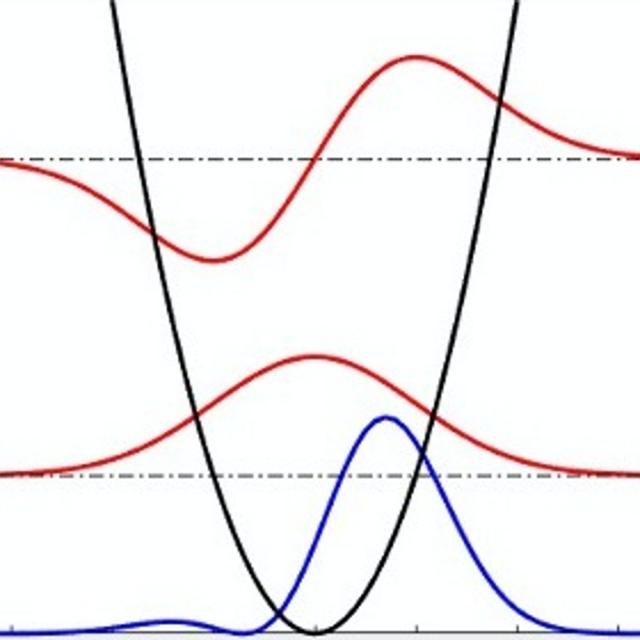
In this module, we will solve several one-dimensional potential problems. They include finite potential well, harmonic oscillator, potential step and potential barrier. We will discuss the physical meaning of the solutions and highlight any non-classical behaviors these problems exhibit.

WEEK 3
Operators and Measurements 1
This module covers the theory of measurements in quantum mechanics. We start our discussion by introducing Stern-Gerlach experiment and the difficulty in interpreting the results classically. We then develop mathematical tools required to properly describe the results and then apply them to the interpretation of Stern-Gerlach experiments.

WEEK 4
Operators and Measurements 2
In this module we expand upon the discussion from the previous module and introduces Hamiltonian, position and momentum operators and the uncertainty principle that governs the relationship between the operators. We also discuss the general principle of change of basis and the specific example of position and momentum representations.

WEEK 5
Time Evolution of Quantum States
This module discusses how to describe the time-evolution of a quantum system. There are two equivalent methods, Schrödinger and Heisenberg pictures, where the time evolution can be obtained by the time-dependent Schrödinger equation and Heisenberg equation of motion, respectively. We will discuss the specific example of harmonic oscillator and finally introduce the particle current.

WEEK 6
Ensembles and Identical Particles
This module discusses how to deal with ensembles. We will first discuss the difference between pure and mixed states and how to use the density matrix to describes them. We then discuss indistinguishable particles and exchange interaction, which eventually lead us to the thermal distribution functions.
Go to Class
MOOC List is learner-supported. When you buy through links on our site, we may earn an affiliate commission.

Related Courses

Basic Mathematics (Coursera) Coursera
Birla Institute of Technology & Science

Basic Mathematics (Coursera)

Welcome to Basic Mathematics course! This course provides elementary introduction to basic mathematics concepts and their applications. In this course, you will be introduced to Complex Numbers, Quadratic Equations, Trigonometry, Matrices, Differential Calculus, Integral Calculus and Ordinary Differential Equations along with the applications of each concept. After completing this course, you will be able to use basic mathematics concepts effectively and also will be able to apply the concepts in real-world problems.

Jun 29th 2026
5-12 Weeks
Calculus: Single Variable Part 3 - Integration (Coursera) Coursera
University of Pennsylvania

Calculus: Single Variable Part 3 - Integration (Coursera)

Calculus is one of the grandest achievements of human thought, explaining everything from planetary orbits to the optimal size of a city to the periodicity of a heartbeat. This brisk course covers the core ideas of single-variable Calculus with emphases on conceptual understanding and applications. The course is ideal for students beginning in the engineering, physical, and social sciences.

Aug 31st 2026
4 Weeks
Quantum Networking (edX) EdX
Purdue University,PurdueX

Quantum Networking (edX)

Learn about the science and engineering of future quantum networks whose security is guaranteed by laws of quantum physics. Applying exotic quantum properties such as entanglement to every-day applications such as communication and computation reveals new dimensions of such applications. Quantum encoding and entanglement distribution provide means to establish fundamentally secure communication links for transfer of classical and quantum data.

Mar 27th 2023
5-12 Weeks
Theory of Angular Momentum (Coursera) Coursera
University of Colorado Boulder

Theory of Angular Momentum (Coursera)

This course can also be taken for academic credit as ECEA xxxx, part of CU Boulder’s Master of Science in Electrical Engineering degree. This course introduces the quantum mechanical concept of angular momentum operator and its relationship with rotation operator. It then presents the angular momentum operators, their eigenvalues and eigenfunctions. Finally, it covers the theory of angular momentum addition.

Aug 24th 2026
3 Weeks
Quantum Mechanics (Coursera) Coursera
University of Colorado Boulder

Quantum Mechanics (Coursera)

Course 2 of Statistical Thermodynamics presents an introduction to quantum mechanics at a level appropriate for those with mechanical or aerospace engineering backgrounds. Using a postulatory approach that describes the steps to follow, the Schrodinger wave equation is derived and simple solutions obtained that illustrate atomic and molecular structural behavior. More realistic behavior is also explored along with modern quantum chemistry numerical solution methods for solving the wave equation.

Aug 31st 2026
3 Weeks
Initiation à la théorie des distributions (Coursera) Coursera
École Polytechnique

Initiation à la théorie des distributions (Coursera)

Une fonction discontinue peut-elle être solution d'une équation différentielle? Comment définir rigoureusement la masse de Dirac (une "fonction" d'intégrale un, nulle partout sauf en un point) et ses dérivées? Peut-on définir une notion de "dérivée d'ordre fractionnaire"? Cette initiation aux distributions répond à ces questions - et à bien d'autres.

Sep 7th 2026
5-12 Weeks
The Discovery of the Higgs Boson (Coursera) Coursera
University of Edinburgh

The Discovery of the Higgs Boson (Coursera)

The discovery of a new fundamental particle at the Large Hadron Collider (LHC), CERN is the latest step in a long quest seeking to answer one of physics’ most enduring questions: why do particles have mass? The experiments’ much anticipated success confirms predictions made decades earlier by Peter Higgs and others, and offers a glimpse into a universe of physics beyond the Standard Model.

Aug 31st 2026
5-12 Weeks
Introduction to Quantum Science & Technology (edX) EdX
Purdue University,PurdueX

Introduction to Quantum Science & Technology (edX)

Learn about fundamental concepts and engineering challenges of quantum technologies. Emerging quantum systems are disruptive technologies redefining computing and communication. Teaching quantum physics to engineers and educating scientists on engineering solutions are critical to address fundamental and engineering challenges of the quantum technologies.

Aug 21st 2023
13-24 Weeks
Differential Equations: Fourier Series and Partial Differential Equations (edX) EdX
MIT,MITx

Differential Equations: Fourier Series and Partial Differential Equations (edX)

Learn to use Fourier series to solve differential equations with periodic input signals and to solve boundary value problems involving the heat equation and wave equation. Differential equations are the mathematical language we use to describe the world around us. Many phenomena are not modeled by differential equations, but by partial differential equations depending on more than one independent variable.

Mar 22nd 2023
5-12 Weeks
Physical Basics of Quantum Computing (Coursera) Coursera
Saint Petersburg State University

Physical Basics of Quantum Computing (Coursera)

Quantum information and quantum computations is a new, rapidly developing branch of physics that has arisen from quantum mechanics, mathematical physics and classical information theory. Significant interest in this area is explained by the great prospects that will open upon the implementation of its ideas, capturing almost all areas of human activity related to the transfer, storage and processing of information.

Jul 25th 2022
5-12 Weeks
Statistical Thermodynamics: Molecules to Machines (Coursera) Coursera
Carnegie Mellon University

Statistical Thermodynamics: Molecules to Machines (Coursera)

Modern engineering research focuses on designing new materials and processes at the molecular level. Statistical thermodynamics provides the formalism for understanding how molecular interactions lead to the observed collective behavior at the macroscale. This course will develop a molecular-level understanding of key thermodynamic quantities like heat, work, free energy and entropy. These concepts will be applied in understanding several important engineering and biological applications.

Sep 6th 2026
5-12 Weeks