Fitting Statistical Models to Data with Python (Coursera)

Fitting Statistical Models to Data with Python (Coursera)

In this course, we will expand our exploration of statistical inference techniques by focusing on the science and art of fitting statistical models to data. We will build on the concepts presented in the Statistical Inference course (Course 2) to emphasize the importance of connecting research questions to our data analysis methods. We will also focus on various modeling objectives, including making inference about relationships between variables and generating predictions for future observations.

Class Deals by MOOC List - Click here and see Coursera's Active Discounts, Deals, and Promo Codes.

This course will introduce and explore various statistical modeling techniques, including linear regression, logistic regression, generalized linear models, hierarchical and mixed effects (or multilevel) models, and Bayesian inference techniques. All techniques will be illustrated using a variety of real data sets, and the course will emphasize different modeling approaches for different types of data sets, depending on the study design underlying the data (referring back to Course 1, Understanding and Visualizing Data with Python).
During these lab-based sessions, learners will work through tutorials focusing on specific case studies to help solidify the week’s statistical concepts, which will include further deep dives into Python libraries including Statsmodels, Pandas, and Seaborn. This course utilizes the Jupyter Notebook environment within Coursera.
Course 3 of 3 in the Statistics with Python Specialization.

Syllabus

WEEK 1
Overview & considerations for statistical modeling
We begin this third course of the Statistics with Python specialization with an overview of what is meant by “fitting statistical models to data.” In this first week, we will introduce key model fitting concepts, including the distinction between dependent and independent variables, how to account for study designs when fitting models, assessing the quality of model fit, exploring how different types of variables are handled in statistical modeling, and clearly defining the objectives of fitting models.

WEEK 2
Fitting models to independent data
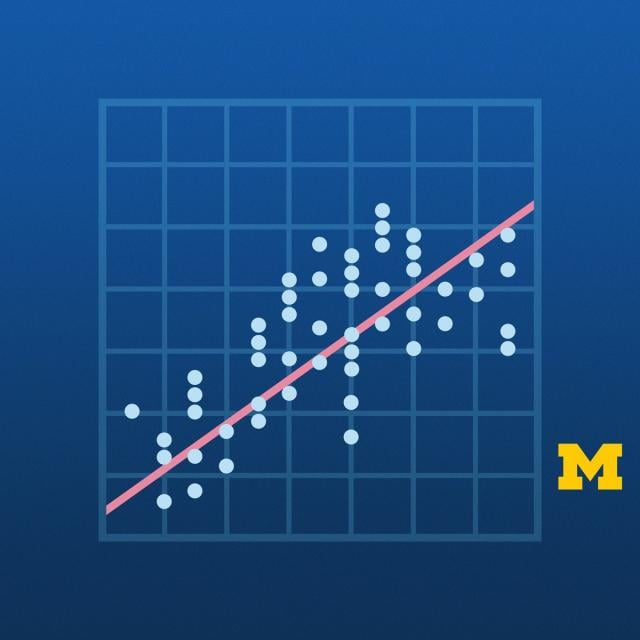
In this second week, we’ll introduce you to the basics of two types of regression: linear regression and logistic regression. You’ll get the chance to think about how to fit models, how to assess how well those models fit, and to consider how to interpret those models in the context of the data. You’ll also learn how to implement those models within Python.

WEEK 3
Fitting models to dependent data
In the third week of this course, we will be building upon the modeling concepts discussed in Week 2. Multilevel and marginal models will be our main topic of discussion, as these models enable researchers to account for dependencies in variables of interest introduced by study designs. We’ll be covering why and when we fit these alternative models, likelihood ratio tests, as well as fixed effects and their interpretations.

WEEK 4
Special Topics
In this final week, we introduce special topics that extend the curriculum from previous weeks and courses further. We will cover a broad range of topics such as various types of dependent variables, exploring sampling methods and whether or not to use survey weights when fitting models, and in-depth case studies utilizing Bayesian techniques to derive insights from data. You’ll also have the opportunity to apply Bayesian techniques in Python.
Go to Class
MOOC List is learner-supported. When you buy through links on our site, we may earn an affiliate commission.

Related Courses

Data Management for Clinical Research (Coursera) Coursera
Vanderbilt University

Data Management for Clinical Research (Coursera)

This course presents critical concepts and practical methods to support planning, collection, storage, and dissemination of data in clinical research. Understanding and implementing solid data management principles is critical for any scientific domain. Regardless of your current (or anticipated) role in the research enterprise, a strong working knowledge and skill set in data management principles and practice will increase your productivity and improve your science. Our goal is to use these modules to help you learn and practice this skill set.

Jun 22nd 2026
5-12 Weeks
Comparing Genes, Proteins, and Genomes (Bioinformatics III) (Coursera) Coursera
University of California, San Diego

Comparing Genes, Proteins, and Genomes (Bioinformatics III) (Coursera)

Once we have sequenced genomes in the previous course, we would like to compare them to determine how species have evolved and what makes them different. In the first half of the course, we will compare two short biological sequences, such as genes (i.e., short sequences of DNA) or proteins. We will encounter a powerful algorithmic tool called dynamic programming that will help us determine the number of mutations that have separated the two genes/proteins.

Jun 22nd 2026
5-12 Weeks
Using Python to Interact with the Operating System (Coursera) Coursera
Google

Using Python to Interact with the Operating System (Coursera)

By the end of this course, you’ll be able to manipulate files and processes on your computer’s operating system. You’ll also have learned about regular expressions -- a very powerful tool for processing text files -- and you’ll get practice using the Linux command line on a virtual machine. And, this might feel like a stretch right now, but you’ll also write a program that processes a bunch of errors in an actual log file and then generates a summary file. That’s a super useful skill for IT Specialists to know.

Jun 23rd 2026
5-12 Weeks
Hypothesis Testing with Python and Excel (Coursera) Coursera
Tufts University

Hypothesis Testing with Python and Excel (Coursera)

In today's job market, leaders need to understand the fundamentals of data to be competitive. An essential procedure to understand business and analytics is hypothesis testing. This short course, designed by Tufts University expert faculty, will teach the fundamentals of hypothesis testing of a population mean and a population proportion, using Excel and Python for calculations. You'll also discover the central limit theorem, which is essential for hypothesis testing. To conclude the course, you will apply your newfound skills by creating a plan for an experiment in your own workplace that uses hypothesis testing.

Jun 23rd 2026
1 Week
Linear Regression and Modeling (Coursera) Coursera
Duke University

Linear Regression and Modeling (Coursera)

This course introduces simple and multiple linear regression models. These models allow you to assess the relationship between variables in a data set and a continuous response variable. Is there a relationship between the physical attractiveness of a professor and their student evaluation scores? Can we predict the test score for a child based on certain characteristics of his or her mother? In this course, you will learn the fundamental theory behind linear regression and, through data examples, learn to fit, examine, and utilize regression models to examine relationships between multiple variables, using the free statistical software R and RStudio.

Jun 22nd 2026
4 Weeks
Machine Learning Foundations: A Case Study Approach (Coursera) Coursera
University of Washington

Machine Learning Foundations: A Case Study Approach (Coursera)

Do you have data and wonder what it can tell you? Do you need a deeper understanding of the core ways in which machine learning can improve your business? Do you want to be able to converse with specialists about anything from regression and classification to deep learning and recommender systems? In this course, you will get hands-on experience with machine learning from a series of practical case-studies.

Jun 22nd 2026
5-12 Weeks
Statistical Inference (Coursera) Coursera
Johns Hopkins University

Statistical Inference (Coursera)

Statistical inference is the process of drawing conclusions about populations or scientific truths from data. There are many modes of performing inference including statistical modeling, data oriented strategies and explicit use of designs and randomization in analyses. Furthermore, there are broad theories (frequentists, Bayesian, likelihood, design based, …) and numerous complexities (missing data, observed and unobserved confounding, biases) for performing inference.

Jun 22nd 2026
4 Weeks
Introduction to Data Science in Python (Coursera) Coursera
University of Michigan

Introduction to Data Science in Python (Coursera)

This course will introduce the learner to the basics of the python programming environment, including fundamental python programming techniques such as lambdas, reading and manipulating csv files, and the numpy library. The course will introduce data manipulation and cleaning techniques using the popular python pandas data science library and introduce the abstraction of the Series and DataFrame as the central data structures for data analysis, along with tutorials on how to use functions such as groupby, merge, and pivot tables effectively. By the end of this course, students will be able to take tabular data, clean it, manipulate it, and run basic inferential statistical analyses.

Jun 22nd 2026
4 Weeks
Introduction to Probability and Data with R (Coursera) Coursera
Duke University

Introduction to Probability and Data with R (Coursera)

This course introduces you to sampling and exploring data, as well as basic probability theory and Bayes' rule. You will examine various types of sampling methods, and discuss how such methods can impact the scope of inference. A variety of exploratory data analysis techniques will be covered, including numeric summary statistics and basic data visualization.

Jun 22nd 2026
5-12 Weeks