Equitable Stage Makeup and Hair (Coursera)

Equitable Stage Makeup and Hair (Coursera)

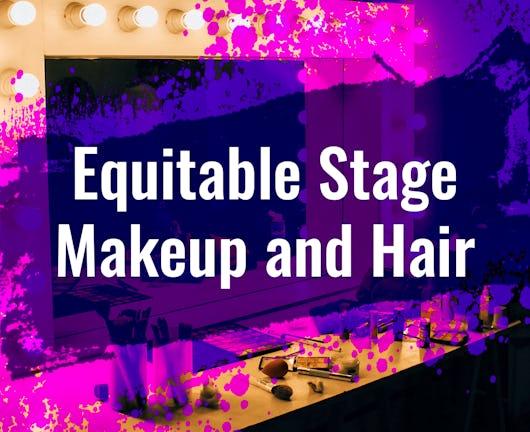
Go beyond the limitations of mainstream courses and gain a broad overview of inclusive makeup and hair practices, regardless of your experience level. Equitable Stage Makeup and Hair offers highly detailed videos and in-depth practice guides to train you on applying makeup for all skin tones and ways to prepare wigs for a variety of different hair textures. Designed to propel forward your skills, training in applying makeup for all skin tones, and wig preparation for a variety of hair textures, you will learn techniques for applying natural makeup for both on stage and camera, and aging makeup.

Class Deals by MOOC List - Click here and see Coursera's Active Discounts, Deals, and Promo Codes.

The course allows you to tailor your learning experience based on your own makeup and hair needs with additional modules on trauma makeup, special effects makeup, or drag makeup.
Makeup application techniques are supported by lessons in facial anatomy, color theory, character analysis, and personalized makeup worksheet demonstrations. Hear from renowned makeup artists, performers, and drag queens to learn from their experience in the entertainment and theater industries. By learning inclusive methods of hair and makeup, you can work to build more equitable spaces for everyone.

What you'll learn

  • Learn foundational techniques for applying stage makeup for all complexions and bone structures.
  • Learn inclusive language and basic techniques for theatrical hair and wig preparation.
  • Analyze text and utilize color theory to develop characters through makeup and hair application.

Syllabus

Introduction to the Course
Welcome! This module will introduce you to the course instructors, share why we have crafted this course, and provide details about course logistics to help you prepare for success on this learning journey.

1: Setting the Stage
In this module, you will be introduced to the necessary vocabulary needed to foster inclusive theatrical makeup and hair processes and terminology. To get started, you will create a makeup kit that will enable you to complete the modules in this course.

2: Designing Makeup for Your Face
In Module 2, you will get to know all about faces - the anatomy and vocabulary that will become the roadmap for makeup design and application. Then, we'll explore color theory and how color informs the application of makeup. After reading the short play, A Park Bench Triptych, you will analyze characters and create a research board that describes your design choices.

3: Basic Contour
It's time to put on some makeup! In Module 3, you will follow along as we hear from guest experts about how to apply contour, highlight, and foundation to create a balanced makeup application. We'll close by discussing strategies for scaling the makeup based on the size of the performance venue.

4: Aging
With a familiarity of makeup tools and techniques, in Module 4, you will apply these skills to age the face, create wrinkles, and explore how to adjust the makeup depending on the venue and lighting. These are great skills to develop especially for educational theatre where performers are often cast to play characters older than themselves.

5: Intro to Special Effects
Building on lessons in color theory, and introducing new household materials, in Module 5 you will have the option to practice simple special effects to create the illusion of bruises and wounds. Skills in this module can be used depending on the requirement of a script, deeper character development, and illusions needed as part of cosplay. Module 5 explores the world of trauma makeup and practical approaches to creating makeup looks for special effects. Building on lessons in color theory, you will also have the option to practice makeup looks for creating the illusion of bruises and wounds. Depending on the script or character needs, skills learned in this module are applicable to cosplay and deeper character development.

6: Hair
In Module 6, you will develop an understanding of different hair textures, and how to prepare different hair textures for wearing a wig. We will take a close look at theatrical wigs and facial hair to understand how to put them on, take them off, and take care of them for extended use.

7: Drag
Meet reality TV star and Drag artist Alexis Michelle! In this optional module, you will be guided through all the steps necessary to heighten your makeup with a fun exploration of gender in applying a drag makeup application. Time to get out some glitter!

Go to Class
MOOC List is learner-supported. When you buy through links on our site, we may earn an affiliate commission.

Related Courses

Trabajar para ser feliz (Coursera) Coursera
Universidad Austral

Trabajar para ser feliz (Coursera)

En nuestra vida diaria nos movemos a toda velocidad por diferentes escenarios: la familia, el trabajo, la vida social. Muchas veces podemos quedar atrapados en la vorágine o en la rutina del día a día y olvidarnos de algo importante y que da sentido a todo lo que hacemos: cómo ser felices y cómo hacer felices a los que nos rodean en casa y en el trabajo. Hoy en día existe una confusión, porque estamos muy centrados en el “bienestar”. Vivimos en una cultura que tiende al consumismo, al activismo y nos olvidamos del “bienser”, entendido como ese sentido de plenitud que lleva a sentirse bien con uno mismo y con su entorno.

Jun 15th 2026
4 Weeks
Color Theory Part 1- Understanding Color Relationships (Skillshare) Skillshare
Skillshare

Color Theory Part 1- Understanding Color Relationships (Skillshare)

I am a high school graduate and soon to be a college student. I plan on studying artwork in college like I have done in high school. Creating artwork has always been a big part of my life. As a child when I started drawing I would spend my days doing that rather than playing video games like my friends. I have been making artwork for a far back as I can remember and that is why I am excited to share what I have learned.

Self Paced
Self-Paced
Designing for Textiles (edX) EdX
Smithsonian,SmithsonianX

Designing for Textiles (edX)

The Designing for Textiles workshop provides those who work in traditional crafts-based media with an introduction, or refresher, to design education through the lens of Armenian textiles. Based on an in-person training program that took place in 2018 through the My Armenia program, this workshop is a series of lessons and extension activities that build upon one another and encourage you to innovate in your own textiles-based design work.

Self Paced
Self-Paced
Graphic Design Essentials (edX) EdX
LCI Education

Graphic Design Essentials (edX)

Acquire the essential skills to become a working Graphic Designer from the basics of color theory to presenting a project to a client. This online course from LaSalle College Vancouver will introduce you to the basics of design, graphic and visual communication, image making, typography and the overall creative process, starting from the client mandate to the final presentations.

Self Paced
Self-Paced
Data Visualization and D3.js (Udacity) Udacity
Udacity,Zipfian Academy

Data Visualization and D3.js (Udacity)

Communicating with Data. Learn the fundamentals of data visualization and practice communicating with data. This course covers how to apply design principles, human perception, color theory, and effective storytelling to data visualization. If you present data to others, aspire to be an analyst or data scientist, or if you’d like to become more technical with visualization tools, then you can grow your skills with this course.

Self Paced
Self-Paced
Digital Footprint (Coursera) Coursera
University of Edinburgh

Digital Footprint (Coursera)

If I Googled you, what would I find? As we move around the online world we leave tracks and traces of our activity all the time: social media accounts, tagged images, professional presences, scraps of text, but also many artefacts we don't always realise we are leaving behind, or that others leave about us. In this course you will hear from a range of experts and you will have an opportunity to explore and reflect on your own online tracks and traces, to understand why your digital footprint is important. We will introduce you to some of the tools and approaches to effectively manage your online presence (or digital footprint).

Jun 15th 2026
3 Weeks
In the Studio: Postwar Abstract Painting (Coursera) Coursera
The Museum of Modern Art

In the Studio: Postwar Abstract Painting (Coursera)

Want to know how some of the 20th century’s most celebrated artists made abstract paintings? This course offers an in-depth, hands-on look at the materials, techniques, and thinking of seven New York School artists, including Willem de Kooning, Yayoi Kusama, Agnes Martin, Barnett Newman, Jackson Pollock, Ad Reinhardt, and Mark Rothko. Through studio demonstrations and gallery walkthroughs, you’ll form a deeper understanding of what a studio practice means and how ideas develop from close looking, and you’ll gain a sensitivity to the physical qualities of paint.

Jun 8th 2026
5-12 Weeks
Speaking to persuade: Motivating audiences with solid arguments and moving language (Coursera) Coursera
University of Washington

Speaking to persuade: Motivating audiences with solid arguments and moving language (Coursera)

In the professional realm, we need to be able to argue without being argumentative. Whether you are fundraising for a nonprofit, pitching a business proposal, or suggesting a change to company policy, you are making arguments. In making the case for your topic, you often want to raise awareness, identify a pressing problem, discuss appropriate solutions, and outline specific steps for the audience.

Jun 15th 2026
5-12 Weeks
Building High-Performing Teams (Coursera) Coursera
University of Pennsylvania

Building High-Performing Teams (Coursera)

Teams are essential to the modern organization, but most never reach their potential. Co-workers miscommunicate, and groups struggle to adapt to changes in the market or their organizations. When teams lack self-awareness about these challenges, performance suffers. Based on years of team culture research and consulting experience, this course helps you understand the problems that hurt productivity, and gives you tools for creating positive change. This course also guides you through creating the ground rules and structure needed to set your team up for success.

Jun 15th 2026
5-12 Weeks