EdX

Del trazo caligráfico al método paleográfico: experimentando la materialidad de los manuscritos históricos (edX)

Del trazo caligráfico al método paleográfico: experimentando la materialidad de los manuscritos históricos (edX)

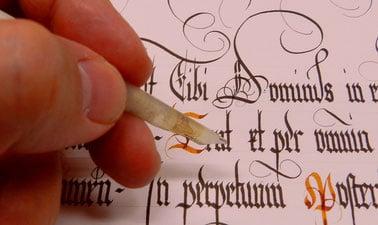
Práctica paleográfica y caligráfica en ciclos de escritura histórica y procesos materiales de creación del manuscrito, conservación e interpretación. El tiempo y el espacio son elementos vertebradores de toda la propuesta de contenidos en torno al mundo del manuscrito histórico. En esta ocasión, la identificación de procesos, la materialidad de los testimonios y los modos de hacer (escritura caligráfica, lectura paleográfica) se suman a la familiaridad con lugares de escritura en momentos concretos del pasado.

Class Deals by MOOC List - Click here and see EdX's Active Discounts, Deals, and Promo Codes.

Las 6 unidades combinarán el trazado de letras históricas unido al conocimiento de la historia de la cultura escrita con especial atención a las cuestiones prácticas de producción, conservación e interpretación.

Se reserva un apartado para subrayar la importancia de las aplicaciones tecnológicas a la lectura, transcripción, interpretación e interacción con el manuscrito. A tenor de los buenos resultados y comentarios dejados en los foros de otros cursos de paleografía y caligrafía realizados por este equipo docente, se contempla una mayor carga de conversatorios y clases demostrativas en centros especializados y con expertos renombrados que aportarán su bagaje tanto intelectual como profesional en ejercicio desde bibliotecas y archivos con colecciones manuscritas históricas. A la vez, constituye una contribución determinante a las humanidades digitales en general con importantes reflexiones en torno a la paleografía digital.

What you'll learn

  • Descubrir la materialidad que define la escritura y su dimensión manufactual.
  • Resolución de casos de transcripción con especial dificultad.
  • Identificación de nuevos retos profesionales en conservación, interpretación y análisis de manuscritos y en Humanidades digitales.
  • Combinar la adquisición de competencias paleográficas (transcripción) con las capacidades caligráficas (reproducción manuscrita).
  • Comprensión del contexto histórico de producción manuscrita.
  • Identificación de los tipos de letra empleados en cada situación histórica: características y morfología.

Syllabus

Semana 1. Investigar en paleografía y caligrafía.
Solucionar problemas singulares (microrretos paleográficos). Leer letra manuscrita en la actualidad; competencias profesionales. Micro proyectos en marcha. Paleografía digital. Comentarios de profesionales de archivos, bibliotecas, investigadores y conservadores especiales. Casos prácticos y conversatorios en Biblioteca Nacional (España)

Semana 2. Fabricar, producir, conservar.
El ciclo de la materialidad constitutiva. Reflexión sobre lo manual. Manufactum vs. Artefactum. Soportes de escritura. Calidades y respuestas de los materiales. Conversatorios.

Semana 3. Un espacio para las letras (Colección del Olmo/Vilas). Biblioteca Lázaro Galdiano.
Del manuscrito a la pantalla. Trabajar con colecciones especiales. Investigar a pie de archivo y biblioteca. Casos prácticos y conversatorios en Archivo Histórico Nacional (España).

Semana 4. Aprender a escribir y a leer.
Manuales, instrucciones, primeras letras. Aprender caligrafía: teoría y práctica. Casos prácticos en diversos archivos y bibliotecas. Conversatorios y sesiones caligráficas del seminario celebrado en la UC3M (24-25 oct. 2019).

Semana 5. Escribir la fe.
Paleografía y caligrafía eclesiástica. Los archivos eclesiásticos. Tipologías documentales y ejercicios de transcripción. Casos prácticos con ejemplos procedentes de diversos archivos y bibliotecas. Conversatorios.

Semana 6. Numerar, datar y contar.
Paleografía y caligrafía de las cifras. Sistemas de cómputo, datación y aplicaciones numéricas a los documentos históricos. Casos prácticos con ejemplos procedentes de diversos archivos y bibliotecas.

Go to Class
MOOC List is learner-supported. When you buy through links on our site, we may earn an affiliate commission.

Related Courses

Factory Automation: Shaping the Future of Manufacturing (Coursera) Coursera
Starweaver

Factory Automation: Shaping the Future of Manufacturing (Coursera)

This course provides a comprehensive understanding of factory automation, covering foundational concepts to practical applications. Participants explore the evolution of automation technology, including robotics and control systems, witnessing its role in optimizing production processes and enhancing productivity. Through real-world case studies, they learn how automation improves efficiency, safety, and innovation in manufacturing.

Sep 14th 2026
4 Weeks
The hidden value - Lean in manufacturing and services (Coursera) Coursera
École des Ponts ParisTech,Boston Consulting Group - BCG

The hidden value - Lean in manufacturing and services (Coursera)

Lean is a powerful methodology that enables managers and employees to shift their mindset and helps companies to keep their business sustainable by creating competitive advantage. Today, in an increasingly complex and dynamic world, where companies struggle to maintain competitive advantage, Lean is more important than ever. This course combines the experience of many senior experts and practitioners from the Boston Consulting Group and École des Ponts, and brings perspectives on Lean in manufacturing and services. It offers strong topic foundation as well as deep practical insights into the art of continuous improvement.

Sep 7th 2026
4 Weeks
Fundamentals of Manufacturing Processes (edX) EdX
MIT,MITx

Fundamentals of Manufacturing Processes (edX)

Study the processes used to manufacture products ranging from toys to smartphones, and learn fundamental principles and practical considerations that enable production at scale. Have you wondered how something was manufactured? Do you want to learn what it takes to turn your design into a finished product at scale? This course introduces a wide range of manufacturing processes including machining, injection molding, casing, and 3D printing; and explains the fundamental and practical aspects of manufacturing at scale.

This course is archived
5-12 Weeks
Fundamentals of Fluid Power (Coursera) Coursera
University of Minnesota

Fundamentals of Fluid Power (Coursera)

In this course, you will be introduced to the fundamental principles and analytical modeling of fluid power components, circuits, and systems. You will learn the benefits and limitations of fluid power compared with other power transmission technologies; the operation, use, and symbols of common hydraulic components; how to formulate and analyze models of hydraulic components and circuits; and how to design and predict the performance of fluid power circuits.

Aug 31st 2026
5-12 Weeks
Micro and Nanofabrication (MEMS) (edX) EdX
École Polytechnique Fédérale de Lausanne,EPFLx

Micro and Nanofabrication (MEMS) (edX)

Learn the fundamentals of microfabrication and nanofabrication by using the most effective techniques in a cleanroom environment. Microfabrication and nanofabrication are the basis of manufacturing for nearly all modern miniaturized systems that are ubiquitously used in our daily life. Examples include; computer chips and integrated sensors for monitoring our environment, cars, mobile phones, medical devices and more.

Self Paced
Self-Paced
Perspectives in Digital Transformation: Manufacturing (Coursera) Coursera
Inter-American Development Bank - IDB

Perspectives in Digital Transformation: Manufacturing (Coursera)

Are you interested in learning how Digital Transformation is driving the manufacturing sector in Latin America and the Caribbean? This course will help you identify challenges and opportunities that digitalization can offer in the industry. Along with specialists from BID Invest and the private sector, you will learn firsthand about the tools and best practices that illustrate the potential of digital solutions, with a cross-cutting focus on sustainability.

Aug 31st 2026
4 Weeks
3D Printing Applications (Coursera) Coursera
University of Illinois at Urbana-Champaign

3D Printing Applications (Coursera)

This course will help you understand how 3D printing is being applied across a number of domains, including design, manufacturing, and retailing. It will also demonstrate the special capabilities of 3D printing such as customization, self-assembly, and the ability to print complex objects. In addition to business applications, this course will also examine how individuals, including those in developing countries, are using this technology to create solutions to the problems they face.

Aug 31st 2026
4 Weeks