EdX

Cultural Heritage in Transformation (edX)

Offered by RWTH Aachen, RWTHx,
Cultural Heritage in Transformation (edX)

Learn how to define, explore, conserve, utilize and manage cultural heritage. In recent decades the sustainable conservation of cultural heritage has become a crucial global challenge. In this context, the trend towards largescale urbanization raises questions as to how new development can take place which respects and maintains the intrinsic values and unique qualities which have been handed down from previous generations, particularly within urban areas.

Class Deals by MOOC List - Click here and see EdX's Active Discounts, Deals, and Promo Codes.

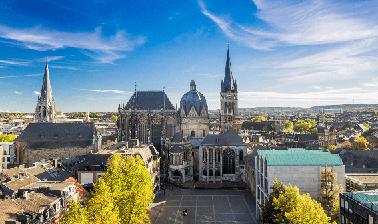
The course addresses these themes by providing participants with the skills to define, explore, conserve, utilize and manage cultural heritage. Throughout the course, you will be introduced to various methodologies and thematic approaches relevant to these skills using the City of Aachen as an example. Through case studies drawn from Aachen and beyond, you will explore examples at a range of spatial scales; from landscape and city scale to individual buildings and artifacts.

Revision questions and assignments will enable you to consolidate your newly acquired skills and to implement these approaches within the city or town of your choice.

What you'll learn

  • The process of defining cultural heritage
  • Various methods to explore cultural heritage
  • Practices dedicated to sustaining cultural heritage and its assets
  • Adaptation strategies regarding the utilization and the management of cultural heritage

Syllabus

WEEK 1: Approaching Cultural Heritage: Introduction to the Course
Week 1 covers the introduction of RWTH Aachen University, its Faculty of Architecture and the Cultural Heritage Group in which several departments team up to approach cultural heritage from various perspectives but with a comprehensive and systematic approach.

WEEK 2: Approaching Aachen: Introduction to the City and its Cultural Heritage
In Week 2, the City of Aachen and its cultural heritage are used as a starting point for the course. The history of the city is briefly outlined and its heritage features are introduced at their different spatial scales, from landscape and city scale to individual buildings and artifacts.

WEEK 3: Defining Cultural Heritage
In Week 3, the process of defining cultural heritage is discussed. This process is approached through criteria-based and also from socially based perspectives. The module gives special emphasis to UNESCO World Heritage, with the Aachen Cathedral providing an outstanding example.

WEEK 4: Exploring Cultural Heritage
Week 4 is dedicated to using various methods to approach and describe cultural heritage. These methods range from archeological to experimental research. They are again exemplified by the City of Aachen’s heritage features.

WEEK 5: Conserving, Utilizing and Managing Cultural Heritage
During Week 5, an insight in practices dedicated to sustaining cultural heritage and its assets is provided. Due to ongoing challenges such as urbanization and the globalization of markets, the conservation of heritage for intrinsic value alone is not always possible. Against this background, adaptation strategies such as the utilization and management of cultural heritage are explained during this week. Whilst developing these themes, the presenters will move beyond the example of Aachen and report on innovations which have happened in other European regions.
Go to Class
MOOC List is learner-supported. When you buy through links on our site, we may earn an affiliate commission.

Related Courses

Arts and Heritage Management (Coursera) Coursera
Università Bocconi

Arts and Heritage Management (Coursera)

Today cultural institutions are facing important dilemmas in many aspects of their management. Over the past decades, a new figure has emerged that of the art manager. Imagine you went to work every day to connect artists with audiences, vision with reality, and money with a mission. That is what managers in the arts do, they play an essential role in transforming the minds, lives, and communities through creative expression. This course has been conceptualized to address the need of skills and techniques to help professionals and managers in running art and cultural institutions.

Oct 5th 2026
5-12 Weeks
Reimagining Blackness and Architecture (Coursera) Coursera
The Museum of Modern Art

Reimagining Blackness and Architecture (Coursera)

Architecture structures our daily lives. It shapes our homes, streets, neighborhoods, cities and more. But who gets to create and occupy these spaces? In the United States, a long history of anti-Black racism has created spatial inequalities that are built into the physical environment and erased the stories of Black architects and communities. Reimagining Blackness and Architecture explores the relationship between architecture and Blackness as an identity and a lived experience.

Oct 5th 2026
5-12 Weeks
A Global History of Architecture (edX) EdX
MIT,MITx

A Global History of Architecture (edX)

Learn about humanity’s rich architectural history on this journey around the globe – from 100,000 BCE to ca. 1,600 CE. How do we understand architecture? One way of answering this question is by looking through the lens of history, beginning with First Societies and extending to the 16th century. This course in architectural history is not intended as a linear narrative, but rather aims to provide a more global view, by focusing on different architectural "moments."

Oct 18th 2023
5-12 Weeks
The Meaning of Rome: The Renaissance and Baroque City (edX) EdX
University of Notre Dame,NotreDameX

The Meaning of Rome: The Renaissance and Baroque City (edX)

Learn how the art, architecture, and urban form of Renaissance and Baroque Rome projected the city’s image of itself to its citizens and the world. We can read a city in a number of ways: in its plan, in the buildings that make its streets and public spaces, in the skyline. We can ask, what are the buildings or spaces saying? How do they say it? How does it all stitch together?

No sessions available
5-12 Weeks
The Architectural Imagination (edX) EdX
HarvardX,Harvard University

The Architectural Imagination (edX)

Learn fundamental principles of architecture — as an academic subject or a professional career — by studying some of history’s most important buildings. Architecture engages a culture’s deepest social values and expresses them in material, aesthetic form. This course will teach you how to understand architecture as both cultural expression and technical achievement. Vivid analyses of exemplary buildings, and hands-on exercises in drawing and modeling, will bring you closer to the work of architects and historians.

Self Paced
Self-Paced
Archaeology and Heritage of Africa (Coursera) Coursera
Universitat Autònoma de Barcelona

Archaeology and Heritage of Africa (Coursera)

Would you like to know more about the new methods archaeologists are using to study African archaeology? And to learn directly from case studies with researchers working on the continent? Are you interested in knowing the role local communities have in the preservation and protection of heritage sites? By enrolling in this course, you will have the opportunity to learn and explore these and so many other subjects in African Archaeology and Heritage and discover the rich and diverse heritage of Africa.

Sep 28th 2026
4 Weeks
Developing Digital Transition Strategies for Cultural Heritage Institutions (edX) EdX
KU Leuven University,KULeuvenX

Developing Digital Transition Strategies for Cultural Heritage Institutions (edX)

How to develop and implement effective digital strategies in Cultural Heritage Institutions. Recently, the necessity for Cultural Heritage Institutions (CHIs) to keep up with the rapid changes in the digitization of society and culture brought them to confront new challenges: 1) adaptation of new digital technologies and 2) the development of impactful digital workflows.

Sep 18th 2023
5-12 Weeks
Software Architecture (Coursera) Coursera
University of Alberta

Software Architecture (Coursera)

The way that software components — subroutines, classes, functions, etc. — are arranged, and the interactions between them, is called architecture. In this course you will study the ways these architectures are represented, both in UML and other visual tools. We will introduce the most common architectures, their qualities, and tradeoffs. We will talk about how architectures are evaluated, what makes a good architecture, and an architecture can be improved. We'll also talk about how the architecture touches on the process of software development.

Sep 21st 2026
4 Weeks