EdX

Boltzmann Law: Physics to Computing (edX)

Offered by Purdue University, PurdueX,
Boltzmann Law: Physics to Computing (edX)

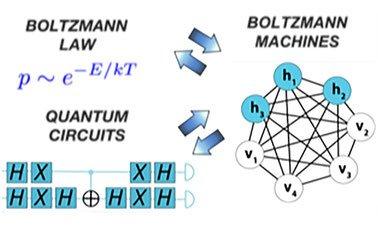
Provides a unified perspective connecting equilibrium statistical mechanics with stochastic neural networks and quantum computing. A unique course that connects three diverse fields using the unifying concept of a state-space with 2^N dimensions defined by N binary bits.

Class Deals by MOOC List - Click here and see EdX's Active Discounts, Deals, and Promo Codes.

We start from the seminal concepts of statistical mechanics like entropy, free energy and the law of equilibrium that have been developed with the purpose of describing interacting systems occurring in nature. We then move to the concept of Boltzmann machines (BM) which are interacting systems cleverly engineered to solve important problems in machine learning. Finally, we move to engineered quantum systems stressing the phenomenon of quantum interference which can lead to awesome computing power.

What you'll learn

  • Boltzmann Law
  • Boltzmann Machines
  • Transition Matrix
  • Quantum Boltzmann Law
  • Quantum Gates

Syllabus

Week 1: Boltzmann Law
1.1 State Space
1.2 Boltzmann Law
1.3 Shannon Entropy
1.4 Free Energy
1.5 Self-consistent Field
1.6 Summary for Exam 1

Week 2: Boltzmann Machines
2.1. Sampling
2.2. Orchestrating Interactions
2.3. Optimization
2.4. Inference
2.5. Learning

Week 3: Transition Matrix
3.1. Markov Chain Monte Carlo
3.2. Gibbs Sampling
3.3. Sequential versus Simultaneous
3.4. Bayesian Networks
3.5. Feynman Paths
3.6 Summary for Exam 2

Week 4: Quantum Boltzmann Law
4.1. Quantum Spins
4.2. One q-bit Systems
4.3. Spin-spin Interactions
4.4. Two q-bit Systems
4.5. Quantum Annealing

Week 5: Quantum Transition Matrix
5.1. Adiabatic to Gated Computing
5.2. Hadamard Gates
5.3. Grover Search
5.4. Shor's Algorithm
5.5. Feynman Paths
5.6 Summary for Exam 3

Epilogue

Go to Class
MOOC List is learner-supported. When you buy through links on our site, we may earn an affiliate commission.

Related Courses

Topology in Condensed Matter: Tying Quantum Knots (edX) EdX
Delft University of Technology,DelftX

Topology in Condensed Matter: Tying Quantum Knots (edX)

Get a simple and hands-on overview of topological insulators, Majoranas, and other topological phenomena. The idea behind topological systems is simple: if there exists a quantity, which cannot change in an insulating system where all the particles are localized, then the system must become conducting and obtain propagating particles when the quantity (called a "topological invariant") finally changes.

No sessions available
5-12 Weeks
Introduction to Quantum Transport (edX) EdX
Purdue University,PurdueX

Introduction to Quantum Transport (edX)

This course introduces the non-equilibrium Green’s function (NEGF) method widely used to describe quantum effects in nanoscale devices, along with its applications to spintronic devices. This course introduces the Schrödinger equation, using the tight-binding method to discuss the concept of bandstructure and E(k) relations, followed by an introduction to the NEGF method with simple illustrative examples. Concept of spinors is introduced along with the application of the NEGF method to spintronic devices.

Feb 12th 2024
5-12 Weeks
Computing: Art, Magic, Science (edX) EdX
ETH Zurich,ETHx

Computing: Art, Magic, Science (edX)

Learn the basics of Information Technology and how to write quality programs in this introductory computer science course. Information Technology (IT) is everywhere. Every aspect of human activity depends on it. All IT processes, whether they drive mobile phones, the Internet, transportation systems, enterprise systems, publishing, social networks or any other application, rely on software.

No sessions available
4 Weeks
Computing for Data Analysis (edX) EdX
Georgia Institute of Technology,GTx

Computing for Data Analysis (edX)

A hands-on introduction to basic programming principles and practice relevant to modern data analysis, data mining, and machine learning. The modern data analysis pipeline involves collection, preprocessing, storage, analysis, and interactive visualization of data. In the course, you’ll see how computing and mathematics come together.

Aug 19th 2024
13-24 Weeks
AP® Physics 2 - Part 1: Fluids and Thermodynamics (edX) EdX
Rice University,RiceX

AP® Physics 2 - Part 1: Fluids and Thermodynamics (edX)

The first course in a comprehensive series designed to prepare you for the AP Physics 2 exam, focusing on thermodynamics and fluids. Preparing for the AP Physics 2 exam requires a deep understanding of many different topics in physics as well as an understanding of the AP exam and the types of questions it asks. This course is Part 1 of our X-Series: AP Physics 2 and it is designed to prepare you for the AP exam.

No sessions available
4 Weeks
Solid State Devices 1 (edX) EdX
Purdue University,PurdueX

Solid State Devices 1 (edX)

Semiconductor are everywhere in human activities, from your credit card to space exploration. This graduate-level introduction brings aspects of physics, chemistry, and engineering together to understand, analyze, and design transistors and solar cells. This course provides the graduate-level introduction to understand, analyze, characterize and design the operation of semiconductor devices such as transistors, diodes, solar cells, light-emitting devices, and more.

Jan 9th 2023
13-24 Weeks