Arctic Change & the Nexus of Governance, Economics & Culture (Coursera)

Arctic Change & the Nexus of Governance, Economics & Culture (Coursera)

In this course, you will learn how the changing Arctic environment is tied to the growing economic and strategic importance of the North. After setting the stage through a review of the peoples of the Arctic and how they are dealing with change, Arctic governance, economies national defense, attention turns to marine use of the Arctic, oil and gas exploration, mining, fisheries and tourism.

Class Deals by MOOC List - Click here and see Coursera's Active Discounts, Deals, and Promo Codes.

The course ends with a survey of recent Arctic events.
Learning Objectives: Articulate the drivers of the growing economic and strategic importance of the Arctic in the context of the environmental changes unfolding in the region, governance, and geopolitics. Identify the impacts of the changing Arctic, both positive and negative, on the peoples of the North.
Course 3 of 3 in the Arctic Climate, Environ. & Geographies of a Changing North Specialization

Syllabus

WEEK 1
Arctic Peoples, Governance, Economics and Geopolitics
In this module, we'll take a closer look at the peoples of the Arctic - the Arctic as a homeland - and then turn attention to the role of the Arctic Council of the eight Arctic nations. After a foray into Arctic demographics, we'll briefly look at some of the big economic drivers in the Arctic (setting a stage for later more focused discussion in subsequent modules) and how the changing Arctic is playing into national defense.

WEEK 2
Marine Use of the Arctic
Here we will learn how the loss of sea ice is opening up the Arctic Ocean to increased marine use and the many issues that have arisen. To set a framework, we will first become familiar with marine use limits in the Arctic Ocean as set by the United Nations Convention Law of the Sea. Then we will explore use of the Northern Sea Route along the Russian Side of the Arctic Ocean, the Northwest Passage through the channels of the Canadian Arctic Archipelago, and the the issues that may play into how heavily these shortcuts between the Atlantic and the Pacific may be used. Finally, we will look at the International Polar Code, which sets requirements for ships operating in polar waters.

WEEK 3
Arctic Riches: Oil and Gas
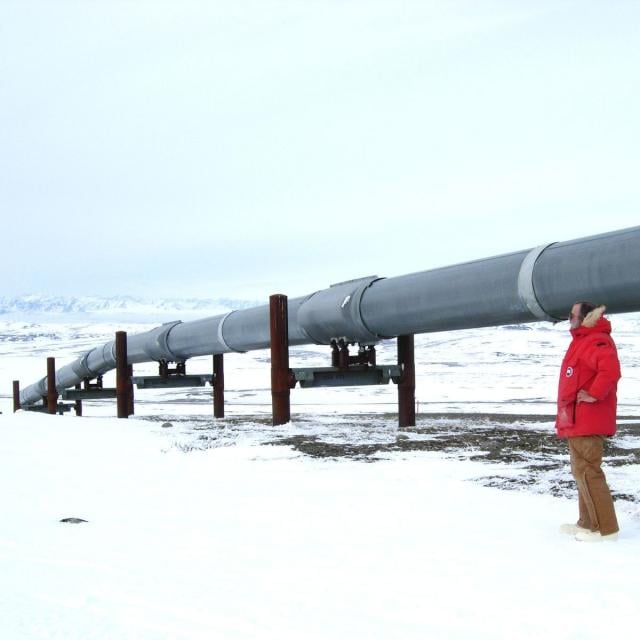
Large areas of the Arctic are underlain by significant deposits of oil and natural gas. In this module, we will look at exploration and production activities by Russia, which are occurring all along its shelf seas and over many land areas, the United States along the North Slope of Alaska, the Beaufort and Chukchi Seas, Norway, where all production is offshore, as well as prospects for Arctic development by Canada and Norway.

WEEK 4
Beyond Oil and Gas
In this module, we'll first look at another big sector of the Arctic's economy - mining - using examples such as Nornickel in Russia, the Red Dog Mine and gold mining in Alaska, diamond mining in Canada, and coal mining in Svalbard. Attention then turns to commercial and sport fishing, and the growing tourist industry. Finally, we'll take a look at some recently emerging events in the Arctic.

Go to Class
MOOC List is learner-supported. When you buy through links on our site, we may earn an affiliate commission.

Related Courses

Economics of Money and Banking (Coursera) Coursera
Columbia University

Economics of Money and Banking (Coursera)

The last three or four decades have seen a remarkable evolution in the institutions that comprise the modern monetary system. The financial crisis of 2007-2009 is a wakeup call that we need a similar evolution in the analytical apparatus and theories that we use to understand that system. Produced and sponsored by the Institute for New Economic Thinking, this course is an attempt to begin the process of new economic thinking by reviving and updating some forgotten traditions in monetary thought that have become newly relevant.

Jun 8th 2026
13-24 Weeks
Social and Economic Networks: Models and Analysis (Coursera) Coursera
Stanford University

Social and Economic Networks: Models and Analysis (Coursera)

Learn how to model social and economic networks and their impact on human behavior. How do networks form, why do they exhibit certain patterns, and how does their structure impact diffusion, learning, and other behaviors? We will bring together models and techniques from economics, sociology, math, physics, statistics and computer science to answer these questions.

Jun 8th 2026
5-12 Weeks
Sharing Cities: Governance and Urban Sustainability (Coursera) Coursera
Lund University

Sharing Cities: Governance and Urban Sustainability (Coursera)

How can we govern the sharing economy in our cities? This course connects the sharing economy, cities, governance and urban sustainability to provide unique knowledge and insights into sharing cities. We utilize a diversity of leading examples of the emerging sharing economy in cities to bring this course to life. The sharing economy can contribute to social, environmental and economic sustainability, and sharing cities can unlock new opportunities and solve urban challenges by facilitating and applying the sharing economy in urban contexts. But it is imperative that the sharing economy is shaped and designed to advance urban sustainability.

Jun 8th 2026
5-12 Weeks
Réussir le Changement (Coursera) Coursera
ESSEC Business School

Réussir le Changement (Coursera)

L'accélération de l'environnement socio-économique conduit les entreprises à multiplier les projets de changement (nouveaux produits, applications digitales, optimisation des coûts, nouvelles organisationnelles, etc.). Le changement n'est plus un phénomène conjoncturel mais permanent. Le changement est devenu un objet gestionnaire avec des méthodologies, des outils et des compétences. La compétence en conduite du changement se développe dans les cabinets de conseil et en interne dans les entreprises. Consultants, chefs de projet, experts du changement, acteurs de la fonction RH et tous les managers doivent se doter d'une compétence en conduite du changement pour réaliser les nombreuses transformations que les entreprises et les administrations ont à mener.

Jun 8th 2026
5-12 Weeks
Sustainable Tourism – promoting environmental public health (Coursera) Coursera
University of Copenhagen

Sustainable Tourism – promoting environmental public health (Coursera)

The MOOC introduces learners to key environmental health and natural resources management challenges associated with the rapid growth in international tourist arrivals into low-income countries. Since infrastructural and regulatory capacities in such countries are often limited they are more exposed to the negative implications of such development. The MOOC will present experiences and potential avenues to develop a more sustainable form of tourism.

Jun 8th 2026
3 Weeks
Economics: Society, Markets, and [In]equality (Coursera) Coursera
Parsons School of Design, The New School

Economics: Society, Markets, and [In]equality (Coursera)

Thinking critically about today's economy can help you understand the world around you. Economics: Society, Markets, and [In]equality will pique your curiosity and inspire you to learn more about the power dynamics that determine how people and resources are valued, how goods move around the world, and how we manage our planet and the future.

Jun 13th 2026
5-12 Weeks
實驗經濟學 (Experimental Economics: Behavioral Game Theory) (Coursera) Coursera
National Taiwan University

實驗經濟學 (Experimental Economics: Behavioral Game Theory) (Coursera)

人是否會如同理論經濟學的預測進行決策?這門課將透過每週的課程影片以及課後作業帶你了解實驗經濟學的基本概念。每週將會有習題練習以及指定閱讀的期刊論文。你將會參與一些線上的實驗、報告論文並且互評其他同學的報告。

Jun 10th 2026
5-12 Weeks
The Power of Team Culture (Coursera) Coursera
University of Pennsylvania

The Power of Team Culture (Coursera)

Behind the success and failure of teams lies team culture. But what exactly is culture? How and why does it contribute to success and failure? In this course, you learn how to recognize aspects of team culture of which most people are typically unaware. It is often these seemingly unimportant aspects that have the greatest effect on the outcomes of group tasks. Your recognition of them enables you to form, join and lead teams more effectively.

Jun 8th 2026
5-12 Weeks
Cost and Economics in Pricing Strategy (Coursera) Coursera
University of Virginia,Boston Consulting Group - BCG

Cost and Economics in Pricing Strategy (Coursera)

How much should you charge for your products and services? Traditionally, businesses have answered this question based on the cost to produce or provide their goods and services. This course shows you the economic factors behind pricing based on cost and the pros and cons of a cost-based pricing approach. Developed at the Darden School of Business at the University of Virginia, and led by top-ranked Darden faculty and Boston Consulting Group global pricing experts, the course provides the practical and research-based models and methods you need to set prices that maximize your profits.

Jun 8th 2026
4 Weeks
Oil & Gas Industry Operations and Markets (Coursera) Coursera
Duke University

Oil & Gas Industry Operations and Markets (Coursera)

The oil and gas industry has an enormous impact on all aspects of daily life. Individuals, corporations, and national governments make financial and policy decisions based on the cost, use, and availability of these two natural resources. This two-week course looks at the two most fundamental aspects of the oil and gas industry, its operations and markets, each of which is addressed as a separate module in the course.

Jun 10th 2026
2 Weeks
Network Dynamics of Social Behavior (Coursera) Coursera
University of Pennsylvania

Network Dynamics of Social Behavior (Coursera)

How do revolutions emerge without anyone expecting them? How did social norms about same sex marriage change more rapidly than anyone anticipated? Why do some social innovations take off with relative ease, while others struggle for years without spreading? More generally, what are the forces that control the process of social evolution –from the fashions that we wear, to our beliefs about religious tolerance, to our ideas about the process of scientific discovery and the best ways to manage complex research organizations?

Jun 8th 2026
5-12 Weeks
Microeconomics: The Power of Markets (Coursera) Coursera
University of Pennsylvania

Microeconomics: The Power of Markets (Coursera)

We make economics decisions every day: what to buy, whether to work or play, what to study. We respond to markets all the time: prices influence our decisions, markets signal where to put effort, they direct firms to produce certain goods over others. Economics is all around us. This course is an introduction to the microeconomic theory of markets: why we have them, how they work, what they accomplish.

Jun 8th 2026
5-12 Weeks