EdX

Analysis and Design of Water Distribution Systems (edX)

Offered by Purdue University, PurdueX,
Analysis and Design of Water Distribution Systems (edX)

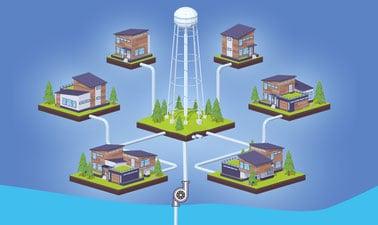
Analyze and design water distribution networks and select pumps for applications. Water distribution networks are crucial for supplying water for residential areas, hospitals, educational institutions, industrial zones, commercial areas, and for firefighting purposes.

Class Deals by MOOC List - Click here and see EdX's Active Discounts, Deals, and Promo Codes.

In this course, we will:
Review fluid properties, and fundamental hydraulics principles leading to continuity equation, energy and momentum equations. Review energy grade lines, and hydraulic grade lines.
Quantify flows through pipes and learn to design simple water distribution networks. Topics such as major and minor energy loss computations in pipe networks, and role of reservoirs, tanks, pumps, etc. in network design will be covered. MS Excel and pipe-network analysis software such as EPANET will be used to analyze pipe networks of varying complexities. Learning assessments will enable students to perform steady-state as well as extended period analyses of water distribution networks.
Select combinations of pumps to meet design needs of flow demands and pressures in water distribution networks during regular, peak, and fire demands. Develop system curves, obtain operating points for pumps, account for cavitation in pumps, analyze single pumps, multiple pumps in series and parallel, and design and select pumps. A project will provide hands-on experience in the design and selection of pumps for water distribution network.

What you'll learn

  • Analyze and design water distribution networks
  • Select and size pumps for simple water distribution system
  • Identify, formulate, and solve complex engineering problems

Syllabus

Week 1: Introduction, review of continuity, momentum and energy equations
Week 2: Friction and minor loss expressions, flow through single pipes, pipes in series and parallel
Week 3: Pipes networks
Week 4: Pump definitions, system and pump curves, operating points, and affinity laws
Week 5: Pump design and selection, pump systems

Go to Class
MOOC List is learner-supported. When you buy through links on our site, we may earn an affiliate commission.

Related Courses

Open Design (Coursera) Coursera
Duke University

Open Design (Coursera)

What is design? How is it a deeply human endeavor? How can we design better products, services, and experiences in our communities? If you’re interested in helping create a more equitable and accessible world, this Center for Computational Thinking module on Open Design is for you.

Sep 14th 2026
1 Week
Revenue Forecasting and Analysis (edX) EdX
International Monetary Fund - IMF,IMFx

Revenue Forecasting and Analysis (edX)

Presented by the IMF Fiscal Affairs Department, the course offers hands-on learning that will help students build foundational knowledge on the different quantitative models and techniques that can be used to forecast revenues and undertake tax policy analysis, while also exploring related issues such as the features of a sound institutional framework and the key principles of tax policymaking.

Self Paced
Self-Paced
Framework for Data Collection and Analysis (Coursera) Coursera
University of Maryland, College Park

Framework for Data Collection and Analysis (Coursera)

This course will provide you with an overview over existing data products and a good understanding of the data collection landscape. With the help of various examples you will learn how to identify which data sources likely matches your research question, how to turn your research question into measurable pieces, and how to think about an analysis plan.

Aug 31st 2026
4 Weeks
Enabling Technologies for Data Science and Analytics: The Internet of Things (edX) EdX
Columbia University,ColumbiaX

Enabling Technologies for Data Science and Analytics: The Internet of Things (edX)

Discover the relationship between Big Data and the Internet of Things (IoT). The Internet of Things is rapidly growing. It is predicted that more than 25 billion devices will be connected by 2020. In this data science course, you will learn about the major components of the Internet of Things and how data is acquired from sensors. You will also examine ways of analyzing event data, sentiment analysis, facial recognition software and how data generated from devices can be used to make decisions.

Self Paced
Self-Paced
Introduction to Statistics (Coursera) Coursera
Stanford University

Introduction to Statistics (Coursera)

Stanford's "Introduction to Statistics" teaches you statistical thinking concepts that are essential for learning from data and communicating insights. By the end of the course, you will be able to perform exploratory data analysis, understand key principles of sampling, and select appropriate tests of significance for multiple contexts. You will gain the foundational skills that prepare you to pursue more advanced topics in statistical thinking and machine learning.

Sep 7th 2026
5-12 Weeks
AI Materials (Coursera) Coursera
Korea Advanced Institute of Science and Technology - KAIST

AI Materials (Coursera)

Learn about the materials that have advanced the performance of artificial intelligence, and the machine learning models that could help accelerate the design and development of novel materials. This course defines artificial intelligence (AI) as a machine to which some or all of the functions of the human brain have been delegated. It highlights the need, and explains in an easy-to-understand way how machine learning from artificial intelligence can dramatically accelerate the development of new materials.

Sep 7th 2026
5-12 Weeks
Urban Ecology Design (edX) EdX
Delft University of Technology,DelftX

Urban Ecology Design (edX)

Learn how to contribute to a more biodiverse, nature-inclusive and sustainable built environment by using nature-based solutions in your designs and policies. As our urban habitats become increasingly complex, the need to address the challenges of accommodating a growing human population becomes ever more pressing. These challenges, intricately intertwined with the built environment and its wider surroundings, encompass the perils of heat stress, loss of biodiversity, land degradation, flood risks, and the urgent need to adapt to a changing climate.

Self Paced
5-12 Weeks
Graphic Design Essentials (edX) EdX
LCI Education

Graphic Design Essentials (edX)

Acquire the essential skills to become a working Graphic Designer from the basics of color theory to presenting a project to a client. This online course from LaSalle College Vancouver will introduce you to the basics of design, graphic and visual communication, image making, typography and the overall creative process, starting from the client mandate to the final presentations.

Self Paced
Self-Paced
Ergonomics in Design (edX) EdX
The Hong Kong University of Science and Technology - HKUST,HKUSTx

Ergonomics in Design (edX)

The course is designed to provide a basic understanding of ergonomics in design through the introduction of human anatomy, anthropometry, and modeling techniques with the aim of improving safety, productivity, comfort and health of people. Ergonomics is the application of scientific information about people in order to design products and systems so that they are safe, productive, comfortable and healthy for people to use.

Self Paced
Self-Paced
Human-Computer Interaction I: Fundamentals & Design Principles (edX) EdX
Georgia Institute of Technology,GTx

Human-Computer Interaction I: Fundamentals & Design Principles (edX)

Learn the principles of Human-Computer Interaction to create intuitive, usable interfaces, with established design principles like feedback cycles, direct manipulation, affordances, signifiers, and more. This course takes you through the first eight lessons of CS6750: Human-Computer Interaction as taught in the Georgia Tech Online Master of Science in Computer Science program.

Self Paced
Self-Paced
Designing an SAP Solution (Coursera) Coursera
SAP

Designing an SAP Solution (Coursera)

Designing an SAP Solution is the fourth course in the SAP Technology Consultant Professional Certificate program. The course dives into the SAP Implementation lifecycle so you can immerse yourself in the key phases, including design, pitch, and re-design. You’ll work with SAP Activate methodology and look at how to identify business requirements to determine system and data requirements. You’ll learn how to interrogate the gaps between SAP technical capabilities within Business Technology Platform and the customer’s existing environment.

Aug 31st 2026
5-12 Weeks