AI Fundamentals (Udacity)

Offered by Udacity, Microsoft Azure,
AI Fundamentals (Udacity)

Learn the AI skills top companies are looking for. This course is an entry point into the world of AI using Microsoft's cloud-based solutions, such as Azure Machine Learning and Azure Cognitive Services. You will have the chance to learn and experience firsthand how to train and deliver machine learning models and use Azure Cognitive Services for typical AI workloads such as Computer Vision, Natural Language Processing and Conversational AI.

Class Deals by MOOC List - Click here and see Udacity's Active Discounts, Deals, and Promo Codes.

AI is a growing field and as more companies are adopting these strategies, the skills gap widens and job openings skyrocket. With Udacity, you will learn the basics of AI without needing any background knowledge in AI or machine learning. This course can be a stepping stone to further AI training and a high-paying career.

What you will learn

Introduction to AI Fundamentals with Azure

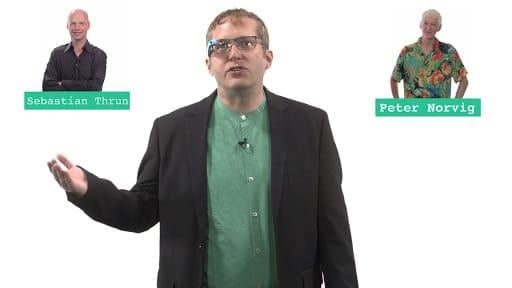
  • Meet your instructors, get an overview of the course, check out the prerequisites and get an introduction to the development of AI and ML.

AI and ML Core Concepts

  • Review the key terms and concepts related to artificial intelligence and machine learning, including responsible AI and responsible ML.

Machine Learning

  • Train and evaluate models using Azure Machine Learning, using its automated machine learning capabilities as well as the Azure Machine Learning designer.

Computer Vision

  • Use Azure Cognitive Services to handle key workloads in computer vision: object detection, image classification, face detection, text analysis and processing forms.

Natural Language Processing

  • Analyze text and speech for intent and translate text and speech between languages.

Conversational AI

  • Create a knowledge base in question-and-answer format and create a bot based off of that knowledge base.

Prerequisites and requirements
No prior experience with ML or AI is required, but a student taking this course should already:

  • Be familiar with basic concepts of linear algebra, probability and statistics
  • Be familiar with basic Python
  • Have experience setting up Azure compute resources (recommended but not required)
  • Understand basic programming skills, such as writing conditional and loop statements in any language, preferably Python
  • Have basic statistics knowledge, such as calculating standard deviation and using linear regression methods
  • Have basic knowledge of machine learning (recommended but not required)

Go to Class
MOOC List is learner-supported. When you buy through links on our site, we may earn an affiliate commission.

Related Courses

Introduction to Large Language Models with Google Cloud (Udacity) Udacity
Udacity,Google Cloud

Introduction to Large Language Models with Google Cloud (Udacity)

Learn how large language models can be utilized and how you can use prompt tuning to enhance LLM performance. This is an introductory level course that explores what large language models (LLM) are, the use cases where they can be utilized, and how you can use prompt tuning to enhance LLM performance. It also covers Google tools to help you develop your own Gen AI apps. Most students will be able to complete this course in under an hour.

Self Paced
Self-Paced
Developing AI Applications on Azure (Coursera) Coursera
LearnQuest

Developing AI Applications on Azure (Coursera)

This course introduces the concepts of Artificial Intelligence and Machine learning. We'll discuss machine learning types and tasks, and machine learning algorithms. You'll explore Python as a popular programming language for machine learning solutions, including using some scientific ecosystem packages which will help you implement machine learning.

Sep 21st 2026
5-12 Weeks
Secure and Private AI (Udacity) Udacity
Udacity,Facebook

Secure and Private AI (Udacity)

Learn how to extend PyTorch with the tools necessary to train AI models that preserve user privacy. This free course will introduce you to three cutting-edge technologies for privacy-preserving AI: Federated Learning, Differential Privacy, and Encrypted Computation. You will learn how to use the newest privacy-preserving technologies, such as OpenMined's PySyft. PySyft extends Deep Learning tools—such as PyTorch—with the cryptographic and distributed technologies necessary to safely and securely train AI models on distributed private data.

Self Paced
Self-Paced
Programming with Cloud IoT Platforms (Coursera) Coursera
Pohang University of Science and Technology - POSTECH

Programming with Cloud IoT Platforms (Coursera)

Internet of Things (IoT) is an emerging area of information and communications technology (ICT) involving many disciplines of computer science and engineering including sensors/actuators, communications networking, server platforms, data analytics and smart applications. IoT is considered to be an essential part of the 4th Industrial Revolution along with AI and Big Data.

Sep 21st 2026
5-12 Weeks
Introduction to Generative AI with Google Cloud (Udacity) Udacity
Udacity,Google Cloud

Introduction to Generative AI with Google Cloud (Udacity)

Learn what Generative AI is, how it is used, and how it differs from traditional machine learning methods. This is an introductory level course aimed at explaining what Generative AI is, how it is used, and how it differs from traditional machine learning methods. It also covers Google Tools to help you develop your own Gen AI apps. This course is estimated to take less than an hour to complete.

Self Paced
Self-Paced
Machine Learning for Accounting with Python (Coursera) Coursera
University of Illinois at Urbana-Champaign

Machine Learning for Accounting with Python (Coursera)

This course, Machine Learning for Accounting with Python, introduces machine learning algorithms (models) and their applications in accounting problems. It covers classification, regression, clustering, text analysis, time series analysis. It also discusses model evaluation and model optimization. This course provides an entry point for students to be able to apply proper machine learning models on business related datasets with Python to solve various problems.

Sep 21st 2026
5-12 Weeks
Machine Learning for All (Coursera) Coursera
University of London

Machine Learning for All (Coursera)

Machine Learning, often called Artificial Intelligence or AI, is one of the most exciting areas of technology at the moment. We see daily news stories that herald new breakthroughs in facial recognition technology, self driving cars or computers that can have a conversation just like a real person. Machine Learning technology is set to revolutionise almost any area of human life and work, and so will affect all our lives, and so you are likely to want to find out more about it.

Sep 21st 2026
4 Weeks
Deep Learning for Business (Coursera) Coursera
Yonsei University

Deep Learning for Business (Coursera)

Your smartphone, smartwatch, and automobile (if it is a newer model) have AI (Artificial Intelligence) inside serving you every day. In the near future, more advanced “self-learning” capable DL (Deep Learning) and ML (Machine Learning) technology will be used in almost every aspect of your business and industry. So now is the right time to learn what DL and ML is and how to use it in advantage of your company. This course has three parts, where the first part focuses on DL and ML technology based future business strategy including details on new state-of-the-art products/services and open source DL software, which are the future enablers.

Sep 21st 2026
5-12 Weeks
Introduction to Machine Learning Course (Udacity) Udacity
Udacity

Introduction to Machine Learning Course (Udacity)

This class will teach you the end-to-end process of investigating data through a machine learning lens. Learn online, with Udacity. Machine Learning is a first-class ticket to the most exciting careers in data analysis today. As data sources proliferate along with the computing power to process them, going straight to the data is one of the most straightforward ways to quickly gain insights and make predictions.

Self Paced
Self-Paced
Knowledge-Based AI: Cognitive Systems (Udacity) Udacity
Georgia Institute of Technology,Udacity

Knowledge-Based AI: Cognitive Systems (Udacity)

The Core of Artificial Intelligence. This is a core course in artificial intelligence. It is designed to be a challenging course, involving significant independent work, readings, assignments, and projects. It covers structured knowledge representations, as well as knowledge-based methods of problem solving, planning, decision-making, and learning.

Self Paced
Self-Paced