Advanced Styling with Responsive Design (Coursera)

Advanced Styling with Responsive Design (Coursera)

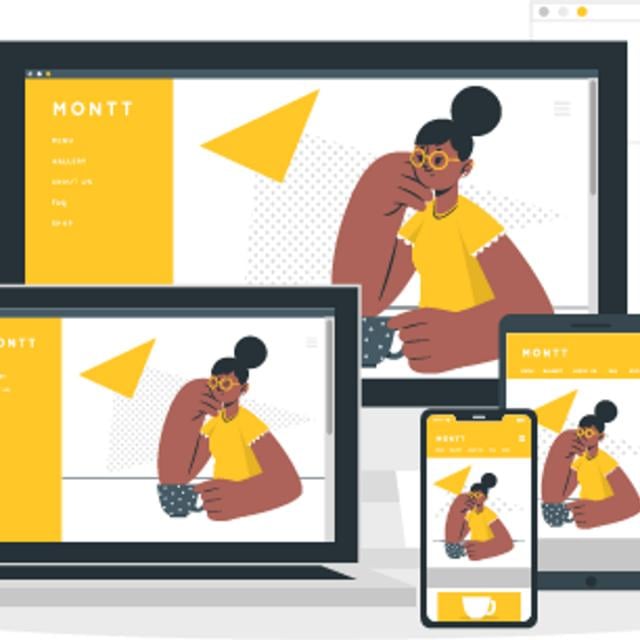
It used to be the case that everyone viewed webpages on about the same size screen. But with the explosion of the use of smartphones to access the Internet, the landscape of design has completely changed. People viewing your site will now expect that it will perform regardless of the platform (smartphone, tablet, laptop, or desktop computer). This ability to respond to any platform is called responsive design.

Class Deals by MOOC List - Click here and see Coursera's Active Discounts, Deals, and Promo Codes.

This course will expand upon the basic knowledge of CSS3 to include topics such as wireframes, fluid design, media queries, and the use of existing styling paradigms such as Bootstrap. After the course, learners will be able to:

  • Explain the mobile-first paradigm and the importance of wireframes in the design phase
  • Create sites that behave across a range of platforms
  • Utilize existing design frameworks such as Bootstrap

This is the fourth course in the Web Design For Everybody specialization. A basic understanding of HTML and CSS is expected when you enroll in this class. Additional courses focus on adding interactivity with the JavaScript Programming Language and completing a capstone project.
Course 4 of 5 in the Web Design for Everybody: Basics of Web Development & Coding Specialization.

Syllabus

WEEK 1
Style with Responsive Design
What does it mean to have responsive design for your site? How can you tell if your existing site is responsive? This week we will begin with the theories behind the "mobile-first paradigm" - the idea that your mobile site should provide everything needed, not a pared-down version of a good page. We end the week by taking the first concrete step of using fluid measurements in your CSS.

WEEK 2
Basic Concepts
This week you will get a chance to put the theories into practice using media queries in your CSS. These queries can automatically detect the size of the browser being used to view the page so that you can decide what type of look you want to achieve. There will also be a discussion on common practices for designing your different views at various screen sizes ("viewports").

WEEK 3
Use Existing Frameworks
After every good programmer has put in time creating sites from scratch, it is common to utilize existing tools out there. After all, why recreate the wheel? The work you have done up to this point will give you the knowledge needed to craft your own unique sites from these frameworks. This week we will work with Bootstrap, a framework that uses HTML5, CSS, and JavaScript (but don't worry if you have never used JavaScript yourself).

WEEK 4
Experiment!
This week is dedicated to solving those little issues that pop up when you move from theory to practice. We look at more advanced framework options and also hear from people who are using the techniques covered in this course.

Go to Class
MOOC List is learner-supported. When you buy through links on our site, we may earn an affiliate commission.

Related Courses

Introduction to HTML5 (Coursera) Coursera
University of Michigan

Introduction to HTML5 (Coursera)

Thanks to a growing number of software programs, it seems as if anyone can make a webpage. But what if you actually want to understand how the page was created? There are great textbooks and online resources for learning web design, but most of those resources require some background knowledge. This course is designed to help the novice who wants to gain confidence and knowledge. We will explore the theory (what actually happens when you click on a link on a webpage?), the practical (what do I need to know to make my own page?), and the overlooked (I have a page, what do I do now?).

Jun 22nd 2026
3 Weeks
Design Computing: 3D Modeling in Rhinoceros with Python/Rhinoscript (Coursera) Coursera
University of Michigan

Design Computing: 3D Modeling in Rhinoceros with Python/Rhinoscript (Coursera)

Why should a designer learn to code? As our world is increasingly impacted by the use of algorithms, designers must learn how to use and create design computing programs. Designers must go beyond the narrowly focused use of computers in the automation of simple drafting/modeling tasks and instead explore the extraordinary potential digitalization holds for design culture/practice.

Jun 22nd 2026
5-12 Weeks
Build Your First Android App (Project-Centered Course) (Coursera) Coursera
CentraleSupélec

Build Your First Android App (Project-Centered Course) (Coursera)

In this project-centered course, you’ll design, build, and distribute your own unique application for the Android mobile platform. We’ll provide you with a set of customizable building blocks that you can assemble to create many different types of apps, and that will help you become familiar with many important specificities of Android development. When you complete the project, in addition to having a personalized app that you can use and share, you’ll have the skills and background you need to move on to more advanced coursework in Android development.

Jun 22nd 2026
4 Weeks
Computational Thinking with Javascript 1: Draw & Animate (Coursera) Coursera
University of Glasgow

Computational Thinking with Javascript 1: Draw & Animate (Coursera)

This is the first course in a sequence of four courses that develops essential 21st century computational thinking (CT) skills using the popular JavaScript language as a vehicle. At the end of this first course you will: know a framework for CT to help you learn about it and work with others; be developing your CT skills so that you can more easily work with digital technology of all kinds; be able to read and write programs in JavaScript that involve drawing and animation, using a specialised library; and post your creations on the web so that others can appreciate your skills.

Jun 22nd 2026
4 Weeks
Introduction to VueJS Framework (Coursera) Coursera
Codio

Introduction to VueJS Framework (Coursera)

Explore HTML, CSS, and VueJS basics without installing anything! This course is designed for beginning learners, providing a solid foundation of basic skills in HTML, CSS, and VueJS. Learners will build an understanding of the creative process of designing as well. The modules in this course cover HTML basics, CSS basics, VueJS basics, as well as provide an exploratory designing experience for learners. At the end of the course, learners will fully develop a todo application using HTML, CSS, and VueJS.

Jun 22nd 2026
3 Weeks
Computational Thinking with JavaScript 3:Organise & Interact (Coursera) Coursera
University of Glasgow

Computational Thinking with JavaScript 3:Organise & Interact (Coursera)

This third course in the Computational Thinking with JavaScript specialization applies your developing JavaScript skills learned in the first two courses to the world of the web. You will learn how HTML and JavaScript together support the web pages with which we are so familiar, and develop skills so that you can create your own. As well as text presentation, at the heart of HTML, you will learn how to develop interactive, animated graphics, using JavaScript to dynamically add, remove and adjust the HTML objects on the screen.

Jun 22nd 2026
4 Weeks
The Full Stack (Coursera) Coursera
Meta

The Full Stack (Coursera)

As you prepare for your role in back-end development, practice bringing together multiple skills to build a full-stack Django app. You’ll start by setting up an environment for a local practical project, and refactoring the front and back-ends of an existing application. You will then have the opportunity to create the front and back-ends of a new application using your full-stack developer skills.

Jun 22nd 2026
5-12 Weeks
How To Create a Website in a Weekend! (Project-Centered Course) (Coursera) Coursera
The State University of New York

How To Create a Website in a Weekend! (Project-Centered Course) (Coursera)

In this project-centered course*, you’ll design, build, and publish a basic website that incorporates text, sound, images, hyperlinks, plug-ins, and social media interactivity. We’ll provide you with step-by-step instructions, exercises, tips, and tools that enable you to set up a domain name, create an attractive layout for your pages, organize your content properly, ensure that your site functions well across different operating systems and on mobile devices, keep your site safe, and finally, let people know your site is online. We’ll even show you how to track your visitors.

Jun 22nd 2026
3 Weeks
Computational Thinking with JavaScript 2: Model & Analyse (Coursera) Coursera
University of Glasgow

Computational Thinking with JavaScript 2: Model & Analyse (Coursera)

This is the second course in a sequence of four courses that develops essential 21st century computational thinking (CT) skills using the popular JavaScript programming language. At the end of this second course you will: know a framework for CT to help you model the real world using abstract data structures; have developing CT skills so that you can perform common data analytics tasks; be able to read and write programs in JavaScript that involve processing, analysing and visualizing data, using a specialised library; and post your creations on the web to share your code with others.

Jun 22nd 2026
4 Weeks
Learn HTML and CSS (Coursera) Coursera
Scrimba

Learn HTML and CSS (Coursera)

This course is perfect if you want to learn how to code websites from scratch. You will learn the basics of HTML and CSS through interactive challenges. Along the way, you will build multiple projects, like a Google.com clone, a Space Exploration page, and a fun birthday site filled with GIFs. While most of the challenges are done in Scrimba's interactive editor, you will also learn how to use professional tools like VS Code for code editing, GitHub for hosting your code, and Netlify for deploying your projects to the world wide web.

Jun 22nd 2026
5-12 Weeks