Why Do People Migrate? Part 2: Theories (iversity)

Why Do People Migrate? Part 2: Theories (iversity)

Why do people move? Which factors influence migrants' decisions? Which theories can explain migration? If you want to find the answers and learn how theories can explain real life cases: Enrol now!

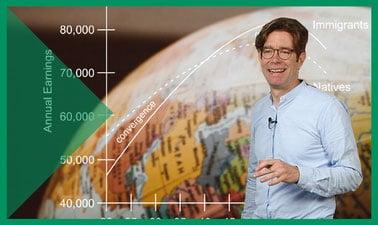
The course approaches migration as a constant phenomenon in human history and examines its main supporting theories. It illustrates theories about people's individual decisions to migrate and also the factors of migration as a structural feature of our societies. It explains the role social networks and institutions play in making people move to another country, or return to their own. Finally, it includes interviews with international experts that describe how migration theories can help to understand some topical case studies of labour migrations in the world.
The course is based on video lectures, didactic videos and podcast interviews with international experts. Assignments consist of short quizzes for each unit and a journal exercise at the end of the course. Suggestions for further reading will be included in order to achieve a more in-depth understanding.
To learn more about irregular migration and asylum seeking, check out Part 1: Facts.
At the end of the course, students will be able to:

  • identify the fundamental terminology used in theoretical debates on migration;
  • illustrate the main theoretical approaches that explain the motivations for people to move and settle outside their home countries;
  • apply main theories to the interpretation of real case studies.
Go to Class
MOOC List is learner-supported. When you buy through links on our site, we may earn an affiliate commission.

Related Courses

An Introduction to Global Health (Coursera) Coursera
University of Copenhagen

An Introduction to Global Health (Coursera)

This course will provide you with an overview of the most important health challenges facing the world today. You will gain insight into how challenges have changed over time, we will discuss the likely determinants of such changes and examine future projections. Successful international strategies and programs promoting human health will be highlighted and global health governance structures will be mapped and the role of the key actors explored.

Jun 8th 2026
5-12 Weeks
Refugees in the 21st Century (Coursera) Coursera
University of London

Refugees in the 21st Century (Coursera)

This MOOC provides insight into the refugee phenomenon as one of the most complex, compelling and (arguably) misunderstood features of the 21st century. Taking a global perspective, it will outline the fundamentals of who ‘refugees’ are, where they come from and where they go, as well as delving into the features of the global system for refugee protection and ‘solutions’ for those who have been forcibly displaced.

Jun 1st 2026
5-12 Weeks
Global Intimacies: Sex, Power, Gender and Migration (FutureLearn) FutureLearn
National Tsing Hua University

Global Intimacies: Sex, Power, Gender and Migration (FutureLearn)

Law

Study the evolution of intimacy in the context of global capitalism and probe the intersections of sex, love, labour and mobility. Explore how freedom of movement impacts sex, gender and our ideas of intimacy. In this time of global capitalism, travelling between countries for work and leisure is common. Global mobility has blurred the boundary between strangers and changed the meaning of intimacy.

May 16th 2022
4 Weeks
Teaching Migration Through Data and Storytelling (FutureLearn) FutureLearn
SOAS University of London,PositiveNegatives,MIDEQ

Teaching Migration Through Data and Storytelling (FutureLearn)

Explore how migration can be taught using both visual storytelling and big data sets. Help learners understand where, why, and how migration happens. There have been urgent recent calls for curricula to address issues of migration. Yet 78% of British teachers asked by the Runnymede Trust said they needed more support “to equip them to teach migration more sensitively and effectively.” On this course, teachers can develop their skills to explain where and why migration happens.

Dec 5th 2022
3 Weeks
Migrations Internationales : Comment les mobilités transforment les sociétés ? (FUN) FUN
Université de Liège

Migrations Internationales : Comment les mobilités transforment les sociétés ? (FUN)

Pourquoi les migrants cherchent-ils à rejoindre l’Europe ? Comment voyagent-ils jusqu’ici ? Quelles sont leurs motivations ? Comment s’intègrent-ils dans les pays de résidence ? Rentreront-ils un jour dans leur pays d’origine ? Dans ce MOOC, nous vous proposons de discuter de ces questions ensemble et vous donner les outils pour développer une réflexion critique et autonome autour de ce phénomène controversé qu’est la migration.

No sessions available
5-12 Weeks
Integrating Newly Arrived Migrant Students in Schools (SchoolEducationGateway) SchoolEducationGateway
Teacher Academy

Integrating Newly Arrived Migrant Students in Schools (SchoolEducationGateway)

The course will explore the practicalities of integrating newly arrived migrant students in a school community and will look at how teachers can work at a very practical level with such students in their classrooms. The course will continue the work started by participants in course 2 of building a support infrastructure that can assist them beyond the course with guidance and resources.

No sessions available
3 Weeks
Migration Law (edX) EdX
LouvainX,Université Catholique de Louvain - UCL

Migration Law (edX)

Law

Learn the fundamentals of Migration Law. This course analyses in a theoretical and practical way the evolution of international migration law. Who can migrate? What are the conditions to move from one country to the other? How are the numbers of migrations evolving over the recent years? Migration is both an ancient and a contemporary question, as it always existed and will never stop.

Feb 6th 2024
13-24 Weeks
Droits humains: Les droits des réfugiés (edX) EdX
Amnesty International,AmnestyInternationalX

Droits humains: Les droits des réfugiés (edX)

Agissez pour les droits humains. Ce cours vous permettra d’acquérir des connaissances sur les droits humains des personnes réfugiées et vous donnera les moyens de défendre ces droits. Aux quatre coins du globe, des barrières se dressent. Chaque jour, des personnes fuyant la guerre et les persécutions voient les portes se fermer devant eux.

No sessions available
3 Weeks
International migrations :a global issue (FUN) FUN
Sciences Po

International migrations :a global issue (FUN)

The world is moving, but not all opinions and governments are willing to accept this poorly understood reality. The issue affects both states and the planet, in a process of globalization and of regionalization of migrations, and raises new questions for international relations, now including the South. This course aims at improving knowledge of the subject, addressing the key issues raised by international migration, and assessing the trends of tomorrow.

No sessions available
5-12 Weeks
Riesgos y oportunidades empresariales en una economía globalizada (Coursera) Coursera
IE Business School

Riesgos y oportunidades empresariales en una economía globalizada (Coursera)

Oportunidades y riesgos empresariales en un mundo globalizado» es el tercer y último curso de la especialización «Globalización, crecimiento económico y estabilidad» impartido por la profesora de IE Business School Gayle Allard. En este curso, los alumnos aprovecharán los conocimientos y la teoría de sus dos cursos anteriores y los aplicarán a los eventos que actualmente suceden en el mundo. Además, puede funcionar como curso independiente para quienes quieran saber cómo afectan los factores macroeconómicos a las economías, los gobiernos y los ciudadanos en diversos países.

Jun 15th 2026
5-12 Weeks