Toledo: Deciphering Secrets of Medieval Spain (Coursera)

Toledo: Deciphering Secrets of Medieval Spain (Coursera)

This course evaluates the medieval history of Toledo from the era of the Visigoth Kingdom (6th-8th centuries) through its Islamic period (8th to 11th centuries) and into its reintegration into Christian Spain (after 1085 c.e.) In particular, we take note of the cultural and religious transformations that characterized the city with a special effort to understand how many peoples and religions came to settle and live amongst one another.

Class Deals by MOOC List - Click here and see Coursera's Active Discounts, Deals, and Promo Codes.

We will virtually-tour the Islamic and Christian structures of the Museo de Santa Cruz, Iglesia de San Román, Sinagoga del Tránsito, Mezquita de Bab al-Mardum, Archivo Municipal de Toledo, and the Archivo Historico de la Nobleza.
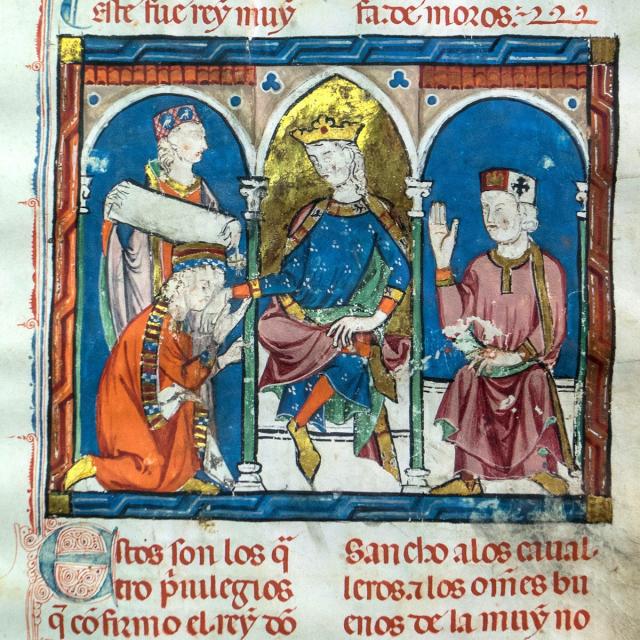
We examine the Visigoths transition from Christian Arianism to Catholicism and the harsh treatment of the Jewish population. We explore Islamic governance and development of the medieval city of three faiths, with a special interest in its cultural achievements. We will study King Alfonso “The Wise” (1252-1284)’s efforts to characterize himself as the “king of three religions” via his legal codices, the creation of the Cantigas de Santa María, and his intellectual endeavor known as the Toledo School of Translators. We evaluate the robust Jewish and converso noble families of the city and appreciate their intellectual, religious, and economic contributions to Castilian life. We will bear witness to the rise of anti-Jewish blood purity statutes, the creation of the Inquisition, and the expulsion of the Jews. We also briefly introduce and study Spanish manuscripts from the municipal and cathedral archives to make new scholarly breakthroughs relating to the Jewish, Christian, and Muslim interrelations.
No knowledge of Spanish is needed to participate in the course or in our transcription efforts.

Syllabus

Week 1
Course Introduction and an Abbreviated History
We start with a course introduction and an abbreviated history of ancient and medieval roots of the city of Toledo. This includes an introduction to medieval Europe, the Byzantine Empire, and the Islamic word.. We also explore the Visigothic Kingdom that called the city of Toledo its capital.

Week 2
Jews, Christians, and Muslims in Medieval Toledo Until 1212 CE
This week we study Jews, Christians, and Muslims in Medieval Toledo until 1212 CE. We will witness the Islamic conquest of Visigothic Spain, the formation of Islamic al-Andalus, the birth of the Christian Reconquest, and Toledo under the Umayyads and as an independent taifa ("party kingdom"). We will also explore Islamic architecture at the Museo de Santa Cruz as well as other local sites.

Week 3
Jews, Christians, and Muslims in Medieval Toledo After 1212 CE
This week we study Jews, Christians, and Muslims in Medieval Toledo and in the broader Iberian Peninsula. We will evaluate the rule of Castilian King X "The Wise" and his legal codes and the Cantigas de Santa Maria. We will also visit the Museo Sefardi and consider how "cleanliness of blood" statutes impact recent converts to Christianity (conversos).

Week 4
Introduction to Archives and Paleography
This week we begin with two visits to archives in Toledo -- the Archivo Municipal de Toledo and the Archivo Historico de la Nobleza (formerly the Archivo Historico Nacional-Seccion Nobleza). Subsequently, our manuscript studies begin with 13th through 19th century paleography (learning to read older forms of handwriting.)
Introduction to Archives and Paleography: Lesson Choices

Week 5
The SILReST Paleography Method for 15th Century Manuscripts
This week we advance our paleographic training by studying and practicing using the SILReST Paleography Method for deciphering the most challenging manuscripts.

Week 6
The Global Team at Work: Transcription & Interpretation Project
During this class, not only will you be mastering your paleography skills, but we will also begin our work as Global Citizen Scholars as we, first, work collectively and, second, independently to transcribe a collection of medieval manuscripts pertaining to Jewish, Christian, and Muslim life in Toledo.
The Global Team at Work: Transcription & Interpretation Project: Lesson Choices
Go to Class
MOOC List is learner-supported. When you buy through links on our site, we may earn an affiliate commission.

Related Courses

The Modern and the Postmodern (Part 2) (Coursera) Coursera
Wesleyan University

The Modern and the Postmodern (Part 2) (Coursera)

This course examines how the idea of "the modern" develops at the end of the 18th century in European philosophy and literature, and how being modern (or progressive, or hip) became one of the crucial criteria for understanding and evaluating cultural change. Are we still in modernity, or have we moved beyond the modern to the postmodern?

Jun 15th 2026
5-12 Weeks
Violences et religions (Coursera) Coursera
University of Geneva

Violences et religions (Coursera)

La question « violences et religions » est d’actualité, et pas seulement depuis les attentats d’Al-Qaïda ou de Daech. Pour bien la comprendre, ce cours propose de prendre du recul et de l’envisager sous un angle historique et comparatiste. Le domaine concerné étant l’espace euro-méditerranéen, ce sont essentiellement le christianisme et l’islam qui seront traités (quelques séquences sont également consacrées au judaïsme).

Jun 15th 2026
5-12 Weeks
Odesa: Jews in the Modern World (Coursera) Coursera
University of California, Santa Cruz

Odesa: Jews in the Modern World (Coursera)

In this course, Peter Kenez and Murray Baumgarten, both emeritus professors at UC Santa Cruz, tell the story of the Jews of the Black Sea port of Odesa. Kenez and Baumgarten include music, literature, and history in their analysis of a city like no other. The course is for anyone with an interest in the history and culture of the Jewish people.

Jun 15th 2026
5-12 Weeks
Reimagining Blackness and Architecture (Coursera) Coursera
The Museum of Modern Art

Reimagining Blackness and Architecture (Coursera)

Architecture structures our daily lives. It shapes our homes, streets, neighborhoods, cities and more. But who gets to create and occupy these spaces? In the United States, a long history of anti-Black racism has created spatial inequalities that are built into the physical environment and erased the stories of Black architects and communities. Reimagining Blackness and Architecture explores the relationship between architecture and Blackness as an identity and a lived experience.

Jun 15th 2026
5-12 Weeks
The Kennedy Half Century (Coursera) Coursera
University of Virginia

The Kennedy Half Century (Coursera)

When John F. Kennedy entered the presidential limousine at Love Field in Dallas, Texas on November 22, 1963, he began his ride into history. That journey continues even today and we call it the Kennedy legacy. This course will explore the Presidency, assassination, and lasting legacy of President John F. Kennedy. Students will learn how JFK’s life, administration, and tragic death have influenced the general public, the media, and each of the nine U.S. presidents who followed.

Jun 8th 2026
4 Weeks
Film, Images & Historical Interpretation in the 20th Century: The Camera Never Lies (Coursera) Coursera
University of London,Royal Holloway, University of London

Film, Images & Historical Interpretation in the 20th Century: The Camera Never Lies (Coursera)

This course is a short taster on the topic of the use of Images, Film, and their use in historical interpretation in the 20th century. It is primarily provided for those who have a general interest in history that draws on photojournalism as primary evidence, and films based on historical events.

Jun 15th 2026
5-12 Weeks
Exploring Beethoven’s Piano Sonatas Part 2 (Coursera) Coursera
Curtis Institute of Music

Exploring Beethoven’s Piano Sonatas Part 2 (Coursera)

Welcome to Part 2 of Exploring Beethoven's Piano Sonatas! I'm delighted to launch another set of new lectures of this course as Part 2. As before, this class is meant for people of all levels of experience with Beethoven's music (including no experience at all!). Remember that you are able to watch the lectures as many times as you like, at whatever pace is comfortable for you.

Jun 15th 2026
5-12 Weeks
Organising an Empire: The Assyrian Way (Coursera) Coursera
Ludwig-Maximilians-Universität München

Organising an Empire: The Assyrian Way (Coursera)

Discover the mighty kingdom of Assyria, which came to be the world’s first great empire three thousand years ago. From the 9th to the 7th centuries BC, during the imperial phase of Assyria’s long history, modern day northern Iraq was the central region of a state reaching from the Mediterranean Sea to the Persian Gulf, and incorporating what is now Iraq, Syria, and Lebanon, as well as half of Israel, and wide parts of south-eastern Turkey, and Western Iran.

Jun 15th 2026
5-12 Weeks
The Arctic as a System (Coursera) Coursera
University of Colorado Boulder

The Arctic as a System (Coursera)

In this course you will first learn about the Arctic as a geographic region, the peoples the Arctic, and the long history of Arctic settlement and exploration. Attention then turns to key features of the Arctic environment – its climate and weather, features of the ocean, sea ice, lands and the Greenland Ice Sheet, and some of the rapid changes being observed.

Jun 8th 2026
5-12 Weeks