Teaching Physical Computing to 5-11 year olds (FutureLearn)

Teaching Physical Computing to 5-11 year olds (FutureLearn)

Teach your young learners how to create electronic circuits, then learn to control them using block-based programming languages. Learn how to create physical computing projects using a Crumble or micro:bit. Physical computing is the process of designing, building, and programming systems that use physical components such as buttons, lights, and motors.

Class Deals by MOOC List - Click here and see FutureLearn's Active Discounts, Deals, and Promo Codes.

On this three-week course from the Raspberry Pi Foundation, you’ll be introduced to the world of physical computing and how it can encourage learners to use their imaginations to solve problems and develop new ideas.
You’ll learn how to support young children aged 5-11 years old as they work through physical computing projects, whilst also developing your own knowledge and skills.
Gain an understanding of inputs and outputs
On the course, you’ll build projects involving connecting both inputs and outputs to a Crumble microcontroller or a BBC micro:bit.
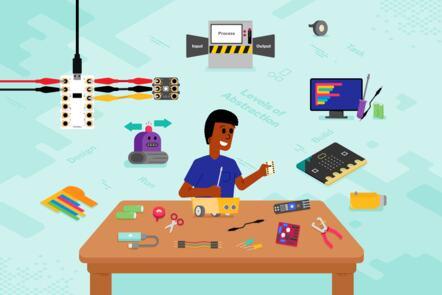
You will use inputs to pass data into the microcontroller, process that data with block-based programming languages, and use outputs to move a robot buggy or provide information to a user.
The course will help you complete several physical computing projects to develop your skills and help you understand the experiences your young learners may have. You’ll also reflect on how your projects use the programming principles of sequence, selection, and repetition.
Learn how to adapt your lessons for young learners, with Raspberry Pi
On the course, you’ll find advice from the experts at Raspberry Pi Foundation on how to make the concepts relevant to young learners.
The projects that you work on also model the use of “levels of abstraction”, a way of splitting up computing projects to help focus on individual aspects, and lower cognitive load.
At the end of the course, you’ll create your own physical computing project involving a buggy to help cement your knowledge and put what you have learned into practice.
What topics will you cover?

  • Using physical computing devices in primary school
  • Using a Crumble to light LEDs and turn motors
  • Using buttons and sensors as inputs to a Crumble
  • The programming concepts of sequence, repetition, selection, and using variables
  • Builidng a buggy with a Crumble
  • An introductino to Micro:bit

Learning on this course
You can take this self-guided course and learn at your own pace. On every step of the course you can meet other learners, share your ideas and join in with active discussions in the comments.

What will you achieve?
By the end of the course, you‘ll be able to...

  • Evaluate different commercially available physical computing tools
  • Apply your programming knowledge to control digital inputs and outputs
  • Develop physical computing projects using a Crumble microcontroller from task to completed build
  • Demonstrate how to use the micro:bit MakeCode editor and emulator
  • Design suitable physical computing projects for your learning context
  • Reflect on your learning and create ideas for your classroom practice

Who is the course for?
This course is designed for educators of all types, in schools or informal settings.
It will help you begin your physical computing journey and use physical computing to help to teach young children how to program.


Go to Class
MOOC List is learner-supported. When you buy through links on our site, we may earn an affiliate commission.

Related Courses

Child Protection for Teachers (FutureLearn) FutureLearn
Queensland University of Technology

Child Protection for Teachers (FutureLearn)

Feel empowered to protect your students by identifying and reporting signs of child abuse and neglect. Learn to identify the warning signs and indicators of child abuse and neglect. This course will enable you to recognise the signs of child abuse and neglect, and learn how maltreatment impacts on children’s learning and development. It will also help you to understand your role as a reporter.

Self Paced
2 Weeks
Teacher Training: Choosing the Right PGCE for You (FutureLearn) FutureLearn
Coventry University

Teacher Training: Choosing the Right PGCE for You (FutureLearn)

Find the right path into teaching for you and get the chance to build the confidence and skills you need for working in teaching. Explore what it takes to become a teacher – and the skills you need to get there. This course aims to develop your understanding of the teaching sector and identify and improve upon the skills you need to become a great teacher.

Self Paced
2 Weeks
Genomics for Educators (FutureLearn) FutureLearn
Wellcome Connecting Science

Genomics for Educators (FutureLearn)

Learn strategies and techniques for teaching genomics in and outside of the classroom to create enriching learning opportunities. Discover the importance of incorporating genomics into your curriculum. This three-week course from Wellcome Connecting Science will help you understand the benefits of teaching genomics and gain confidence in genomics education.

Self Paced
3 Weeks
Teaching English Online (FutureLearn) FutureLearn
Cambridge Assessment English

Teaching English Online (FutureLearn)

Learn how to transfer your teaching skills to an online context and start teaching English online. Become an expert online English teacher. Is it time for a new online direction in your teaching career? Join our 4-week course to learn how to adapt your face-to-face teaching skills to an online environment. Teaching English online is now becoming increasingly important all over the world, giving learners and teachers flexibility to work and learn wherever they want in the world.

Self Paced
4 Weeks
Innovative Teaching: Engaging Adult Learners with Active Learning (FutureLearn) FutureLearn
University of Padova

Innovative Teaching: Engaging Adult Learners with Active Learning (FutureLearn)

Discover the power of active participation in adult learning, encouraging teamwork and collaboration among students. Explore the power of teaching and how interactive learning can aid the classroom. Active learning is the leading innovative teaching approach in education today. It encourages teachers to foster a more student-centred, interactive and participatory approach to learning.

Self Paced
4 Weeks
Exploring Teaching and Assessments for Higher Education (FutureLearn) FutureLearn
Coventry University

Exploring Teaching and Assessments for Higher Education (FutureLearn)

Discover new approaches to teaching and assessing students and understand how to effectively support their learning. Invigorate your teaching, learning, and assessment practices. On this two-week course from Coventry University, you will have the opportunity to explore evidence-based theories, methods, and concepts to critique and enhance your practice for the dynamic higher education environment.

Sep 2nd 2024
2 Weeks
Train the Trainer: Design Genomics and Bioinformatics Training (FutureLearn) FutureLearn
Wellcome Connecting Science

Train the Trainer: Design Genomics and Bioinformatics Training (FutureLearn)

Discover how to plan and design engaging learning for those wanting to generate and analyse genomic data. Explore techniques for genomics training. Genomics and bioinformatics is a growing area of research with important practical implications for sectors as diverse as healthcare, food production, and environmental research. On this course, you’ll learn how to train students, peers, professionals, and future experts in genomic techniques, and come away able to plan and design engaging lessons for adult learners.

Self Paced
3 Weeks
Getting Started with Teaching Data Science in Schools (FutureLearn) FutureLearn
University of Glasgow

Getting Started with Teaching Data Science in Schools (FutureLearn)

Learn the basics of data science and how to introduce data science in the classroom. Learn practical ways to teach data science. Understanding how to use and interpret data will be essential for the next generation, but many schools and teachers aren’t equipped to teach basic data science to students. This course will help you introduce data science in the classroom so that your students are prepared for the future.

Self Paced
3 Weeks
Software Development Basics (FutureLearn) FutureLearn
FutureLearn

Software Development Basics (FutureLearn)

Learn the basics of HTML code, gain expert insights into web development, and decide if the industry is right for you. Kick-start your career in web-based software development. The web design and development industry is growing exponentially and offers several exciting employment opportunities. Many people perceive this field as too complex, assume they won’t understand the material and therefore don’t consider it as a viable job prospect.

Self Paced
4 Weeks
Using Film to Teach Literacy Online and in the Classroom (FutureLearn) FutureLearn
The British Film Institute - BFI,INTO FILM

Using Film to Teach Literacy Online and in the Classroom (FutureLearn)

Explore the inspiring ways in which film can be used to deliver literacy learning for school students. Discover how to improve literacy using film. On this online course, you’ll identify how you can use film as a key tool to deliver literacy lessons, whether online or in the classroom, with your pupils.

Self Paced
2 Weeks
Computer Programming for Everyone (FutureLearn) FutureLearn
University of Leeds,Institute of Coding

Computer Programming for Everyone (FutureLearn)

Discover the art of computer programming and learn what code can do with the Institute of Coding and the University of Leeds. Explore computer programming and complete block-language programming exercises. What are computers good at and how can you get the best out of them? On this course, you’ll find out how and why people program computers.

Self Paced
2 Weeks
Clinical Supervision: Teaching and Facilitating Learning (FutureLearn) FutureLearn
University of East Anglia

Clinical Supervision: Teaching and Facilitating Learning (FutureLearn)

Create a conducive learning environment and facilitate effective learning with this online course for clinical supervisors. Help your undergraduate and postgraduate learners to learn effectively. This online course will focus on the importance of the learning environment for teaching and facilitating learning among undergraduate and postgraduate learners.

Self Paced
3 Weeks