Software Analysis & Testing (Udacity)

Software Analysis & Testing (Udacity)

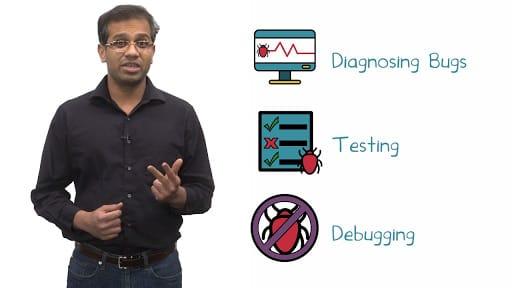
This course covers the theory and practice of software analysis, which lies at the heart of many software development processes such as diagnosing bugs, testing, debugging, and more. It presents diverse techniques, each with their own strengths and limitations, for automating tasks such as testing, debugging, and finding bugs in complex real-world programs. These techniques include dataflow analysis, constraint-based analysis, type systems, model checking, symbolic execution, and more. The course teaches the principles underlying these techniques as well as imparts hands-on experience with using and implementing tools based on these techniques.

Class Deals by MOOC List - Click here and see Udacity's Active Discounts, Deals, and Promo Codes.

Take this course if you need to learn how to test complex, large-scale programs using state of the art testing paradigms.

What You Will Learn

LESSON 1
Testing

  • Principles of random testing.
  • Automatically generating tests.

LESSON 2
Analysis

  • Analyzing dataflows within a program.
  • Analyzing pointers.
  • Analyzing software based on constraints.

LESSON 3
Debugging

  • Basics of type systems.
  • Statistical principles of debugging.
  • Dynamic symbolic execution.

Prerequisites and Requirements
To be prepared for this course, you should be very comfortable with:

  • Mathematical and logical reasoning (e.g. basics of set theory, graph theory, boolean algebra, and probability)
  • Programming in a high-level language like Java
  • Shell scripting on Linux-like operating systems
Go to Class
MOOC List is learner-supported. When you buy through links on our site, we may earn an affiliate commission.

Related Courses

Avatar Psychology for Designers (Coursera) Coursera
Michigan State University

Avatar Psychology for Designers (Coursera)

This course covers the latest and greatest psychological research on avatars and is relevant to current and future designers of any medium that includes user self-representations (e.g., video games, virtual worlds, robots, automobiles, social media, etc.). By taking this course, you will be able to define digital and non-digital avatars and identify how they are applicable in everyday life.

Aug 3rd 2026
4 Weeks
Responsive Images (Udacity) Udacity
Udacity,Google

Responsive Images (Udacity)

Fewer Bytes, Faster Loads. Did you know that images account for more than 60% of the bytes on average needed to load a web page? In this course you will learn how to work with images on the modern web, so that your images look great and load quickly on any device. Along the way, you will pick up a range of skills and techniques to smoothly integrate responsive images into your development workflow. By the end of the course, you will be developing with images that adapt and respond to different viewport sizes and usage scenarios.

Self Paced
Self-Paced
Introduction to .NET Core (Coursera) Coursera
Board Infinity

Introduction to .NET Core (Coursera)

This course is an introductory-level course for software developers who want to learn the basics of developing applications with .NET Core. .NET Core is a cross-platform, open-source development platform that allows developers to create applications for Windows, Linux, and macOS. Throughout this course, students will learn the fundamental concepts of .NET Core, including its architecture, programming model, and tools. They will also learn how to create, build, and deploy applications using .NET Core.

Aug 10th 2026
3 Weeks
Capstone: Autonomous Runway Detection for IoT (Coursera) Coursera
EIT Digital

Capstone: Autonomous Runway Detection for IoT (Coursera)

The students will develop a larger system using the learning outcomes from these courses, and the students will evaluate the developed system in a real-world programming environment. This course is a true engineering task in which the student must, not only implement the algorithm code, but also handle the interfaces between many different actors and hardware platforms.

Aug 10th 2026
3 Weeks
AI for Efficient Programming: Harnessing the Power of LLMs (Coursera) Coursera
Fred Hutchinson Cancer Center

AI for Efficient Programming: Harnessing the Power of LLMs (Coursera)

This course on Artificial Intelligence (AI) for software development explores the use of AI large language models such as ChatGPT, Bard, and others and their potential benefits and challenges. Through examples and hands-on activities, you will develop an understanding of the ways in which AI can speed up software development tasks and free up time for more creative and strategic work.

Aug 10th 2026
4 Weeks
Quantitative Model Checking (Coursera) Coursera
EIT Digital

Quantitative Model Checking (Coursera)

The integration of ICT (information and communications technology) in different applications is rapidly increasing in e.g. Embedded and Cyber physical systems, Communication protocols and Transportation systems. Hence, their reliability and dependability increasingly depends on software. Defects can be fatal and extremely costly (with regards to mass-production of products and safety-critical systems).

Aug 10th 2026
5-12 Weeks
An Introduction to Interactive Programming in Python (Part 2) (Coursera) Coursera
Rice University

An Introduction to Interactive Programming in Python (Part 2) (Coursera)

This two-part course is designed to help students with very little or no computing background learn the basics of building simple interactive applications. Our language of choice, Python, is an easy-to learn, high-level computer language that is used in many of the computational courses offered on Coursera. To make learning Python easy, we have developed a new browser-based programming environment that makes developing interactive applications in Python simple.

Aug 10th 2026
4 Weeks
Data Analytics for Lean Six Sigma (Coursera) Coursera
University of Amsterdam

Data Analytics for Lean Six Sigma (Coursera)

Welcome to this course on Data Analytics for Lean Six Sigma. In this course you will learn data analytics techniques that are typically useful within Lean Six Sigma improvement projects. At the end of this course you are able to analyse and interpret data gathered within such a project. You will be able to use Minitab to analyse the data. I will also briefly explain what Lean Six Sigma is.

Aug 3rd 2026
5-12 Weeks
Software Processes and Agile Practices (Coursera) Coursera
University of Alberta

Software Processes and Agile Practices (Coursera)

This course delves into a variety of processes to structure software development. It also covers the foundations of core Agile practices, such as Extreme Programming and Scrum. Upon successful completion of this course, you will be able to: distinguish between different process models for organizing software production; gauge the applicability of process models for a software development project; apply the fundamentals of Agile software development and management practices.

Aug 3rd 2026
4 Weeks