Quantitative Model Checking (Coursera)

Offered by EIT Digital,
Quantitative Model Checking (Coursera)

The integration of ICT (information and communications technology) in different applications is rapidly increasing in e.g. Embedded and Cyber physical systems, Communication protocols and Transportation systems. Hence, their reliability and dependability increasingly depends on software. Defects can be fatal and extremely costly (with regards to mass-production of products and safety-critical systems).

Class Deals by MOOC List - Click here and see Coursera's Active Discounts, Deals, and Promo Codes.

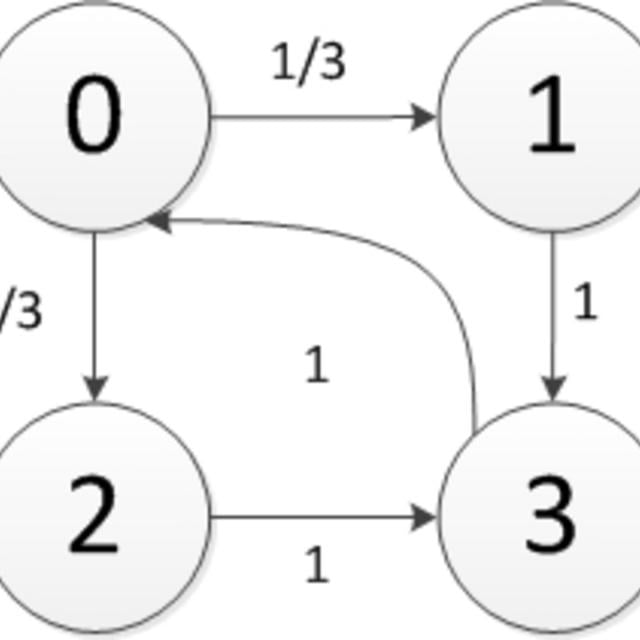
First, a model of the real system has to be built. In the simplest case, the model reflects all possible states that the system can reach and all possible transitions between states in a (labelled) State Transition System. When adding probabilities and discrete time to the model, we are dealing with so-called Discrete-time Markov chains which in turn can be extended with continuous timing to Continuous-time Markov chains. Both formalisms have been used widely for modeling and performance and dependability evaluation of computer and communication systems in a wide variety of domains. These formalisms are well understood, mathematically attractive while at the same time flexible enough to model complex systems.
Model checking focuses on the qualitative evaluation of the model. As formal verification method, model checking analyzes the functionality of the system model. A property that needs to be analyzed has to be specified in a logic with consistent syntax and semantics. For every state of the model, it is then checked whether the property is valid or not.
The main focus of this course is on quantitative model checking for Markov chains, for which we will discuss efficient computational algorithms. The learning objectives of this course are as follows:

  • Express dependability properties for different kinds of transition systems .
  • Compute the evolution over time for Markov chains.
  • Check whether single states satisfy a certain formula and compute the satisfaction set for properties.

Syllabus

WEEK 1
Module 1: Computational Tree Logic
We introduce Labeled Transition Systems (LTS), the syntax and semantics of Computational Tree Logic (CTL) and discuss the model checking algorithms that are necessary to compute the satisfaction set for specific CTL formulas.

WEEK 2
Discrete Time Markov Chains
We enhance transition systems by discrete time and add probabilities to transitions to model probabilistic choices. We discuss important properties of DTMCs, such as the memoryless property and time-homogeneity. State classification can be used to determine the existence of the limiting and / or stationary distribution.

WEEK 3
Probabilistic Computational Tree Logic
We discuss the syntax and semantics of Probabilistic Computational Tree logic and check out the model checking algorithms that are necessary to decide the validity of different kinds of PCTL formulas. We shortly discuss the complexity of PCTL model checking.

WEEK 4
Continuous Time Markov Chains
We enhance Discrete-Time Markov Chains with real time and discuss how the resulting modelling formalism evolves over time. We compute the steady-state for different kinds of CMTCs and discuss how the transient probabilities can be efficiently computed using a method called uniformisation.

WEEK 5
Continuous Stochastic Logic
We introduce the syntax and semantics of Continuous Stochastic Logic and describe how the different kinds of CSL formulas can be model checked. Especially, model checking the time bounded until operator requires applying the concept of uniformisation, which we have discussed in the previous module.
Go to Class
MOOC List is learner-supported. When you buy through links on our site, we may earn an affiliate commission.

Related Courses

Agile Planning for Software Products (Coursera) Coursera
University of Alberta

Agile Planning for Software Products (Coursera)

This course covers the techniques required to break down and map requirements into plans that will ultimately drive software production. Upon successful completion of this course, you will be able to: create effective plans for software development; map user requirements to developer tasks; assess and plan for project risks; apply velocity-driven planning techniques; generate work estimates for software products.

Aug 3rd 2026
4 Weeks
Games, Sensors and Media (Coursera) Coursera
University of California, Irvine

Games, Sensors and Media (Coursera)

You will learn to make fluid digital interactive experiences that are suitable for gaming and use the advanced sensor hardware built into the iPhone and iPad. This includes drawing 2D graphics, playing sounds and music, integrating with Game Center, the iOS physics engine and detecting device orientation and location.

Aug 3rd 2026
4 Weeks
Introduction to Computers and Office Productivity Software (Coursera) Coursera
The Hong Kong University of Science and Technology - HKUST

Introduction to Computers and Office Productivity Software (Coursera)

In this course, you will learn the following essential computer skills for the digital age: major hardware components of a computer system; different types of software on a computer system; photo Editing using GIMP; and word processing applications, including MS Word, MS Excel, and MS PowerPoint.

Aug 3rd 2026
5-12 Weeks
Principles of Computing (Part 2) (Coursera) Coursera
Rice University

Principles of Computing (Part 2) (Coursera)

This two-part course introduces the basic mathematical and programming principles that underlie much of Computer Science. Understanding these principles is crucial to the process of creating efficient and well-structured solutions for computational problems. To get hands-on experience working with these concepts, we will use the Python programming language. The main focus of the class will be weekly mini-projects that build upon the mathematical and programming principles that are taught in the class.

Aug 10th 2026
4 Weeks
Client Needs and Software Requirements (Coursera) Coursera
University of Alberta

Client Needs and Software Requirements (Coursera)

This course covers practical techniques to elicit and express software requirements from client interactions. Upon successful completion of this course, you will be able to: Create clear requirements to drive effective software development; visualize client needs using low-fidelity prototypes; maximize the effectiveness of client interactions - adapt to changing product requirements.

Aug 3rd 2026
4 Weeks
Process Mining: Data science in Action (Coursera) Coursera
Eindhoven University of Technology

Process Mining: Data science in Action (Coursera)

Process mining is the missing link between model-based process analysis and data-oriented analysis techniques. Through concrete data sets and easy to use software the course provides data science knowledge that can be applied directly to analyze and improve processes in a variety of domains. Data science is the profession of the future, because organizations that are unable to use (big) data in a smart way will not survive. It is not sufficient to focus on data storage and data analysis. The data scientist also needs to relate data to process analysis.

Jul 27th 2026
5-12 Weeks
CompTIA Exam Prep (Coursera) Coursera
LearnQuest

CompTIA Exam Prep (Coursera)

This course is geared towards anyone looking to take the CompTIA A+ certification exam. This certification focuses predominately on computer support or helpdesk. This course gives you easy access to the invaluable learning techniques used by many in their preparation of the CompTIA A+ certification exam. We’ll learn about the exam process, expectations, and tip & tricks that can be used in passing the exam. Using these approaches, regardless of your skill levels in the topics and objective areas of the exam.

Aug 3rd 2026
3 Weeks
Introduction to .NET Core (Coursera) Coursera
Board Infinity

Introduction to .NET Core (Coursera)

This course is an introductory-level course for software developers who want to learn the basics of developing applications with .NET Core. .NET Core is a cross-platform, open-source development platform that allows developers to create applications for Windows, Linux, and macOS. Throughout this course, students will learn the fundamental concepts of .NET Core, including its architecture, programming model, and tools. They will also learn how to create, build, and deploy applications using .NET Core.

Aug 10th 2026
3 Weeks