Sexing the Canvas: Art and Gender (Coursera)

Sexing the Canvas: Art and Gender (Coursera)

What do paintings tell us about sex? How is art gendered? In this course we will study some of the world’s most beloved pictures guided by expert curators and art historians who step outside of the square, bringing a gendered reading to the masterpieces contained in the magnificent collections that we have been lucky enough to bring to the Coursera platform.

Class Deals by MOOC List - Click here and see Coursera's Active Discounts, Deals, and Promo Codes.

In this course you will learn how:

  • Gender and sexuality is an integral part of the production and reception of works of art
  • To increase your understanding of paintings through theories of gender and sexuality
  • To understand key terms from gender-related theories of art history and museology
  • To recognise the operation of what is termed ‘the gaze’ and how it works in relation to paintings
  • Ideas about gender and sexuality can productively be employed in theorising art curatorial practices
  • To take the initiative in relating theoretical ideas about gender and sexuality to the reading and display of art and visual cultures.

Syllabus

WEEK 1
Tiepolo’s Cleopatra
We begin this MOOC by introducing you to some of the theories about gender and sexuality that we will be calling upon throughout this course. We will look at the tradition of the representation of women in art and the operation of the 'male gaze', which renders most female subjects passive in pictures. We will focus, in this unit, on an unusual exception to this tradition, Tiepolo's Banquet of Cleopatra at the National Gallery of Victoria, in which we see Cleopatra depicted as a powerful regent. How does Tiepolo break the rules in this painting, emphasising Cleopatra’s agency? How did Tiepolo’s facility with paint work to produce this gendered narrative? And who exactly was Cleopatra?

WEEK 2
The Culture of Sensibility and the ‘Man of Feeling’
This week we examine in detail Thomas Gainsborough’s much loved Portrait of an officer of the Fourth Regiment of Foot, the portrait of Richard St George Mansergh-St George in the collection of the National Gallery of Victoria. Here we consider how Gainsborough produced his portrait of the young soldier through the ideals associated with the culture of sensibility, so much a part of late eighteenth century ruling class culture. How is the concept of the ‘man of feeling’ utilised in Gainsborough’s enigmatic portrait? What is the relevance of Gainsborough’s focus upon the soldier’s hound? What does the picture tell us about masculinity and the way the culture of sensibility was gendered in eighteenth century Britain?

WEEK 3
Gainsborough at the Huntington
We consider five pictures by Thomas Gainsborough in week three of this course that are held in the collection of the Huntington Gallery in California, through an explication of how the artist represented his subjects in the context of the culture of sensibility. Beginning with Gainsborough’s painting of Karl Friedrich Abel, we consider how the artist produced his portrait of masculinity through references to music, science and the senses. We then move to Gainsborough’s pendant portraits of Lord and Lady Ligonier, and The Blue Boy, focussing upon boundaries of gender and sexuality, including debates around effeminacy and passion between the sexes. We conclude with the Huntington’s Cottage Door, considering how this staged scene calls the viewer to look with charity upon impoverished rural women and their children.

WEEK 4
Sexual Codes in Eighteenth Century French Courtly Painting
This week Jennifer Milam, Professor of Art History at the University of Sydney, reveals the sexual codes and symbols of art in eighteenth century French painting. Professor Milam uncovers the erotic references imbedded in the courtly art of François Boucher and Jean-Honoré Fragonard. Two pastoral paintings by François Boucher form the centrepiece of this discussion of the playful and provocative representation of gender in the Ancien Régime. In addition, Professor Milam provides an in depth account of how these codes operated in some famous prints and drawings of the period.

WEEK 5
Orientalism, Gender and Display - Painting in Morocco
This week Dr Caroline Wallace and I present a study of two artists working in Morocco in the early twentieth century; the British Royal Academy painter John Lavery and the Australian modernist Hilda Rix Nicholas. They examine how these artists used orientalist conventions to represent a European point of view of life in Morocco. In this unit we consider how colonialism, orientalism and gender relate to each other, impacting upon academic and modernist art in a variety of ways that are not immediately apparent. We discuss how orientalist art is gendered, investigating why Rix Nicholas’ practice has been described as counter-orientalist.

WEEK 6
Henri Rousseau: Challenging the Myth of the Passive Woman
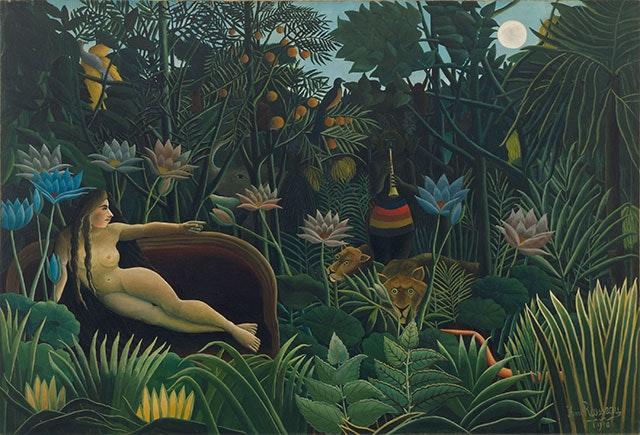
This week Professor Barbara Creed explores the way Henri Rousseau challenged the myth of the passive woman and relocates women as a vital source of creativity and mystery in art. In The Dream woman is represented as the new Eve living in harmony with nature in a jungle paradise, while in The Sleeping Gypsy woman is on an inner journey into the realms of the unconscious. Professor Creed explores the spiritual dimensions of this painting and offers a new and exciting interpretation of its historical significance.

WEEK 7
Henri Matisse, Paul Cezanne and Max Dupain - Modernism, Gender and the Science of Movement
Scientific advances in the nineteenth and early twentieth century created new ideas about male and female bodies. In a unique reading of Henri Matisse's Dance and Paul Cezanne's The Bather, we consider how Darwinian theory and science impacted upon the work of these French modernists and how modernism itself undercut erotic codes in art. Dr Isobel Crombie, Senior Curator of Photography at the National Gallery of Victoria, interprets the representation of gender in the work of the Australian photographer Max Dupain as an expression of the twentieth century movement of vitalism.

WEEK 8
Frida Kahlo, Glyn Philpot and the Struggle to Paint
This week we begin by looking at Frida Kahlo’s Fulang-Chang and I as well as her Self-Portrait with Cropped Hair Canvas. These lectures on Frida Kahlo's pictures at MOMA finish with a discussion between myself and Redmond Barry Distinguished Professor Barbara Creed in which we consider WJT Mitchell 's famous question 'what do pictures want? This is followed by a video on Glyn Philpot’s Oedipus presented by Dr Ted Gott, Senior Curator of International Art at the National Gallery of Victoria.

WEEK 9
What is Women’s Business? Indigenous Art and the Dreaming
National Gallery of Victoria Senior Curator of Indigenous Art, Judith Ryan, takes us deep into the Dreaming of the Australian Indigenous tradition. She examines in detail the making of two masterpieces by women artists from the Australian outback; Emily Kam Kngwarray's Big Yam Dreaming and Martumili artists’ Ngayartu Kujarra. In this unit we look at these iconic works in the context of ‘women's business’ and the gendered stories of indigenous Australia.

Go to Class
MOOC List is learner-supported. When you buy through links on our site, we may earn an affiliate commission.

Related Courses

ART of the MOOC: Activism and Social Movements (Coursera) Coursera
Duke University,Creative Time

ART of the MOOC: Activism and Social Movements (Coursera)

This course is for activists, artists, and thinkers who wish to better understand and participate in social change. We will focus on the prolific and exciting overlap between socially engaged art and cultural practices generated by recent social movements around the world. Rather than assess the political efficacy of activities like mourning, listening, organizing, dancing, or partying, the lectures examine such cultural activities next to, and within, contemporary art practice.

Jun 22nd 2026
5-12 Weeks
Space is Everywhere (Coursera) Coursera
University of Colorado Boulder

Space is Everywhere (Coursera)

You are here! Welcome to Course 4 - Space is Everywhere and the last course of this specialization. You are on the final stretch of this journey to finding your Pathway to Space. The topics of Course 4 span four weeks and nine lessons with 36 learning objectives. This course contains some of my most favorite aha moments in the the entire specialization. I hope that you find them and that they impact you in a positive way. We will discuss how space is communicated through news, art, movies, books, music and more. Space is everywhere in our lives and therefore everyone can be involved in it. So keep up the pace. You can do this. Your reward awaits you, finding your pathway to space.

Jun 22nd 2026
4 Weeks
What Is Contemporary Art? (Coursera) Coursera
The Museum of Modern Art

What Is Contemporary Art? (Coursera)

What is contemporary art? In this course, you’ll consider this question through more than 70 works of art made between 1980 and the present, with a focus on art from the past decade. You’ll hear directly from artists, architects, and designers from around the globe about their creative processes, materials, and inspiration.

Jun 22nd 2026
5-12 Weeks
Gender Equality (Coursera) Coursera
University of Western Australia

Gender Equality (Coursera)

Many countries are signing up to international conventions on gender equality and social inclusion to demonstrate their commitment to equal access to education, health, and social protection. In this course, you will learn what is meant by gender equality, why it is important, and how legal frameworks are used to develop inclusive policies and action plans in both developed and developing countries.

Jun 22nd 2026
4 Weeks
Specialty Topics: Biology Across Disciplines (Coursera) Coursera
University of Colorado Boulder

Specialty Topics: Biology Across Disciplines (Coursera)

In this course, we will explore the applicability and relationship of biology to the arts, business, and psychology. First, we’ll discuss art as a foundational practice to biology and how biology as a science can explain how we interact with the arts, in particular, our experiences making and listening to music. Next, we will discuss the business of biology and how research is funded and the process of clinical trials and human subjects research.

Jun 22nd 2026
5-12 Weeks
World Design for Video Games (Coursera) Coursera
California Institute of the Arts

World Design for Video Games (Coursera)

Start creating your world. A game world is not just a backdrop for your game—be it minimal or detailed, contained or part of a much bigger universe, it provides the context for your player. Ultimately, a game world should feel alive and wholly unique to any player who will experience it. In this course, we will explore game worlds in existing games and study the art and influences that inform their themes and styles. We will also investigate key components of environment and level design as well as strategies designers use to define gameplay or advance it. We’ll also look at navigation and the elements that make your world as real (or unreal) as you want it to be.

Jun 15th 2026
4 Weeks
Sports and Society (Coursera) Coursera
Duke University

Sports and Society (Coursera)

Sports play a giant role in contemporary society worldwide. But few of us pause to think about the larger questions of money, politics, race, sex, culture, and commercialization that surround sports everywhere. This course draws on the tools of anthropology, sociology, history, and other disciplines to give you new perspectives on the games we watch and play.

Jun 15th 2026
5-12 Weeks
Photography Techniques: Light, Content, and Sharing (Coursera) Coursera
Michigan State University

Photography Techniques: Light, Content, and Sharing (Coursera)

Welcome to Course FOUR! In Modules 1-4 you will cover the final elements of the Specialization necessary to round out this introduction to the fundamentals of Photography, and prepare you for creating your own exciting project in the Capstone! You have come a long way since the beginning of this journey from Smartphone Basics to DSLR and Beyond. Just think of all the information you have absorbed and put to use in your assignments and quizzes, and the confidence you have gained that you CAN control the camera to make pictures you are proud to share.

Jun 15th 2026
4 Weeks
ART of the MOOC: Arte Público y Pedagogía (Coursera) Coursera
Duke University,Creative Time

ART of the MOOC: Arte Público y Pedagogía (Coursera)

Los alumnos de este curso aprenderán a hacer sus propias obras de arte social y público si así lo desean, o podrán simplemente estudiar la teoría e historia reciente del medio. Diseñado por el artista y profesor de Duke, Pedro Lasch, e impartido con el director artístico de Creative Time, Nato Thompson, este curso presenta el arte y la cultura pública en sus formas contemporáneas radicalmente re-inventadas. Las conferencias enlazan acontecimientos claves de las últimas décadas en este campo con temas más amplios como la política espacial, estructuras sociales cotidianas y la educación experimental.

Jun 22nd 2026
5-12 Weeks
Music and Social Action (Coursera) Coursera
Yale University

Music and Social Action (Coursera)

What is a musician’s response to the condition of the world? Do musicians have an obligation and an opportunity to serve the needs of the world with their musicianship? At a time of crisis for the classical music profession, with a changing commercial landscape, a shrinking audience base, and a contraction in the number of professional orchestras, how does a young musician construct a career today? Are we looking at a dying art form or a moment of reinvigoration?

Jun 15th 2026
5-12 Weeks
Plagues, Witches, and War: The Worlds of Historical Fiction (Coursera) Coursera
University of Virginia

Plagues, Witches, and War: The Worlds of Historical Fiction (Coursera)

A unique and exciting introduction to the genre and craft of historical fiction, for curious students, aspiring authors--anyone with a passion for the past. Read classics of the genre, encounter bestselling writers of historical fiction, and discover your own historical archive while interacting with a global community of interested readers.

Jun 22nd 2026
5-12 Weeks