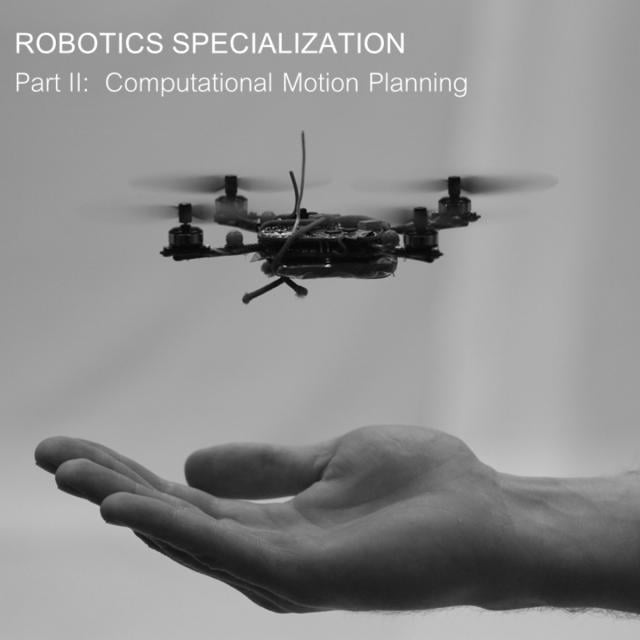
Robotics: Computational Motion Planning (Coursera)

Robotics: Computational Motion Planning (Coursera)

Robotic systems typically include three components: a mechanism which is capable of exerting forces and torques on the environment, a perception system for sensing the world and a decision and control system which modulates the robot's behavior to achieve the desired ends. In this course we will consider the problem of how a robot decides what to do to achieve its goals.

Class Deals by MOOC List - Click here and see Coursera's Active Discounts, Deals, and Promo Codes.

This problem is often referred to as Motion Planning and it has been formulated in various ways to model different situations. You will learn some of the most common approaches to addressing this problem including graph-based methods, randomized planners and artificial potential fields. Throughout the course, we will discuss the aspects of the problem that make planning challenging.

Course 2 of 6 in the Robotics Specialization.

Syllabus

WEEK 1
Introduction and Graph-based Plan Methods
Welcome to Week 1! In this module, we will introduce the problem of planning routes through grids where the robot can only take on discrete positions. We can model these situations as graphs where the nodes correspond to the grid locations and the edges to routes between adjacent grid cells. We present a few algorithms that can be used to plan paths between a start node and a goal node including the breadth first search or grassfire algorithm, Dijkstra’s algorithm and the A Star procedure.

WEEK 2
Configuration Space
Welcome to Week 2! In this module, we begin by introducing the concept of configuration space which is a mathematical tool that we use to think about the set of positions that our robot can attain. We then discuss the notion of configuration space obstacles which are regions in configuration space that the robot cannot take on because of obstacles or other impediments. This formulation allows us to think about path planning problems in terms of constructing trajectories for a point through configuration space. We also describe a few approaches that can be used to discretize the continuous configuration space into graphs so that we can apply graph-based tools to solve our motion planning problems.

WEEK 3
Sampling-based Planning Methods
Welcome to Week 3! In this module, we introduce the concept of sample-based path planning techniques. These involve sampling points randomly in the configuration space and then forging collision free edges between neighboring sample points to form a graph that captures the structure of the robots configuration space. We will talk about Probabilistic Road Maps and Randomly Exploring Rapid Trees (RRTs) and their application to motion planning problems.

WEEK 4
Artificial Potential Field Methods
Welcome to Week 4, the last week of the course! Another approach to motion planning involves constructing artificial potential fields which are designed to attract the robot to the desired goal configuration and repel it from configuration space obstacles. The robot’s motion can then be guided by considering the gradient of this potential function. In this module we will illustrate these techniques in the context of a simple two dimensional configuration space.

Go to Class
MOOC List is learner-supported. When you buy through links on our site, we may earn an affiliate commission.

Related Courses

Modern Robotics, Course 5: Robot Manipulation and Wheeled Mobile Robots (Coursera) Coursera
Northwestern University

Modern Robotics, Course 5: Robot Manipulation and Wheeled Mobile Robots (Coursera)

Do you want to know how robots work? Are you interested in robotics as a career? Are you willing to invest the effort to learn fundamental mathematical modeling techniques that are used in all subfields of robotics? If so, then the "Modern Robotics: Mechanics, Planning, and Control" specialization may be for you. This specialization, consisting of six short courses, is serious preparation for serious students who hope to work in the field of robotics or to undertake advanced study. It is not a sampler.

Jun 22nd 2026
4 Weeks
Predictive Modeling and Machine Learning with MATLAB (Coursera) Coursera
MathWorks

Predictive Modeling and Machine Learning with MATLAB (Coursera)

In this course, you will build on the skills learned in Exploratory Data Analysis with MATLAB and Data Processing and Feature Engineering with MATLAB to increase your ability to harness the power of MATLAB to analyze data relevant to the work you do. These skills are valuable for those who have domain knowledge and some exposure to computational tools, but no programming background.

Jun 22nd 2026
4 Weeks
Digitalisation in the Aerospace Industry (Coursera) Coursera
Technische Universität München - TUM

Digitalisation in the Aerospace Industry (Coursera)

The online course Digitalisation in Aerospace aims at making you aware of special production requirements connected with digitalisation. You will learn about the role of robotics and automation in manufacturing and gain a better understanding of differing perspectives on research and manufacturing as well as the points where these intersect.

Jun 15th 2026
3 Weeks
Fundamentals of Robotics & Industrial Automation (Coursera) Coursera
L&T EduTech

Fundamentals of Robotics & Industrial Automation (Coursera)

The "Fundamentals of Robotics & Industrial Automation" course is tailored to provide a comprehensive understanding of essential concepts and practical skills necessary for excelling in the field of collaborative robotics. Through three dynamic modules, participants will explore the intricacies of sensors & transducers in machine tools & robots, servo systems, and interfacing and simulation techniques.

Jun 22nd 2026
3 Weeks
Dynamical Modeling Methods for Systems Biology (Coursera) Coursera
Icahn School of Medicine at Mount Sinai

Dynamical Modeling Methods for Systems Biology (Coursera)

An introduction to dynamical modeling techniques used in contemporary Systems Biology research. We take a case-based approach to teach contemporary mathematical modeling techniques. The course is appropriate for advanced undergraduates and beginning graduate students. Lectures provide biological background and describe the development of both classical mathematical models and more recent representations of biological processes. The course will be useful for students who plan to use experimental techniques as their approach in the laboratory and employ computational modeling as a tool to draw deeper understanding of experiments.

Jun 15th 2026
5-12 Weeks
Introduction to Image Processing (Coursera) Coursera
MathWorks

Introduction to Image Processing (Coursera)

In this introduction to image processing, you'll take your first steps in accessing and adjusting digital images for analysis and processing. You will load, save, and adjust image size and orientation while also understanding how digital images are recognized. You will then perform basic segmentation and quantitative analysis. Lastly, you will enhance the contrast of images to make objects of interest easier to identify.

Jun 22nd 2026
4 Weeks
Data Science Project: MATLAB for the Real World (Coursera) Coursera
MathWorks

Data Science Project: MATLAB for the Real World (Coursera)

Like most subjects, practice makes perfect in Data Science. In the capstone project, you will apply the skills learned across courses in the Practical Data Science with MATLAB specialization to explore, process, analyze, and model data. You will choose your own pathway to answer key questions with the provided data. To complete the project, you must have mastery of the skills covered in other courses in the specialization. The project will test your ability to import and explore your data, prepare the data for analysis, train a predictive model, evaluate and improve your model, and communicate your results.

Jun 15th 2026
4 Weeks
Mathematics for Engineers: The Capstone Course (Coursera) Coursera
The Hong Kong University of Science and Technology - HKUST

Mathematics for Engineers: The Capstone Course (Coursera)

Mathematics for Engineers: The Capstone Course provides a capstone project for students who are completing the Mathematics for Engineers specialization. Students will first learn some basic concepts in computational fluid dynamics, and then apply these concepts to compute the fluid flow around a cylinder. Access to MATLAB online and the MATLAB grader is given to all students who enroll.

Jun 15th 2026
3 Weeks