EdX

Queuing Theory: from Markov Chains to Multi-Server Systems (edX)

Queuing Theory: from Markov Chains to Multi-Server Systems (edX)

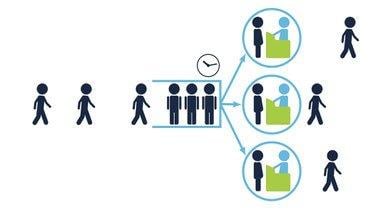
Learn key mathematical tools necessary to anticipate the performance levels of queueing systems and understand the behavior of other systems that evolve randomly over time. Situations where resources are shared among users appear in a wide variety of domains, from lines at stores and toll booths to queues in telecommunication networks. The management of these shared resourcescan have direct consequences on users,whether it be waiting times or blocking probabilities.

Class Deals by MOOC List - Click here and see EdX's Active Discounts, Deals, and Promo Codes.

In this course, you'll learn how to describe a queuing system statistically, how to model the random evolution of queue lengths over time and calculate key performance indicators, such as an average delay or a loss probability.

This course is aimed at engineers, students and teachers interested in network planning.
Practical coursework will be carried out using ipython notebooks on a Jupyterhub server which you will be given access to.
What you'll learn

  • Characterize a queue, based on probabilistic assumptions about arrivals and service times, number of servers, buffer size and service discipline
  • Describe the basics of discrete time and continuous time Markov chains
  • Model simple queuing systems, e.g. M/M/1 or M/M/C/C queues, as continuous time Markov chains
  • Compute key performance indicators, such as an average delay, a resource utilization rate, or a loss probability, in simple single-server or multi-server system
  • Design queuing simulations with the Python language to analyze how systems with limited resources distribute them between customers

Syllabus

This is a five week course :

  • Week 1 is an introduction to queuing theory. We will introduce basic notions such as arrivals and departures. Particular attention will be paid to the Poisson process and to exponential distribution, two important particular cases of arrivals and service times.
  • During week 2 we will analyze a first simple example of a no-loss queue , the so called M/M/1 queue, and we will compute its average performance metrics.
  • Week 3 will be dedicated to a basic course in discrete time Markov chains. We will learn how they are characterized and how to compute their steady-state distribution.
  • Then in week 4 we will move on to continuous time Markov chains. Again we will learn how to characterize them and how to analyze their steady-state distribution. Equipped with these tools we will then analyze the M/M/1 queue.
  • In week 5 we will study multiserver and finite capacity queues and study how to dimension a loss network.

Each week of the course will include five or six video lectures, a quiz to test your understanding of the main concepts introduced during that week and a lab using python.

Go to Class
MOOC List is learner-supported. When you buy through links on our site, we may earn an affiliate commission.

Related Courses

Introduction to Geometry (edX) EdX
School Yourself

Introduction to Geometry (edX)

Measure angles, prove geometric theorems, and discover how to calculate areas and volumes in this interactive course! More than 2000 years ago, long before rockets were launched into orbit or explorers sailed around the globe, a Greek mathematician measured the size of the Earth using nothing more than a few facts about lines, angles, and circles.

Self Paced
Self-Paced
Data Analysis: Statistical Modeling and Computation in Applications (edX) EdX
MIT,MITx

Data Analysis: Statistical Modeling and Computation in Applications (edX)

A hands-on introduction to the interplay between statistics and computation for the analysis of real data. -- Part of the MITx MicroMasters program in Statistics and Data Science. Data science requires multi-disciplinary skills ranging from mathematics, statistics, machine learning, problem solving to programming, visualization, and communication skills. In this course, learners will combine these foundational and practical skills with domain knowledge to ask and answer questions using real data.

May 13th 2024
13-24 Weeks
AP® Calculus: Challenging Concepts from Calculus AB & Calculus BC (edX) EdX
Davidson Next

AP® Calculus: Challenging Concepts from Calculus AB & Calculus BC (edX)

Master the most difficult topics in your AP® Calculus AB & Calculus BC courses. Well-respected AP instructors from around the United States will lead you through video instruction, exam-style questions and interactive activities to help you master the most challenging concepts in the AP® Calculus AB & Calculus BC curriculum.

No sessions available
13-24 Weeks
Calculus 1A: Differentiation (edX) EdX
MIT,MITx

Calculus 1A: Differentiation (edX)

Discover the derivative---what it is, how to compute it, and when to apply it in solving real world problems. Part 1 of 3. How does the final velocity on a zip line change when the starting point is raised or lowered by a matter of centimeters? What is the accuracy of a GPS position measurement? How fast should an airplane travel to minimize fuel consumption? The answers to all of these questions involve the derivative.

Jun 1st 2022
5-12 Weeks
Maths Essentials (edX) EdX
Imperial College Business School,Imperial College London

Maths Essentials (edX)

Discover and acquire the fundamental maths skills that you will need to use while studying an MBA program, from algebra to differentiation and geometric series. Planning to study for an MBA but unsure of your basic maths skills? All MBA programs, and in business generally require some maths, particularly on quantitative subjects such as Accounting, Economics and Finance.

Self Paced
Self-Paced
Fun with Prime Numbers: The Mysterious World of Mathematics (edX) EdX
Kyoto University,KyotoUx

Fun with Prime Numbers: The Mysterious World of Mathematics (edX)

Learn about prime numbers, solve math problems and explore recent discoveries and theories. Prime numbers are one of the most important subjects in mathematics. Many mathematicians from ancient times to the 21st century have studied prime numbers. In this math course, you will learn the definition and basic properties of prime numbers, and how they obey mysterious laws.

No sessions available
4 Weeks
I "Heart" Stats: Learning to Love Statistics (edX) EdX
University of Notre Dame,NotreDameX

I "Heart" Stats: Learning to Love Statistics (edX)

Is your relationship with statistics dysfunctional? We can help: Get to know stats, build a healthy bond, and maybe even fall in love! When you meet a new person, it is hard to know what to expect. You may not be able to read the person or understand what they mean. Even if you want to have a good relationship with them, this lack of understanding can make interactions tense, unpredictable and scary!

No sessions available
4 Weeks
Introduction to Engineering Mathematics with Applications (edX) EdX
University of Texas at Arlington,UTArlingtonX

Introduction to Engineering Mathematics with Applications (edX)

Learn basic engineering mathematics and how to apply basic mathematics to solve engineering problems. The goal of this mathematics course is to provide high school students and college freshmen an introduction to basic mathematics and especially show how mathematics is applied to solve fundamental engineering problems.

No sessions available
5-12 Weeks
Pre-University Calculus (edX) EdX
Delft University of Technology,DelftX

Pre-University Calculus (edX)

Prepare for Introductory Calculus courses. Mathematics is the language of Science, Engineering and Technology. Calculus is an elementary Mathematical course in any Science and Engineering Bachelor. Pre-university Calculus will prepare you for the Introductory Calculus courses by revising four important mathematical subjects that are assumed to be mastered by beginning Bachelor students: functions, equations, differentiation and integration.

Self Paced
Self-Paced
Discovery Precalculus: A Creative and Connected Approach (edX) EdX
University of Texas at Austin,UTAustinX

Discovery Precalculus: A Creative and Connected Approach (edX)

Strengthen your critical thinking skills in this inquiry-based Pre-calculus course. In this interactive pre-Calculus course, you will deepen and extend your knowledge of functions, graphs, and equations from high school algebra and geometry courses so you can successfully work with the concepts in a rigorous university-level calculus course.

No sessions available
13-24 Weeks
Calculus 1B: Integration (edX) EdX
MIT,MITx

Calculus 1B: Integration (edX)

Discover the integral---what it is and how to compute it. See how to use calculus to model real world phenomena. Part 2 of 3. How long should the handle of your spoon be so that your fingers do not burn while mixing chocolate fondue? Can you find a shape that has finite volume, but infinite surface area? How does the weight of the rider change the trajectory of a zip line ride? These and many other questions can be answered by harnessing the power of the integral.

Sep 14th 2022
13-24 Weeks