Programming for a Networked World (Coursera)

Offered by Vanderbilt University,
Programming for a Networked World (Coursera)

Want to learn the basics of computer programming in a fun and innovative way? This course introduces computer programming using an educational block-based visual programming environment called NetsBlox, emphasizing modern computer science concepts like networking, the internet, and distributed computing.

Class Deals by MOOC List - Click here and see Coursera's Active Discounts, Deals, and Promo Codes.

The curriculum is hands-on, focusing on translating ideas into working computer programs and developing a mastery of practical computational literacy. After completing this course, you will have a solid foundation to learn professional languages like Python, Java, etc.
The course is especially suitable for K12 teachers and students who want to get a gentle introduction to computer science.

What you'll learn

  • Fundamental computer programming concepts such as variables, control structures, functions and many others.
  • The basics of distributed computing and computer networking.
  • Problem solving using an accessible visual programming environment.
  • Computational thinking through hands-on projects that make programming more engaging.

Syllabus

Introduction
Module 1
Introduction to the course, to block-based programming and to the primary tool used called NetsBlox

Custom Blocks, Events and RPCs
Module 2
Introduction to custom blocks, events and Remote Procedure Calls (RPC)

Loops and Lists
Module 3
Introduction to iteration (loops), scoping variables and lists

Structured Data
Module 4
Working with multi-dimensional lists

Distributed Programming
Module 5
Introduction to distributed programming using message passing

Text Analysis
Module 6
Working with text
Go to Class
MOOC List is learner-supported. When you buy through links on our site, we may earn an affiliate commission.

Related Courses

Statistical Thinking for Industrial Problem Solving, presented by JMP (Coursera) Coursera
SAS

Statistical Thinking for Industrial Problem Solving, presented by JMP (Coursera)

Statistical Thinking for Industrial Problem Solving is an applied statistics course for scientists and engineers offered by JMP, a division of SAS. By completing this course, students will understand the importance of statistical thinking, and will be able to use data and basic statistical methods to solve many real-world problems.

Sep 21st 2026
5-12 Weeks
Programming Languages, Part C (Coursera) Coursera
University of Washington

Programming Languages, Part C (Coursera)

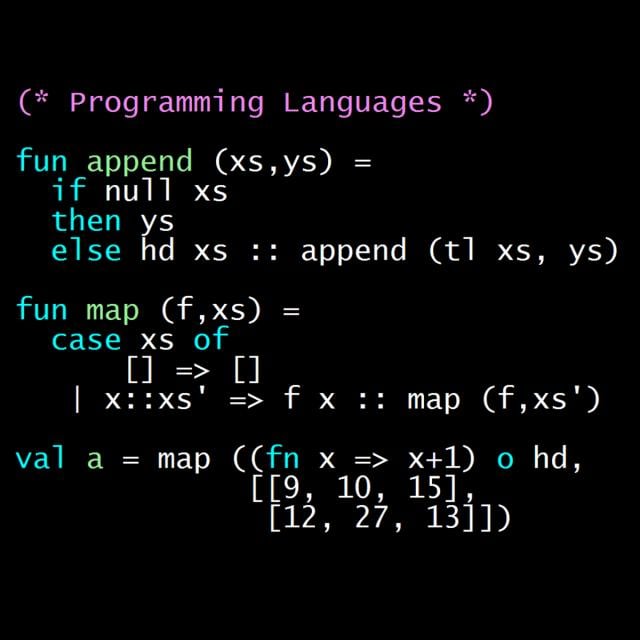
This course is an introduction to the basic concepts of programming languages, with a strong emphasis on functional programming. The course uses the languages ML, Racket, and Ruby as vehicles for teaching the concepts, but the real intent is to teach enough about how any language “fits together” to make you more effective programming in any language -- and in learning new ones.

Sep 21st 2026
3 Weeks
Programando con Java para aplicaciones Android (Coursera) Coursera
Universidad Nacional Autónoma de México

Programando con Java para aplicaciones Android (Coursera)

¡Aprende lo mejor de Java para el desarrollo en Android! Descubre lo necesario para construir tus aplicaciones móviles de una forma sencilla, objetiva y práctica. A lo largo del curso, verás diversos ejemplos para crear tu primer Hola Mundo y practicarás la programación orientada a objetos.

Sep 21st 2026
3 Weeks
Big Data Analysis with Scala and Spark (Coursera) Coursera
École Polytechnique Fédérale de Lausanne

Big Data Analysis with Scala and Spark (Coursera)

Manipulating big data distributed over a cluster using functional concepts is rampant in industry, and is arguably one of the first widespread industrial uses of functional ideas. This is evidenced by the popularity of MapReduce and Hadoop, and most recently Apache Spark, a fast, in-memory distributed collections framework written in Scala. In this course, we'll see how the data parallel paradigm can be extended to the distributed case, using Spark throughout.

Sep 14th 2026
4 Weeks
Videojuegos: ¿de qué hablamos? (Coursera) Coursera
Universitat Autònoma de Barcelona

Videojuegos: ¿de qué hablamos? (Coursera)

Probablemente, todos hemos jugado a algún videojuego, pero ¿qué hay detrás de él? Podemos decir que - con independencia del videojuego - hay un árduo trabajo multidisciplinar que incluye desde aspectos de diseño hasta la programación como tal del videojuego. Este curso pretende ser un curso introductorio que muestre qué aspectos hay que considerar en el videojuego, y que permita con posterioridad abordar individualmente los temas que se consideran nucleares: diseño, arte, motor del videojuego y 'game play'.

Sep 21st 2026
5-12 Weeks
Machine Design Part I (Coursera) Coursera
Georgia Institute of Technology

Machine Design Part I (Coursera)

“Machine Design Part I” is the first course in an in-depth three course series of “Machine Design.” The “Machine Design” Coursera series covers fundamental mechanical design topics, such as static and fatigue failure theories, the analysis of shafts, fasteners, and gears, and the design of mechanical systems such as gearboxes. Throughout this series of courses we will examine a number of exciting design case studies, including the material selection of a total hip implant, the design and testing of the wing on the 777 aircraft, and the impact of dynamic loads on the design of an bolted pressure vessel. In this first course, you will learn robust analysis techniques to predict and validate design performance and life.

Sep 14th 2026
5-12 Weeks
Algorithms, Part I (Coursera) Coursera
Princeton University

Algorithms, Part I (Coursera)

This course covers the essential information that every serious programmer needs to know about algorithms and data structures, with emphasis on applications and scientific performance analysis of Java implementations. Part I covers elementary data structures, sorting, and searching algorithms. Part II focuses on graph- and string-processing algorithms.

Sep 21st 2026
5-12 Weeks
Creative Programming for Digital Media & Mobile Apps (Coursera) Coursera
University of London,Goldsmiths, University of London

Creative Programming for Digital Media & Mobile Apps (Coursera)

This course is for anyone who would like to apply their technical skills to creative work ranging from video games to art installations to interactive music, and also for artists who would like to use programming in their artistic practice. This course will teach you how to develop and apply programming skills to creative work. This is an important skill within the development of creative mobile applications, digital music and video games. It will teach the technical skills needed to write software that make use of images, audio and graphics, and will concentrate on the application of these skills to creative projects. Additional resources will be provided for students with no programming background.

Sep 14th 2026
5-12 Weeks
VLSI CAD Part I: Logic (Coursera) Coursera
University of Illinois at Urbana-Champaign

VLSI CAD Part I: Logic (Coursera)

A modern VLSI chip has a zillion parts -- logic, control, memory, interconnect, etc. How do we design these complex chips? Answer: CAD software tools. Learn how to build thesA modern VLSI chip is a remarkably complex beast: billions of transistors, millions of logic gates deployed for computation and control, big blocks of memory, embedded blocks of pre-designed functions designed by third parties (called “intellectual property” or IP blocks). How do people manage to design these complicated chips? Answer: a sequence of computer aided design (CAD) tools takes an abstract description of the chip, and refines it step-wise to a final design.

Sep 21st 2026
5-12 Weeks