Pressure, Force, Motion, and Humidity Sensors (Coursera)

Pressure, Force, Motion, and Humidity Sensors (Coursera)

This is our third course in our specialization on Embedding Sensor and Motors. To get the most out of this course, you should first take our first course entitled Sensors and Sensor Circuits. Our first course gives you a tutorial on how to use the hardware and software development kit we have chosen for the lab exercises. This third course assumes that you already know how to use the kit.

Class Deals by MOOC List - Click here and see Coursera's Active Discounts, Deals, and Promo Codes.

After taking this course, you will be able to:
● Understand how to specify the proper AC or DC motor for a machine design.
● Integrate the motor to a machine, based on analysis of motor equations for voltage, current, torque and speed.
● Implement the motor and accompanying rotary sensor into a motor control circuit in both hardware and software.
● Add a motor and motor control circuit into a microprocessor based development kit.
● Create hardware and firmware to process motor feedback data to a microprocessor for further evaluation.
After taking this course, you will be able to:
● Understand how to specify the proper pressure, force, strain, position, motion, acceleration, occupancy, and humidity sensors for taking real-time process data.
● Implement these sensors into an embedded system in both hardware and software.
● Add the sensor and sensor interface into a microprocessor based development kit.
● Create hardware and firmware to process sensor signals and feed data to a microprocessor for further evaluation.
Course 3 of 4 in the Embedding Sensors and Motors Specialization.

What You Will Learn

  • Choose the right pressure, force, strain, position, motion, acceleration, occupancy, and humidity sensor for an application
  • Design these sensors into an embedded circuit.

Syllabus

WEEK 1
Pressure Sensors
In module 1 you will learn how to specify and use various types of pressure sensors for an embedded circuit. First, you will learn about piezoresistive, capacitive, and vacuum sensors. This includes a deep dive into the piezoresistive effect and how a Wheatstone bridge is used in these systems. This is followed by a discussion on pressure transmitters and how to calculate an error budget. Finally, we will give you examples of commercial pressure sensors and explain what you need to know to purchase them on a web site.

WEEK 2
Force and Strain Sensors and Touch Screens
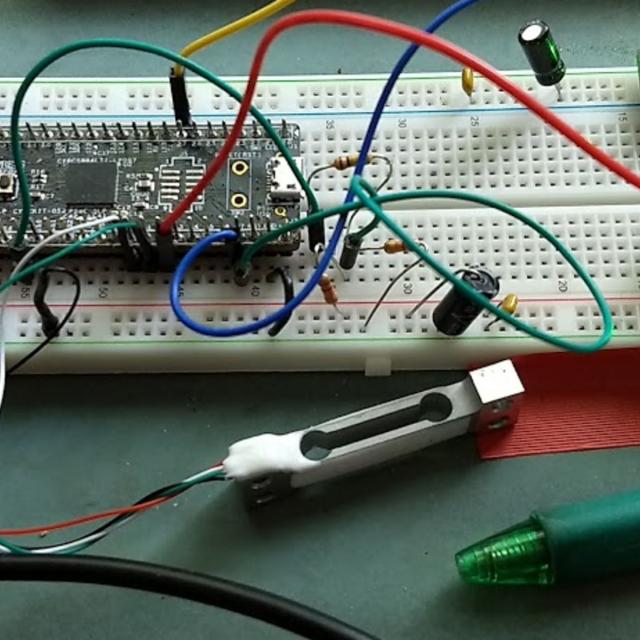
In module 2 you will learn how to specify and use various types of force and strain sensors for an embedded circuit. First, you will learn about how strain gauges use the piezoresistive effect and Wheatstone bridges to output a strain signal. Then you will learn how load cells use strain gauges to output a force signal. We have a video on a teardown of a weight scale for you to watch, where we teach you how the strain gauges are arranged in an unusual bridge circuit. Finally, we teach you about how touch screens used in kiosks, PC's and smart phones work. We have a lab exercise for you to perform on strain gauges, where you will get hands-on experience wiring the gauges into the PSoC system, and writing code to read the gauges.

WEEK 3
Position, Acceleration and Velocity Sensors
In module 3 you will first learn how magnetic detection sensors such as Hall sensors and LVDT's work, as well as how capacitive detection sensors. Then you will learn how to specify and use accelerometers in an embedded circuit. We will discuss how the first accelerometers used the piezoelectric effect to output a sinusoidal signal. We will review the key principles and equations involved in vibrational measurement. Then you will learn later accelerometers used the piezoresistive effect and internal strain gauges to output a sinusoidal signal representative of force, as opposed to acceleration. Then we will explain how accelerometers are now using MEMS technology and changes in capacitive to output the signal. We teach you about gyroscopes, both traditional mechanical ones, still used in aircraft for angular position sensing, and modern MEMS ones used to determine angular velocity.

WEEK 4
Motion, Distance and Humidity Sensors
In module 4 you will learn how to specify and use position and motion detectors in an embedded circuit. First, you will learn about the pyroelectric effect. Then you will learn how Passive Infrared motion detectors use the pyroelectric effect in commercial burglar alarms. Then you will learn how ultrasonic distance detection is accomplished, the same principles that whales, dolphins and bats use to navigate their worlds. We tackle microwave detection sensors last, as these are the most complex sensors that we cover in the course. They are used in long range position detection sensors and commercial security sensors for outdoors use.

WEEK 5
Course Projects
This module contains the materials you need to complete the Strain Gauge lab assignment.
Go to Class
MOOC List is learner-supported. When you buy through links on our site, we may earn an affiliate commission.

Related Courses

Introduction to Acoustics (Part 2) (Coursera) Coursera
Korea Advanced Institute of Science and Technology - KAIST

Introduction to Acoustics (Part 2) (Coursera)

Learners might have learned the basic concepts of the acoustics from the ‘Introduction to Acoustics (Part 1).’ Now it is time to apply to the real situation and develop their own acoustical application. Learners will analyze the radiation, scattering, and diffraction phenomenon with the Kirchhoff –Helmholtz Equation. Then learners will design their own reverberation room or ducts that fulfill the condition they have set up.

Aug 10th 2026
5-12 Weeks
Mastering Statics (Coursera) Coursera
The Hong Kong University of Science and Technology - HKUST

Mastering Statics (Coursera)

Statics is the most fundamental course in Mechanics. In this course, you will learn the conditions under which an object or a structure subjected to time-invariant (static) forces is in equilibrium - i.e. the conditions under which it remains stationary or moves with a constant velocity-. You will also learn how to calculate the reaction forces as well as the internal forces experienced throughout the structure so that later you can properly design and size the foundation and the members of the structure to assure the structure’s safety and serviceability.

Aug 10th 2026
5-12 Weeks
Sensor Manufacturing and Process Control (Coursera) Coursera
University of Colorado Boulder

Sensor Manufacturing and Process Control (Coursera)

This is our fourth course in our specialization on Embedding Sensor and Motors. To get the most out of this course, you should first take our first course entitled "Sensors and Sensor Circuits", our second course entitled "Motor and Motor Control Circuits", and our third course entitled "Pressure, Force, Motion, and Humidity Sensors". Our first course gives you a tutorial on how to use the hardware and software development kit we have chosen for the lab exercises. Our second and third courses give you three hands-on lab experiments using the kit. This third course assumes that you already know how to use the kit.

Jul 20th 2026
5-12 Weeks
Municipal Solid Waste Management in Developing Countries (Coursera) Coursera
École Polytechnique Fédérale de Lausanne

Municipal Solid Waste Management in Developing Countries (Coursera)

Have you come across large piles of garbage in neighborhoods and streets, or smelly waste disposal sites polluting the environment of low and middle income countries? Are you also convinced that improvements are necessary and do you want to know what kind of sustainable solutions are appropriate to better manage waste and enhance recycling and recovery? If yes, this course is for you!

Aug 10th 2026
5-12 Weeks
The Finite Element Method for Problems in Physics (Coursera) Coursera
University of Michigan

The Finite Element Method for Problems in Physics (Coursera)

This course is an introduction to the finite element method as applicable to a range of problems in physics and engineering sciences. The treatment is mathematical, but only for the purpose of clarifying the formulation. The emphasis is on coding up the formulations in a modern, open-source environment that can be expanded to other applications, subsequently.

Aug 10th 2026
13-24 Weeks
Silicon Thin Film Solar Cells (Coursera) Coursera
École Polytechnique

Silicon Thin Film Solar Cells (Coursera)

This course consists of a general presentation of solar cells based on silicon thin films. It is the third MOOC of the photovoltaic series of Ecole polytechnique on Coursera. The general aspects of the photovoltaic field are treated in "Photovoltaic Solar Energy". And the detailed description of the crystalline silicon solar cells can be found in "Physics of Silicon Solar Cells".

Aug 10th 2026
3 Weeks
Image and video processing: From Mars to Hollywood with a stop at the hospital (Coursera) Coursera
Duke University

Image and video processing: From Mars to Hollywood with a stop at the hospital (Coursera)

In this course, you will learn the science behind how digital images and video are made, altered, stored, and used. We will look at the vast world of digital imaging, from how computers and digital cameras form images to how digital special effects are used in Hollywood movies to how the Mars Rover was able to send photographs across millions of miles of space.

Aug 10th 2026
5-12 Weeks
Introduction to Basic Vibrations (Coursera) Coursera
Korea Advanced Institute of Science and Technology - KAIST

Introduction to Basic Vibrations (Coursera)

Introduction to Basic Vibrations starts with the fundamental principle of vibrations with a single and double degree of freedom systems. These fundamental vibration systems provide a solid platform not only to understand general vibrations but also to apply or use them into simple mechanical problems.

Aug 10th 2026
5-12 Weeks
Computers, Waves, Simulations: A Practical Introduction to Numerical Methods using Python (Coursera) Coursera
Ludwig-Maximilians-Universität München

Computers, Waves, Simulations: A Practical Introduction to Numerical Methods using Python (Coursera)

Interested in learning how to solve partial differential equations with numerical methods and how to turn them into python codes? This course provides you with a basic introduction how to apply methods like the finite-difference method, the pseudospectral method, the linear and spectral element method to the 1D (or 2D) scalar wave equation.

Aug 10th 2026
5-12 Weeks
Mécanique Lagrangienne (Coursera) Coursera
École Polytechnique Fédérale de Lausanne

Mécanique Lagrangienne (Coursera)

Le formalisme de Lagrange permet une résolution efficace de problèmes complexes de mécanique. Il permet aussi d'apporter un éclairage plus fondamental sur les lois de conservation (théorème de Noether). A titre d'illustration de la méthode de Lagrange, on traitera le problème très important des oscillateurs harmoniques couplés, exprimé comme un problème de valeurs propres et de vecteurs propres. On termine avec un formalisme permettant d'analyser les résonances paramétriques, notion illustrée par l'expérience montrant la stabilité d'un pendule inversé forcé.

Aug 10th 2026
5-12 Weeks
Renewable Energy: Fundamentals and Job Opportunities (Coursera) Coursera
University at Buffalo

Renewable Energy: Fundamentals and Job Opportunities (Coursera)

This course prepares you to recognize the complexities and nuances of different renewable energy solutions, as well as relevant career opportunities (both technical occupations and roles not typically associated with clean energy). Learners are immersed in discussions about green energy technologies, the impact of sustainability on society, energy consumption in the United States and conservation. Topics include: tenets of green building design and construction, solar energy conversion through photovoltaic cells, wind turbine site selection and design, and nanotechnology applications in clean energy.

Aug 10th 2026
5-12 Weeks