Object-oriented Programming in Python: Create Your Own Adventure Game (FutureLearn)

Object-oriented Programming in Python: Create Your Own Adventure Game (FutureLearn)

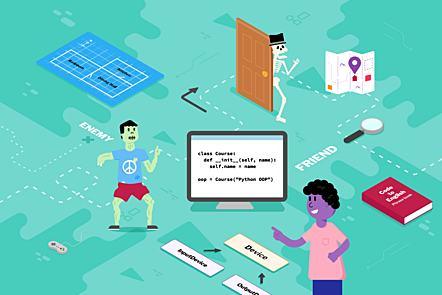
Learn object-oriented programming principles by creating your own text-based adventure game in Python. Object-oriented programming is a programming paradigm based on objects and data rather than actions and logic. This online course will introduce you to the principles of object-oriented programming in Python, showing you how to create objects, functions, methods, and classes.

Class Deals by MOOC List - Click here and see FutureLearn's Active Discounts, Deals, and Promo Codes.

You’ll use what you learn to create your own text-based adventure game. You will have the chance to share your code with other learners, and see theirs.
If you’re an educator, you’ll also be able to develop ideas for using object-oriented programming in your classroom.

What topics will you cover?

  • Introduce the principles of object-oriented programming in Python.
  • Understand the difference between a function and an object.
  • Create objects, functions, methods, and classes.
  • Write a text-based adventure game.
  • Extending other people’s classes, including inheritance and polymorphism.
  • Share your code with other learners, and see theirs.
  • Develop ideas for using object-oriented programming in the classroom.

Learning on this course
You can take this self-guided course and learn at your own pace. On every step of the course you can meet other learners, share your ideas and join in with active discussions in the comments.

What will you achieve?
By the end of the course, you'll be able to...

  • Explore using objects in programming, and understand the difference between a function and an object.
  • Develop your understanding of how writing your own class allows you to combine functions and data.
  • Demonstrate extending other people’s classes, including inheritance and polymorphism.
  • Produce a module to apply your learning of object oriented programming.
  • Collaborate by sharing your code with other people.

Who is the course for?
This course is designed for people who are already familiar with Python programming and want to learn a different programming paradigm, understand and use existing libraries more effectively, or create code which is useful to other people.
It will be particularly useful for educators and students of a post-16 qualification.

Go to Class
MOOC List is learner-supported. When you buy through links on our site, we may earn an affiliate commission.

Related Courses

Programming 103: Saving and Structuring Data (FutureLearn) FutureLearn
Raspberry Pi Foundation,National Centre for Computing Education

Programming 103: Saving and Structuring Data (FutureLearn)

Learn how to save and structure data in external files, and import files back into your Python programs. Supported by Google. Discover how to save data to use it across multiple runs of your program. On this course, you will learn how to save text and binary files, and how to structure data so that programs can interpret it correctly.

Jan 2nd 2023
3 Weeks
Big Ideas in Programming: Expressing Yourself with Python (FutureLearn) FutureLearn
University of Michigan

Big Ideas in Programming: Expressing Yourself with Python (FutureLearn)

Harness the power of Python and its programming concepts to express yourself and automate the work you do. Learn the Python basics you need to create the content and projects you want. Coding and programming allow better work performance, across diverse professions. If you want to discuss ideas with programming professionals or develop the code yourself, you need to know the basics.

Sep 27th 2021
4 Weeks
Software Development Basics (FutureLearn) FutureLearn
FutureLearn

Software Development Basics (FutureLearn)

Learn the basics of HTML code, gain expert insights into web development, and decide if the industry is right for you. Kick-start your career in web-based software development. The web design and development industry is growing exponentially and offers several exciting employment opportunities. Many people perceive this field as too complex, assume they won’t understand the material and therefore don’t consider it as a viable job prospect.

Self Paced
4 Weeks
Teaching Physical Computing to 5-11 year olds (FutureLearn) FutureLearn
Raspberry Pi Foundation,National Centre for Computing Education

Teaching Physical Computing to 5-11 year olds (FutureLearn)

Teach your young learners how to create electronic circuits, then learn to control them using block-based programming languages. Learn how to create physical computing projects using a Crumble or micro:bit. Physical computing is the process of designing, building, and programming systems that use physical components such as buttons, lights, and motors.

Mar 6th 2023
3 Weeks
Programming Pedagogy in Secondary Schools: Inspiring Computing Teaching (FutureLearn) FutureLearn
Raspberry Pi Foundation,National Centre for Computing Education

Programming Pedagogy in Secondary Schools: Inspiring Computing Teaching (FutureLearn)

Examine a range of pedagogical approaches suitable for teaching computing in Key Stage 3 (Grade 6–8 in the USA). Transform your teaching by developing your pedagogical approach. In the first two weeks of this course, you’ll be introduced to a range of pedagogical approaches suitable for Key Stage 3. You’ll look at a range of pedagogies aimed at developing your students’ computational thinking skills, from unplugged approaches to PRIMM, and more. You’ll also investigate worked examples and targeted tasks such as Parson’s Problems.

Mar 6th 2023
3 Weeks
Introduction to Data Analytics with Python (FutureLearn) FutureLearn
FutureLearn

Introduction to Data Analytics with Python (FutureLearn)

Learn the fundamentals of using Python for data analysis and develop skills in two of Python’s core libraries, Pandas and Seaborn. Build your data analytics toolkit with Python. We are in the era of ‘big data’. According to a Forbes article published in 2018, around 2.5 quintillion bytes of data were being generated each day globally. On this four-week course, created in collaboration with Tableau, you’ll gain a foundational knowledge of data science for business applications, acting as a launchpad to help you become a successful data scientist.

Self Paced
4 Weeks
Get ready for a Masters in Data Science and AI (FutureLearn) FutureLearn
Coventry University

Get ready for a Masters in Data Science and AI (FutureLearn)

Identify whether you’re ready for Master’s study, improve your data science skills, and get to grips with the basics of Python. Get a taste of life as a Data Science and AI Master's student. On this course, you’ll have the opportunity to explore the disciplines involved in a Master’s degree in Data Science and Artificial Intelligence (AI).

Apr 17th 2023
2 Weeks
Robotics With Raspberry Pi: Build and Program Your First Robot Buggy (FutureLearn) FutureLearn
Raspberry Pi Foundation,National Centre for Computing Education

Robotics With Raspberry Pi: Build and Program Your First Robot Buggy (FutureLearn)

Build and program your first robot buggy using a Raspberry Pi, learning how to connect motors, add sensors and write algorithms. Learn robotics by building a robot buggy and controlling it with a Raspberry Pi. On this course from the Raspberry Pi Foundation, you’ll build a robot buggy controlled by a Raspberry Pi.

Jan 2nd 2023
3 Weeks
Data Visualisation with Python: Bokeh and Advanced Layouts (FutureLearn) FutureLearn
FutureLearn

Data Visualisation with Python: Bokeh and Advanced Layouts (FutureLearn)

Elevate your data visualisation skills and better communicate your data insights with the data visualisation package, Bokeh. Learn how to use Bokeh in Python. On the first week of the course, you’ll explore the key functions of Bokeh and how it can be used to create interactive visualisations and dashboards.

May 30th 2022
4 Weeks
Networking with Python: Socket Programming for Communication (FutureLearn) FutureLearn
Raspberry Pi Foundation,National Centre for Computing Education

Networking with Python: Socket Programming for Communication (FutureLearn)

Discover how you can create networked applications in Python by using sockets. Supported by Google. Build your practical network application skills and understanding. On this course from the Raspberry Pi Foundation, you’ll learn how to create programs that communicate over the internet.

Mar 6th 2023
3 Weeks
Functional Programming in Haskell: Supercharge Your Coding (FutureLearn) FutureLearn
University of Glasgow

Functional Programming in Haskell: Supercharge Your Coding (FutureLearn)

Get an introduction to Haskell, the increasingly popular functional programming language, with this University of Glasgow course. Do you want to develop software using the latest programming language paradigm? Haskell is a functional programming language, based on formal mathematical principles. As such, it is easy to reason about and develop, and it executes efficiently on modern multicore machines. From investment banks to social networks, everyone is adopting Haskell.

Self Paced
5-12 Weeks
Fortran for Scientific Computing (FutureLearn) FutureLearn
Partnership for Advanced Computing in Europe - PRACE,Vlaams Supercomputer Centre

Fortran for Scientific Computing (FutureLearn)

Learn how to program in Fortran. Use object-oriented programming to design efficient and maintainable code. Discover the power of Fortran for scientific programming. Fortran is a programming language that has been designed for scientific computing, allowing users to naturally express numerical problems. On this course, you’ll discover how to express your numerical problems as a Fortran program, exploring the power and versatility of this popular programming language.

Sep 27th 2021
5-12 Weeks