Network Analysis (Coursera)

Network Analysis (Coursera)

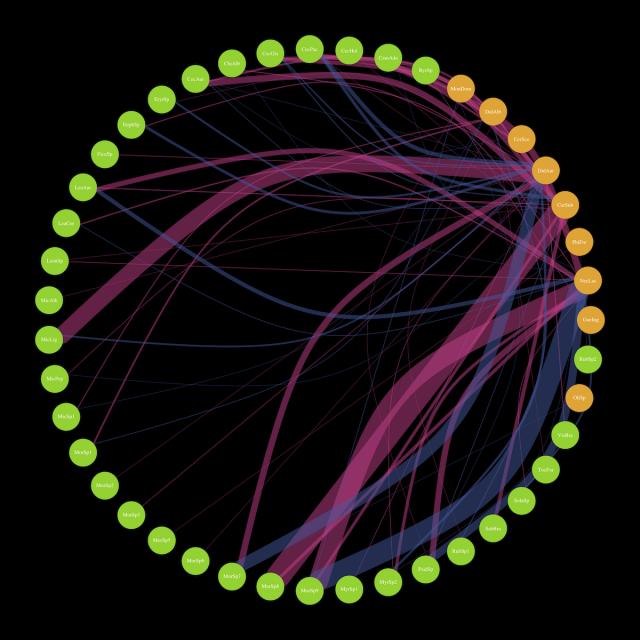
People are social entities. They build complex relationships with others around them, form communities and social circles, belong to organizations. Every decision to make a connection to others is based a large variety of variables (called attributes). Every connection, in turn, affects people’s attitudes, behavior, and actions. This relationship between the structure of people’s connections to others and everything that this structure affects is called social dynamics.

Class Deals by MOOC List - Click here and see Coursera's Active Discounts, Deals, and Promo Codes.

Social dynamics is the focus of social network analysis. In this course, we will introduce this exciting field, starting with the very basics – the definitions of network concepts. You will quickly learn that network analysis allows to answer questions and find insights not available with any other approaches.
In business, where relationships are essential to efficiency and effectiveness of an organization, it is crucial that analysts know how to analyze these relationships. Therefore, we will not only show you the network concepts, but apply them immediately to real-life business datasets.
The possibilities of network analysis are quite broad. In this course, we divide the complex field according to the three major theoretical concepts in social relations: social selection, social influence, and community building. Models of social influence help explain why networks can affect individual behavior. Models of social selection help us understand how people create their network. Community detection models allow us to find the communities that people build, to better understand the structure of such communities.
Taken together with network statistics, these models are being demonstrated on real-life datasets collected in real companies. Learners can immediately see how much more powerful relational analysis (networks) are relative to standard statistics alone.

Course 2 of 4 in the Network Analytics for Business Specialization

Syllabus

WEEK 1
What are Networks?
The first lecture is designed to familiarize the learners with the idea of networks. First, networks are highly visual, so the lecture introduces the network graphs. Then, we talk about what is social network analysis (SNA), the role of networks in our lives, and applications of SNA in a variety of settings. Finally, we talk about network theory in organizations and application of SNA in organization. A session in R is dedicated to demonstrating networks.

WEEK 2
Network Analysis as a Method
This lecture introduces all the foundational network concepts. We start with important terminology, then move to network study design, data collection and descriptive statistics. Then, we examine everything learned in the lecture on a real-life dataset. R session has several segments: loading and manipulating network data, drawing graphs using different packages, interpreting graphs.

WEEK 3
Foundational Network Measures
This lecture starts with analyzing networks on the very basic units: dyads and triads. We learn how to interpret triadic census. Then, we move on to one of the most important concepts in network analysis: centrality. We explore these foundational network measures on a real-life dataset. R sessions are dedicated to local analyses (dyads, triads and other measures) and calculating centrality measures.

WEEK 4
Social Influence Models
In this lecture, we introduce the idea of modeling on networks. The idea is simple in principle: we use the network measures, which we’ve learned in previous lectures, as predictors in regular statistical models, such as regression. First, we discuss the theories of social influence. Then, we discuss how social influence models are built. We discuss best practices in social influence network models and apply them to a real-life dataset in an R session.

WEEK 5
Social Selection Modeling
This lecture takes network analysis to a next level – the models of social selection. We start by talking about the very idea of statistical network models – why do we need them? Then, we talk about social processes and the theory behind network formation. Next we discuss the role of random graphs in the analytic process, which leads us to exponential random graph models (or the models of social selection). We discuss how to build ERGMs and apply this knowledge to a real-life dataset.

WEEK 6
Community Detection Approaches
One of the most important application of network analysis is community detection. We start by talking about communities: what are they? Then, we discuss various approaches to community detection and look at a network-level method: blockmodels. We discuss theory in blockmodeling, roles and positions, and learn how to build blockmodels in R on a real-life dataset.

WEEK 7
Project Assignment

Go to Class
MOOC List is learner-supported. When you buy through links on our site, we may earn an affiliate commission.

Related Courses

Performing Network, Path, and Text Analyses in SAS Visual Analytics (Coursera) Coursera
SAS

Performing Network, Path, and Text Analyses in SAS Visual Analytics (Coursera)

In this course, you learn about the data structure needed for network, path, and text analytics and how to create network analysis, path analysis, and text analytics in SAS Visual Analytics. What tou will learn: To describe the data structure needed for network analysis, path analysis, and text analytics; How to create network analysis to analyze relationship between entities in SAS Visual Analytics; How to create path analysis to understand frequent paths in SAS Visual Analytics; How to create text analytics to analyze unstructured text in SAS Visual Analytics.

Jun 15th 2026
1 Week
Go for Cloud and Networks (Coursera) Coursera
Edureka

Go for Cloud and Networks (Coursera)

Step into the world of Go for Cloud and Networks course, where you will explore the powerful combination of Go programming language and cloud-based networking in this comprehensive course. Designed for both beginners and intermediate-level developers, this program delves into the intricacies of building scalable and efficient cloud-native applications using Go.

Jun 22nd 2026
5-12 Weeks
Connecting to Devices and Networks (Coursera) Coursera
Codio

Connecting to Devices and Networks (Coursera)

Practice managing devices and networks without installing anything! This course is designed for learners with no technical experience, providing a solid foundation of connecting to devices and networks. Learners will gain hands-on practice on an Ubuntu system that can be easily transferred to other Unix-based operating systems. The modules in this course cover managing devices and partitions, basic networking tools and name resolution, and securely transferring data over networks to create backups.

Jun 15th 2026
3 Weeks
Computational Social Science Capstone Project (Coursera) Coursera
University of California, Davis

Computational Social Science Capstone Project (Coursera)

CONGRATULATIONS! Not only did you accomplish to finish our intellectual tour de force, but, by now, you also already have all required skills to execute a comprehensive multi-method workflow of computational social science. We will put these skills to work in this final integrative lab, where we are bringing it all together. We scrape data from a social media site (drawing on the skills obtained in the 1st course of this specialization). We then analyze the collected data by visualizing the resulting networks (building on the skills obtained in the 3rd course). We analyze some key aspects of it in depth, using machine learning powered natural language processing (putting to work the insights obtained during the 2nd course).

Jun 22nd 2026
4 Weeks
Os vários elementos das redes informáticas (Coursera) Coursera
Google

Os vários elementos das redes informáticas (Coursera)

Este curso foi concebido para proporcionar uma vista geral das redes informáticas. Vamos abordar desde os princípios básicos das tecnologias e protocolos de redes modernos até aplicações práticas e resolução de problemas de rede. Para terminar, vamos abordar o modo como estas informações podem surgir numa entrevista de emprego e dar-lhe algumas sugestões para resolver problemas no local.

Jun 22nd 2026
5-12 Weeks
Asymmetric Cryptography and Key Management (Coursera) Coursera
University of Colorado System

Asymmetric Cryptography and Key Management (Coursera)

In asymmetric cryptography or public-key cryptography, the sender and the receiver use a pair of public-private keys, as opposed to the same symmetric key, and therefore their cryptographic operations are asymmetric. This course will first review the principles of asymmetric cryptography and describe how the use of the pair of keys can provide different security properties. Then, we will study the popular asymmetric schemes in the RSA cipher algorithm and the Diffie-Hellman Key Exchange protocol and learn how and why they work to secure communications/access.

Jun 22nd 2026
4 Weeks
International Cyber Conflicts (Coursera) Coursera
The State University of New York

International Cyber Conflicts (Coursera)

By nature, cyber conflicts are an international issue that span across nation-state borders. By the end of the course, you will be able to apply the knowledge gained for analysis and management of international cyber incidents and conflicts including for activities such as development of policy related to cybercrime and cyberwarfare. Management of cyber incidents and conflicts requires an interdisciplinary perspective including an understanding of: 1) characteristics of the cyber threats and conflicts themselves, 2) international efforts to reduce and improve cyber security, and 3) psychological and sociopolitical factors.

Jun 8th 2026
5-12 Weeks
Internet of Things: Communication Technologies (Coursera) Coursera
University of California, San Diego

Internet of Things: Communication Technologies (Coursera)

Have you wondered how “Things” talk to each other and the cloud? Do you understand the alternatives for conveying latency-sensitive real time data versus reliable signaling data? Building on the skills from the Sensing and Actuation course, we will explore protocols to exchange information between processors.

Jun 15th 2026
4 Weeks
Administrasi Sistem dan Layanan Infrastruktur TI (Coursera) Coursera
Google

Administrasi Sistem dan Layanan Infrastruktur TI (Coursera)

Materi ini akan membantu Anda beralih dari hanya mengerjakan satu komputer menjadi menangani seluruh armada komputer. Administrasi sistem adalah bidang TI yang bertanggung jawab atas pemeliharaan sistem komputer yang andal di lingkungan multi-pengguna. Pada materi ini, Anda akan belajar tentang layanan infrastruktur yang membuat semua organisasi, baik besar maupun kecil, tetap aktif dan berjalan. Kita akan membahas lebih jauh mengenai cloud sehingga Anda akan memahami semuanya, mulai dari penyiapan infrastruktur cloud hingga cara mengelola sumber daya cloud.

Jun 15th 2026
5-12 Weeks
Introduction to High-Performance and Parallel Computing (Coursera) Coursera
University of Colorado Boulder

Introduction to High-Performance and Parallel Computing (Coursera)

This course introduces the fundamentals of high-performance and parallel computing. It is targeted to scientists, engineers, scholars, really everyone seeking to develop the software skills necessary for work in parallel software environments. These skills include big-data analysis, machine learning, parallel programming, and optimization. We will cover the basics of Linux environments and bash scripting all the way to high throughput computing and parallelizing code.

Jun 22nd 2026
4 Weeks