Internet of Things: How did we get here? (Coursera)

Internet of Things: How did we get here? (Coursera)

It is hard to imagine life without your Smartphone – you have come to rely on it so much – for your work; to stay in touch with family and friends; to capture and share those special moments; to find your way around in a new neighborhood. Did you ever wonder how and when all this happened? Or how and when GPS sensors came to be in your cell phone?

Class Deals by MOOC List - Click here and see Coursera's Active Discounts, Deals, and Promo Codes.

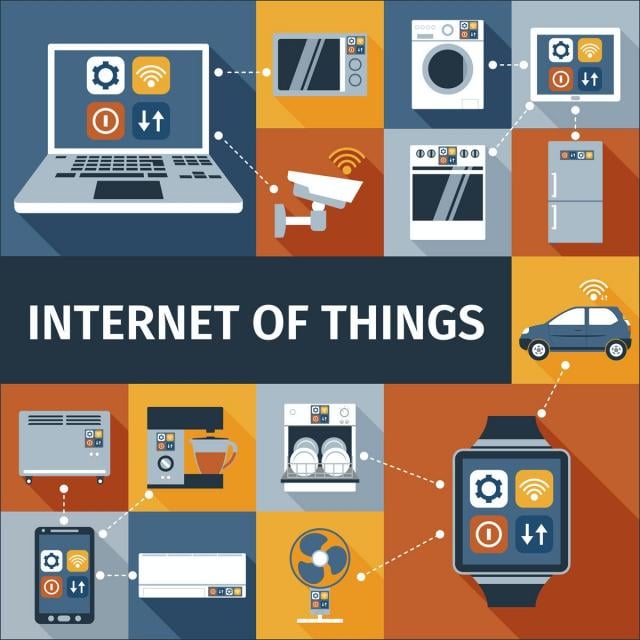
In this course, we will explore the convergence of multiple disciplines leading to todays’ Smartphones. You will learn about the birth and evolution of Telephony Networks, Broadcast Networks (TV and Radio) and Consumer Electronics. We will discuss the impact of Internet, (multimedia) content, smartphones and apps on everyday lives. We will then look at how this emerging platform called the Internet of Things – wherein billions and trillions of devices communicating with each other and “the cloud” – could enable unprecedented, innovative products and services. Take this course if you want to understand what great new advances in mobile-enabled products will be coming our way!
Learning Goals: This course provides a core grounding in how science and technology have developed to enable the Internet of Things – in a way appropriate for any learner. For those interested in developing further hands-on expertise in designing and developing for the Internet of Things, this course will provide a context to the discoveries and converging technologies that will springboard the next round of innovations. After completing this course, you will be able to:

  1. Compare how the telephone system works (that is, peer-to-peer networks) with how media delivery works (that is, broadcast/multicast networks).
  2. Explain the tradeoffs between circuit switched networks (that is, dedicated resources) and packet switched networks (that is, shared resources).
  3. Tell interesting stories about key innovations that transformed the communications, entertainment and consumer electronics industries.
  4. Explain how email, YouTube, SMS, etc. work.
  5. Find resources for those wishing to do more of a “deep-dive” into the above topics.

Course 1 of 6 in the Internet of Things and AI Cloud Specialization

Syllabus

WEEK 1
Welcome
Welcome to the first course in the Internet of Things specialization! We hope you’re just as excited as we are to begin this fascinating journey! Before getting started with the material, we would like to introduce you to the team that made this all possible, as well as give you a preview of what to expect throughout the entire specialization.
Circuit Switched Networks
In order to answer the big question, “how did we get here?” we must start from the beginning. The beginning of what you may ask, well the beginning of telecommunication! In this course we will cover the birth of the telephone and its gradual evolution through different networks. Humans love to talk, which might explain the speedy growth of telephony networks.
Packet Switched Networks
Now that we have looked at circuit switched networks, we will begin to talk about packet switched networks. Digital networking will change in the telephone industry is what allowed all of the exciting new features we see on mobile phones. In this course, we will clarify differences between circuit and packet switched networks, as well as reveal what digital networking allows us to do.

WEEK 2
Computer Telephony
The convergence begins! Computers and telephones start working together which served a great opportunity for business in many ways. Imagine a world without caller ID or voicemail, scary isn’t it? Telephony begins to take the digital route, which brings a whole new experience in telecommunications. The digitization of telephones wasn’t all positive, for it created the possibility of hackers accessing personal information.
Wireless Technologies
Telephones eventually become a new entity which we might recognize as the cell phone. Phone mobility revolutionizes the telecommunications market, phones are no longer apply to homes but rather to people. Cell phones were a game changer for telephone companies.
Features and Apps
Phone applications are born! This is probably the greatest contribution to the telephone industry because now phone don’t just make phone calls and take messages, but also handle finances, entertain, educate, control your home, turn on your car and anything you can imagine! The limits of a technology have never been more endless, if you can think it you can sure build an app for it.
Future Outlook
Congratulations! You’ve made it to the last module in this course! At this point, you should know the history of the internet and many innovations that it has advanced with, but what is the Internet of Things anyway? That question and many more will be answered in this final course!

Go to Class
MOOC List is learner-supported. When you buy through links on our site, we may earn an affiliate commission.

Related Courses

Cryptography and Information Theory (Coursera) Coursera
University of Colorado System

Cryptography and Information Theory (Coursera)

This course combines cryptography (the techniques for protecting information from unauthorized access) and information theory (the study of information coding and transfer). More specifically, the course studies cryptography from the information-theoretical perspectives and discuss the concepts such as entropy and the attacker knowledge capabilities, e.g., Kerckhoff's Principle. It also contrasts information-theoretic security and computational security to highlight the different train of thoughts that drive the cryptographic algorithmic construction and the security analyses.

Jun 22nd 2026
4 Weeks
IoT Communications and Networks (Coursera) Coursera
Institut Mines-Telecom

IoT Communications and Networks (Coursera)

By presenting the building blocks of the IoT network architecture, this MOOC will help learners adapt to the fast changing communications and networking environment of IoT. The IoT world represents billions of sophisticated objects, such as sensors, actuators and meters, that are deployed nearly everywhere, in homes, hospitals, factories, cities, and are connected to the Internet. However, they come with limited capacity in terms of memory storage, computational power and energy; how can these objects then ensure network reliability and timely transmission?

Jun 22nd 2026
4 Weeks
Internet of Things Capstone: Build a Mobile Surveillance System (Coursera) Coursera
University of California, San Diego

Internet of Things Capstone: Build a Mobile Surveillance System (Coursera)

In the Capstone project for the Internet of Things specialization, you will design and build your own system that uses at least 2 sensors, at least 1 communication protocol and at least 1 actuator. You will have a chance to revisit and apply what you have learned in our courses to achieve a robust, practical and/or fun-filled project. We absolutely encourage you to design whatever you can think up! This is your chance to be creative or to explore an idea that you have had. But if you don’t have your own idea, we provide the description of a surveillance system, for you to build.

Jun 22nd 2026
4 Weeks
Cybersecurity and the Internet of Things (Coursera) Coursera
University System of Georgia

Cybersecurity and the Internet of Things (Coursera)

Welcome to “Cybersecurity and the Internet of Things”! This course is for you if you are curious about the most recent trends and activities in the internet capabilities and concerns about programmed devices. There are complexities and areas of necessary awareness when the industrial sector becomes connected to your home.

Jun 22nd 2026
4 Weeks
Operational Context and Data (Coursera) Coursera
University at Buffalo,The State University of New York

Operational Context and Data (Coursera)

By the end of this course, learners are empowered to implement data-driven process improvement objectives at their organization. The course covers: the business case for IoT (Internet of Things), the strategic importance of aligning operations and performance goals, best practices for collecting data, and facilitating a process mapping activity to visualize and analyze a process’s flow of materials and information. Learners are prepared to focus efforts around business needs, evaluate what the organization should measure, discern between different types of IoT data and collect key performance indicators (KPIs) using IoT technology. Learners have the opportunity to implement process improvement objectives in a mock scenario and consider how the knowledge can be transferred to their own organizational contexts.

Jun 22nd 2026
4 Weeks
Posicionamiento en redes: estrategias de contenido. (Coursera) Coursera
RTVE

Posicionamiento en redes: estrategias de contenido. (Coursera)

Este curso está dirigido no solo a los profesionales de los medios de comunicación sino también a cualquier personal interesada en conocer las redes sociales, diferenciarlas, utilizar herramientas para generar contenido para las redes sociales y evitar errores en su generación, sin importar la edad o el nivel de instrucción.

Jun 22nd 2026
4 Weeks
Social Network Analysis (Coursera) Coursera
University of California, Davis

Social Network Analysis (Coursera)

This course is designed to quite literally ‘make a science’ out of something at the heart of society: social networks. Humans are natural network scientists, as we compute new network configurations all the time, almost unaware, when thinking about friends and family (which are particular forms of social networks), about colleagues and organizational relations (other, overlapping network structures), and about how to navigate delicate or opportunistic network configurations to save guard or advance in our social standing (with society being one big social network itself).

Jun 22nd 2026
5-12 Weeks
Gestão da Cadeia de Suprimentos (Coursera) Coursera
FIA Business School

Gestão da Cadeia de Suprimentos (Coursera)

Nossas boas-vindas ao Curso Gestão da Cadeia de Suprimentos. Neste curso, você aprenderá sobre os principais conceitos necessários para entender o que é a cadeia de suprimentos, como ela pode gerar maior valor para a empresa, quais são as novas tecnologias que permitem uma maior eficácia na sua gestão e como podemos personalizar a oferta para os segmentos de cliente da empresa.

Jun 22nd 2026
4 Weeks
Cybersecurity for Data Science (Coursera) Coursera
University of Colorado Boulder

Cybersecurity for Data Science (Coursera)

This course aims to help anyone interested in data science understand the cybersecurity risks and the tools/techniques that can be used to mitigate those risks. We will cover the distinctions between confidentiality, integrity, and availability, introduce learners to relevant cybersecurity tools and techniques including cryptographic tools, software resources, and policies that will be essential to data science. We will explore key tools and techniques for authentication and access control so producers, curators, and users of data can help ensure the security and privacy of the data.

Jun 22nd 2026
5-12 Weeks
Internet of Things Capstone V2: Build a Mobile Surveillance System (Coursera) Coursera
University of California, San Diego

Internet of Things Capstone V2: Build a Mobile Surveillance System (Coursera)

In the Capstone project for the Internet of Things specialization, you will design and build your own system that uses at least 2 sensors, at least 1 communication protocol and at least 1 actuator. You will have a chance to revisit and apply what you have learned in our courses to achieve a robust, practical and/or fun-filled project. We absolutely encourage you to design whatever you can think up! This is your chance to be creative or to explore an idea that you have had. But if you don’t have your own idea, we provide the description of a surveillance system, for you to build. We will participate in the Capstone with you by building a surveillance system that features an off-grid solar powered workstation that will serve as a hub to multiple surveillance sensors.

Jun 22nd 2026
4 Weeks
Interfacing with the Arduino (Coursera) Coursera
University of California, Irvine

Interfacing with the Arduino (Coursera)

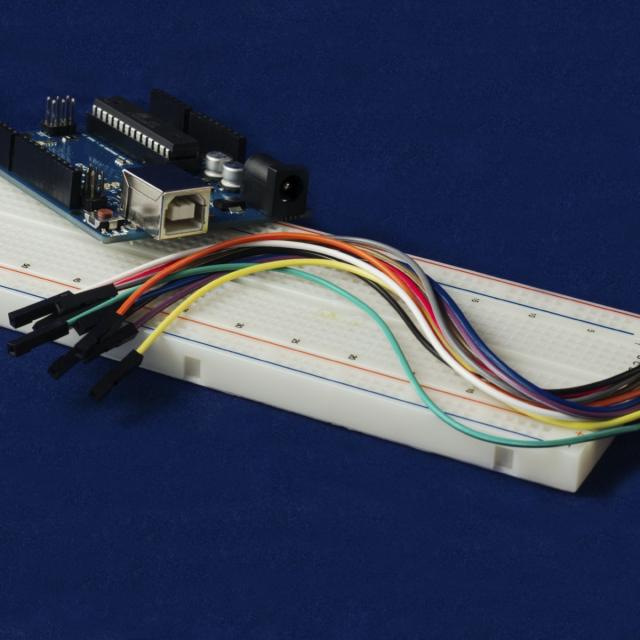
Arduino senses the environment by receiving inputs from add-on devices such as sensors, and can control the world around it by adjusting lights, motors, and other actuators. In this class you will learn how and when to use the different types of sensors and how to connect them to the Arduino. Since the external world uses continuous or analog signals and the hardware is digital you will learn how these signals are converted back-and-forth and how this must be considered as you program your device. You'll also learn about the use of Arduino-specific shields and the shields software libraries to interface with the real world.

Jun 22nd 2026
4 Weeks
Classical Cryptosystems and Core Concepts (Coursera) Coursera
University of Colorado System

Classical Cryptosystems and Core Concepts (Coursera)

Welcome to Introduction to Applied Cryptography. Cryptography is an essential component of cybersecurity. The need to protect sensitive information and ensure the integrity of industrial control processes has placed a premium on cybersecurity skills in today’s information technology market. Demand for cybersecurity jobs is expected to rise 6 million globally by 2019, with a projected shortfall of 1.5 million, according to Symantec, the world’s largest security software vendor. According to Forbes, the cybersecurity market is expected to grow from $75 billion in 2015 to $170 billion by 2020.

Jun 22nd 2026
3 Weeks