EdX

Mathematics of Waves: Visualized with Neural Networks (edX)

Offered by Purdue University, PurdueX,
Mathematics of Waves: Visualized with Neural Networks (edX)

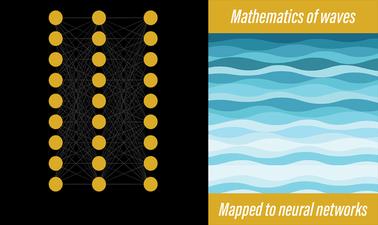
All around us, information is carried by waves of many kinds, like acoustic, electromagnetic, gravitational or probability waves. Enjoy this unifying view of all wave phenomena using neural networks to visualize the underlying mathematics.

Class Deals by MOOC List - Click here and see EdX's Active Discounts, Deals, and Promo Codes.

In the physical world we are surrounded by waves of all kinds, each with its own underlying physics. Acoustic waves for example involve the vibrations of the medium which we can hear, while electromagnetic waves involve vibrations of electric fields that require no medium and are detected with specially designed antennas. These vibrations are physically very different and are usually taught in very different courses although they are governed by very similar partial differential equations. Furthermore, the equations are sufficiently opaque that they hide the underlying unity. Our aim is to make this unity apparent through a unifying viewpoint, using neural networks (NN) as a pictorial tool to visualize the underlying mathematics.
All waves can be viewed as a collection of individual oscillators, and so we will start in Week 1 by laying out the mathematical and conceptual framework for oscillatory systems as diverse as mechanical oscillators (mass-spring), electrical oscillators (inductor-capacitor), ferromagnets and quantum spins. The physical variables are very different and even the equations may look different, but we will stress their unifying characteristics, introducing the concept of normal modes and mapping them all to an NN model. In Week 2 , we will show how the coupling of different elementary oscillators leads to different wave systems, with quantitative illustrative examples.
This is a pilot 2-week course where we will illustrate the basic idea for acoustic, Schrödinger and electromagnetic waves, all in Week 2. In future versions, our aim will be to expand the content with more illustrative examples as well as with more advanced topics such as quantized oscillators and waves.

What you'll learn

  • The mathematical structure underlying diverse oscillatory systems along with a pictorial representation using neural networks along with the concept of normal modes.
  • The formation of wave systems by coupling individual oscillators along with the concepts of dispersion relation and group velocity.
  • How to perform quantitative calculations of the waves generated by sources.
  • Visualizing diverse systems in terms of recurrent neural networks that can be used to compute and visualize numerical solutions.

Syllabus

Week 1: Oscillators
1.1. Simple oscillators
1.2. Normal modes
1.3. Spinor oscillators
1.4. Vector oscillators
1.5. Tensor oscillators

Week 2: Waves
2.1. Scalar waves
2.2. Group velocity
2.3. Schrödinger wavepackets
2.4. Electromagnetic waves
2.5. Acoustic waves
Go to Class
MOOC List is learner-supported. When you buy through links on our site, we may earn an affiliate commission.

Related Courses

I "Heart" Stats: Learning to Love Statistics (edX) EdX
University of Notre Dame,NotreDameX

I "Heart" Stats: Learning to Love Statistics (edX)

Is your relationship with statistics dysfunctional? We can help: Get to know stats, build a healthy bond, and maybe even fall in love! When you meet a new person, it is hard to know what to expect. You may not be able to read the person or understand what they mean. Even if you want to have a good relationship with them, this lack of understanding can make interactions tense, unpredictable and scary!

No sessions available
4 Weeks
An Introduction to Evidence-Based Undergraduate STEM Teaching (edX) EdX
CornellX,Cornell University

An Introduction to Evidence-Based Undergraduate STEM Teaching (edX)

Learn how to implement evidence-based teaching strategies in your university classroom as well as effective methods for assessing teaching and learning. This course is designed to provide future STEM faculty, graduate students and post-doctoral fellows with an introduction to effective teaching strategies and the research that supports them.

Jun 17th 2024
5-12 Weeks
Algèbre Linéaire (Partie 3) (edX) EdX
École Polytechnique Fédérale de Lausanne,EPFLx

Algèbre Linéaire (Partie 3) (edX)

Un MOOC francophone d'algèbre linéaire accessible à tous, enseigné de manière rigoureuse et ne nécessitant aucun prérequis. Vous voulez apprendre l'algèbre linéaire, un précieux outil complémentaire à vos connaissances acquises durant vos études en économie, ingénierie, physique, ou statistique? Ou simplement pour la beauté de la matière? Alors ce cours est fait pour vous!

Self Paced
Self-Paced
Cours préparatoire: Fonctions trigonométriques, logarithmiques et exponentielles (edX) EdX
École Polytechnique Fédérale de Lausanne,EPFLx

Cours préparatoire: Fonctions trigonométriques, logarithmiques et exponentielles (edX)

Ce cours donne les connaissances fondamentales liées aux fonctions trigonométriques, logarithmiques et exponentielles. Le cours propose une approche très détaillée et précise des notions fondamentales liées aux fonctions trigonométriques, logarithmiques et exponentielles.

Self Paced
Self-Paced
Calculus 1B: Integration (edX) EdX
MIT,MITx

Calculus 1B: Integration (edX)

Discover the integral---what it is and how to compute it. See how to use calculus to model real world phenomena. Part 2 of 3. How long should the handle of your spoon be so that your fingers do not burn while mixing chocolate fondue? Can you find a shape that has finite volume, but infinite surface area? How does the weight of the rider change the trajectory of a zip line ride? These and many other questions can be answered by harnessing the power of the integral.

Sep 14th 2022
13-24 Weeks
Introduction to Geometry (edX) EdX
School Yourself

Introduction to Geometry (edX)

Measure angles, prove geometric theorems, and discover how to calculate areas and volumes in this interactive course! More than 2000 years ago, long before rockets were launched into orbit or explorers sailed around the globe, a Greek mathematician measured the size of the Earth using nothing more than a few facts about lines, angles, and circles.

Self Paced
Self-Paced
Aplicaciones de la Teoría de Grafos a la vida real (I) (edX) EdX
Universitat Politècnica de València,UPValenciaX

Aplicaciones de la Teoría de Grafos a la vida real (I) (edX)

Aprenderemos a modelizar problemas del mundo real mediante su representación con grafos y a resolverlos mediante sus algoritmos asociados. Este curso trata la Teoría de Grafos desde el punto de vista de la modelización, lo que nos permitirá con posterioridad resolver muchos problemas de diversa índole. Presentaremos ejemplos de los distintos problemas en un contexto real, analizaremos la representación de éstos mediante grafos y veremos los algoritmos necesarios para resolverlos.

Self Paced
Self-Paced
Fun with Prime Numbers: The Mysterious World of Mathematics (edX) EdX
Kyoto University,KyotoUx

Fun with Prime Numbers: The Mysterious World of Mathematics (edX)

Learn about prime numbers, solve math problems and explore recent discoveries and theories. Prime numbers are one of the most important subjects in mathematics. Many mathematicians from ancient times to the 21st century have studied prime numbers. In this math course, you will learn the definition and basic properties of prime numbers, and how they obey mysterious laws.

No sessions available
4 Weeks
AP® Calculus: Challenging Concepts from Calculus AB & Calculus BC (edX) EdX
Davidson Next

AP® Calculus: Challenging Concepts from Calculus AB & Calculus BC (edX)

Master the most difficult topics in your AP® Calculus AB & Calculus BC courses. Well-respected AP instructors from around the United States will lead you through video instruction, exam-style questions and interactive activities to help you master the most challenging concepts in the AP® Calculus AB & Calculus BC curriculum.

No sessions available
13-24 Weeks
Introduction to Algebra (edX) EdX
School Yourself

Introduction to Algebra (edX)

Solve equations, draw graphs, and play with quadratics in this interactive course! We live in a world of numbers. You see them every day: on clocks, in the stock market, in sports, and all over the news. Algebra is all about figuring out the numbers you don't see.

Self Paced
Self-Paced
Complex Analysis with Physical Applications (edX) EdX
NUST MISIS,MISISx

Complex Analysis with Physical Applications (edX)

Learn to master differential equations and special functions in this graduate level course. In this advanced math course, you will learn how to build solutions to important differential equations in physics and their asymptotic expansions. Armed with the tools mastered in this course, you will have a solid command of the methods of tackling differential equations and integrals encountered in theoretical and applied physics and material science.

No sessions available
5-12 Weeks