EdX

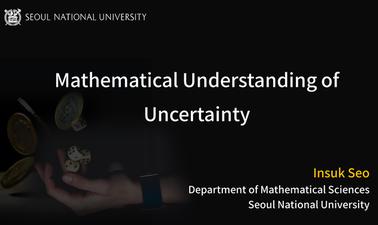
Mathematical understanding of uncertainty (edX)

Mathematical understanding of uncertainty (edX)

This lecture series discusses how the concept of probability can be used to handle, control, and exploit uncertainty in the real-world. It is an undergraduate-level lecture series on probability, but is entirely different from the usual courses on probability theory. The lectures cover the basics of probability theory including the relevant mathematics, but instead of focusing on mathematics, the lectures explain how probability theory can help understand real-world uncertainty using various examples.

Class Deals by MOOC List - Click here and see EdX's Active Discounts, Deals, and Promo Codes.

The examples are used to describe how uncertainty can be exploited to implement modern randomized algorithms such as Markov chain Monte Carlo and deep learning.
The first part of the series (three weeks) discusses the basics of probability theory such as the mathematical formulation of probability, random variables, expectation, and variance in a creative way as a means to quantify uncertainty.
The second part of the series (five weeks) introduces a few universal principles of probability theory. Standard theorems in probability theory such as the law of large numbers and the central limit theorems are introduced as fundamental examples of universal principles, and hence, are discussed from a unique perspective. These universal principles are used to explain uncertainty in the real-world, and numerous interesting examples are introduced for illustration.
The third part of the series (four weeks) introduces the concept of Markov chain and then discusses various randomized algorithms as examples of Markov chains. For example, riffle shuffle of playing cards, Markov chain Monte Carlo, and deep learning algorithms are discussed based on the modern theory of Markov chains.
The lecture series requires knowledge of calculus, but knowledge of higher mathematics and probability is not a pre-requisite.

What you'll learn

  • Basic probability theory including random variable, expectation, and variance
  • Universal principles in probability theory such as law of large numbers, central limit theorem, and large deviation principles, and their applications
  • Heavy-tailed phenomenon
  • Theory random processes and applications to real world problem
  • Theory of Markov chains and applications to simulation, randomization, and deep learning.

Syllabus

Lecture 1. Uncertainty: Control vs Exploit
1) A toy example
2) Control the uncertainty
3) Exploit the uncertainty

Lecture 2. Quantification of Uncertainty (1): Probability and Random Variables
1) Mathematical formulation of probability
2) Random variables
3) Independence

Lecture 3. Quantification of Uncertainty (2): Expectation and Variance
1) Expectation
2) Variance and standard deviation
3) Applications

Lecture 4. Universal Principle (1): Law of large numbers
1) Introduction to universality
2) Law of large numbers
3) Proof of law of large numbers
4) Applications

Lecture 5. Universal Principle (2): Central limit theorem
1) Central limit theorem
2) Applications to statistics

Lecture 6. Universal Principle (3): More on fluctuation
1) Heavy-tailed random variables
2) Large deviation principles

Lecture 7. Universal Principle (4): Random processes
1) Introduction to random processes
2) Simple random walk on a line
3) Applications to gambling

Lecture 8. Universal Principle (5): Universality of random processes
1) Universality in random walks
2) Galton-Watson tree

Lecture 9. How to use uncertainty? (1): Introduction to Markov Chains
1) Markov processes
2) Markov chains
3) Examples

Lecture 10. How to use uncertainty? (2): Universal principles of Markov chains
1) Stationary distribution
2) Universal principles for Markov chains

Lecture 11. How to use uncertainty? (3): MCMC and Cutoff phenomenon
1) Markov chain Monte Carlo (MCMC)
2) Markov chain mixing theory
3) Cutoff phenomenon

Lecture 12. How to use uncertainty? (4): Stochastic optimizations and deep learning
1) Gradient descent
2) Stochastic gradient descent
3) Mini-batch gradient descent

Go to Class
MOOC List is learner-supported. When you buy through links on our site, we may earn an affiliate commission.

Related Courses

Calculus 1C: Coordinate Systems & Infinite Series (edX) EdX
MIT,MITx

Calculus 1C: Coordinate Systems & Infinite Series (edX)

Master the calculus of curves and coordinate systems; approximate functions with polynomials and infinite series. Part 3 of 3. How did Newton describe the orbits of the planets? To do this, he created calculus. But he used a different coordinate system more appropriate for planetary motion. We will learn to shift our perspective to do calculus with parameterized curves and polar coordinates. And then we will dive deep into exploring the infinite to gain a deeper understanding and powerful descriptions of functions.

Feb 15th 2023
13-24 Weeks
Cours préparatoire: Fonctions trigonométriques, logarithmiques et exponentielles (edX) EdX
École Polytechnique Fédérale de Lausanne,EPFLx

Cours préparatoire: Fonctions trigonométriques, logarithmiques et exponentielles (edX)

Ce cours donne les connaissances fondamentales liées aux fonctions trigonométriques, logarithmiques et exponentielles. Le cours propose une approche très détaillée et précise des notions fondamentales liées aux fonctions trigonométriques, logarithmiques et exponentielles.

Self Paced
Self-Paced
Aplicaciones de la Teoría de Grafos a la vida real (I) (edX) EdX
Universitat Politècnica de València,UPValenciaX

Aplicaciones de la Teoría de Grafos a la vida real (I) (edX)

Aprenderemos a modelizar problemas del mundo real mediante su representación con grafos y a resolverlos mediante sus algoritmos asociados. Este curso trata la Teoría de Grafos desde el punto de vista de la modelización, lo que nos permitirá con posterioridad resolver muchos problemas de diversa índole. Presentaremos ejemplos de los distintos problemas en un contexto real, analizaremos la representación de éstos mediante grafos y veremos los algoritmos necesarios para resolverlos.

Self Paced
Self-Paced
Applications of Linear Algebra Part 1 (edX) EdX
Davidson College,DavidsonX

Applications of Linear Algebra Part 1 (edX)

Learn to use linear algebra in computer graphics by making images disappear in an animation or creating a mosaic or fractal and in data mining to measure similarities between movies, songs, or friends. From simulating complex phenomenon on supercomputers to storing the coordinates needed in modern 3D printing, data is a huge and growing part of our world.

No sessions available
4 Weeks
AP® Calculus: Challenging Concepts from Calculus AB & Calculus BC (edX) EdX
Davidson Next

AP® Calculus: Challenging Concepts from Calculus AB & Calculus BC (edX)

Master the most difficult topics in your AP® Calculus AB & Calculus BC courses. Well-respected AP instructors from around the United States will lead you through video instruction, exam-style questions and interactive activities to help you master the most challenging concepts in the AP® Calculus AB & Calculus BC curriculum.

No sessions available
13-24 Weeks
Differential Equations: Fourier Series and Partial Differential Equations (edX) EdX
MIT,MITx

Differential Equations: Fourier Series and Partial Differential Equations (edX)

Learn to use Fourier series to solve differential equations with periodic input signals and to solve boundary value problems involving the heat equation and wave equation. Differential equations are the mathematical language we use to describe the world around us. Many phenomena are not modeled by differential equations, but by partial differential equations depending on more than one independent variable.

Mar 22nd 2023
5-12 Weeks
Introduction to Geometry (edX) EdX
School Yourself

Introduction to Geometry (edX)

Measure angles, prove geometric theorems, and discover how to calculate areas and volumes in this interactive course! More than 2000 years ago, long before rockets were launched into orbit or explorers sailed around the globe, a Greek mathematician measured the size of the Earth using nothing more than a few facts about lines, angles, and circles.

Self Paced
Self-Paced
Further Mathematics Year 13 course 2: Applications of Differential Equations, Momentum, Work, Energy & Power, The Poisson Distribution, The Central Limit Theorem, Chi Squared Tests, Type I and II Errors (edX) EdX
Imperial College London,ImperialX

Further Mathematics Year 13 course 2: Applications of Differential Equations, Momentum, Work, Energy & Power, The Poisson Distribution, The Central Limit Theorem, Chi Squared Tests, Type I and II Errors (edX)

Develop your thinking skills, fluency and confidence in the applied mathematics content of A-level further maths and prepare for undergraduate STEM degrees. This course by Imperial College London is designed to help you develop the skills you need to succeed in your A-level further maths exams. You will investigate key topic areas to gain a deeper understanding of the skills and techniques that you can apply throughout your A-level study.

Jan 3rd 2022
5-12 Weeks