EdX

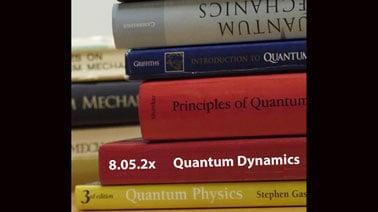
Mastering Quantum Mechanics Part 2: Quantum Dynamics (edX)

Offered by MIT,
Mastering Quantum Mechanics Part 2: Quantum Dynamics (edX)

Learn about the Heisenberg uncertainty principle, quantum dynamics and two-state systems including applications to NMR and masers.

Class Deals by MOOC List - Click here and see EdX's Active Discounts, Deals, and Promo Codes.

This physics course covers Heisenberg’s uncertainty principle and the concept of compatible operators. You will also learn about the Schrödinger and Heisenberg pictures of quantum mechanics and the coherent and squeezed states of the harmonic oscillator. The course concludes with two state systems and their applications to NMR and masers.

This is the second of three courses offering a sophisticated view of quantum mechanics and its proper mathematical foundation.
Part 1: Wave Mechanics
Part 2: Quantum Dynamics
Part 3: Entanglement and Angular Momentum
To understand the material in this course you should have taken Mastering Quantum Mechanics Part 1: Wave Mechanics.
Completing the 3-part Quantum Mechanics series will give you the necessary foundation to pursue advanced study or research at the graduate level in areas related to quantum mechanics
What you'll learn:

  • Heisenberg Uncertainty Principle and compatible operators.
  • The Schrödinger and Heisenberg pictures of quantum mechanics.
  • Coherent and Squeezed States.
  • Two state systems and applications to NMR and MRI.

Syllabus

Week 1: The uncertainty principle and compatible operators.
Week 2: The harmonic oscillator, Schrodinger equation as unitary time evolution, The Heisenberg picture of quantum mechanics.
Week 3: Coherent and squeezed states of the harmonic oscillator.
Week 4: Coherent photon states. Two state systems, Nuclear Magnetic Resonance (NMR), and the ammonia maser.
Week 5: The setup for NMR (Nuclear Magnetic Resonance) and basic MRI (Magnetic Resonance Imaging).
Final assessment
Go to Class
MOOC List is learner-supported. When you buy through links on our site, we may earn an affiliate commission.

Related Courses

How Stuff Moves, Part 1: Linear Motion (edX) EdX
Harvey Mudd College,HarveyMuddX

How Stuff Moves, Part 1: Linear Motion (edX)

A Calculus-based introduction to Newtonian mechanics that emphasizes problem-solving. WHAT IS “HOW STUFF MOVES”? Mechanics is the study of how things move. It was the first quantitative science to achieve wide power to predict behavior, including things never before directly observed. Newton, Leibniz, and others invented calculus to describe motion and we will find both differential and integral calculus extremely useful throughout this course.

No sessions available
4 Weeks
Introduction to Quantum Science & Technology (edX) EdX
Purdue University,PurdueX

Introduction to Quantum Science & Technology (edX)

Learn about fundamental concepts and engineering challenges of quantum technologies. Emerging quantum systems are disruptive technologies redefining computing and communication. Teaching quantum physics to engineers and educating scientists on engineering solutions are critical to address fundamental and engineering challenges of the quantum technologies.

Aug 21st 2023
13-24 Weeks
Astrophysics: Exploring Exoplanets (edX) EdX
Australian National University - ANU,ANUx

Astrophysics: Exploring Exoplanets (edX)

Explore the mysteries of exoplanets - planets around other stars – in this introductory astrophysics course. The discovery of exoplanets is one of the greatest revolutions in modern astrophysics. Twenty years ago, we had no idea whether any of the countless stars out there beyond our solar system had planets or not.

Self Paced
Self-Paced
Fundamentals of Transistors (edX) EdX
Purdue University,PurdueX

Fundamentals of Transistors (edX)

This course develops a simple framework for understanding the essential physics of transistors, including modern nanoscale transistors. Important technology considerations and circuit applications are also discussed. The transistor has been called the greatest invention of the 20th century - it enabled the electronics systems that have shaped the world we live in. Today's nanotransistors are a high volume, high impact success of the nanotechnology revolution.

Feb 13th 2023
5-12 Weeks
Quantum Mechanics of Molecular Structures (edX) EdX
The University of Tokyo,UTokyoX

Quantum Mechanics of Molecular Structures (edX)

Learn two methods used to determine molecular structures and their properties in this introduction to Quantum Mechanics. Knowing the geometrical structure of the molecules around us is one of the most important and fundamental issues in the field of chemistry. This course introduces the two primary methods used to determine the geometrical structure of molecules: molecular spectroscopy and gas electron diffraction.

Self Paced
Self-Paced
Science & Cooking: From Haute Cuisine to Soft Matter Science (chemistry) (edX) EdX
HarvardX,Harvard University

Science & Cooking: From Haute Cuisine to Soft Matter Science (chemistry) (edX)

Top chefs and Harvard researchers explore how everyday cooking and haute cuisine can illuminate basic principles in chemistry, physics, and engineering. Learn about food molecules and how chemical reactions can affect food texture and flavor. During each module of this course, chefs reveal the secrets behind some of their most famous culinary creations — often right in their own restaurants. Inspired by such cooking mastery, the Harvard team will then explain the science behind the recipe.

Self Paced
Self-Paced
Mecanique des Fluides (edX) EdX
École Polytechnique Fédérale de Lausanne,EPFLx

Mecanique des Fluides (edX)

Ce cours de base est composé des sept premiers modules communs à deux cours bachelor, donnés à l’EPFL en génie mécanique et génie civil. Ce cours est une première introduction à la mécanique des fluides. Nous allons aborder tout d'abord les propriétés physiques des fluides : les états de la matière et la notion de viscosité.

No sessions available
5-12 Weeks
Global Warming Science (edX) EdX
MIT,MITx

Global Warming Science (edX)

Learn about the physics, chemistry, biology, and geology of the earth’s climate system. Global Warming Science teaches you about the risks and uncertainties of future climate change by examining the science behind the earth’s climate. You will be able to answer such questions as, “What is the Greenhouse Effect?” and “How and why has earth’s climate changed through geologic history?”

No sessions available
13-24 Weeks