Introduction to Software Testing (Coursera)

Introduction to Software Testing (Coursera)

After completing this course, you will have an understanding of the fundamental principles and processes of software testing. You will have actively created test cases and run them using an automated testing tool. You will being writing and recognizing good test cases, including input data and expected outcomes.

Class Deals by MOOC List - Click here and see Coursera's Active Discounts, Deals, and Promo Codes.

After completing this course, you will be able to…

  • Describe the difference between verification and validation.
  • Explain the goal of testing.
  • Use appropriate test terminology in communication; specifically: test fixture, logical test case, concrete test case, test script, test oracle, and fault.
  • Describe the motivations for white and black box testing.
  • Compare and contrast test-first and test-last development techniques.
  • Measure test adequacy using statement and branch coverage.
  • Reason about the causes and acceptability of and poor coverage
  • Assess the fault-finding effectiveness of a functional test suite using mutation testing.
  • Critique black-box and white-box testing, describing the benefits and use of each within the greater development effort.
  • Distinguish among the expected-value (true), heuristic, consistency (as used in A/B regression), and probability test oracles and select the one best-suited to the testing objective.
  • Craft unit and integration test cases to detect defects within code and automate these tests using JUnit. To achieve this, students will employ test doubles to support their tests, including stubs (for state verification) and mocks (for behavioral verification).

This course is primarily aimed at those learners interested in any of the following roles: Software Engineer, Software Engineer in Test, Test Automation Engineer, DevOps Engineer, Software Developer, Programmer, Computer Enthusiast. We expect that you should have an understanding of the Java programming language (or any similar object-oriented language and the ability to pick up Java syntax quickly) and some knowledge of the Software Development Lifecycle.

Course 1 of 4 in the Software Testing and Automation Specialization.

What You Will Learn

  • You will gain an understanding of the theory of testing.
  • You will practice writing tests for a variety of quality intent, including code coverage, defect finding, and statistical testing.
  • You will develop test plans to guide the testing stage of the software development lifecycle.
  • You will create defect reports to provide transparency and understanding to supervisors, colleagues, and users.

Syllabus

WEEK 1
Introduction
In this module, you will be introduced to the basics of testing, especially the variety of terminology to be used through the rest of the course.

WEEK 2
Testing Foundations
In this module, you will investigate a variety of testing principles, models of testing, and types of systematic testing strategies.

WEEK 3
Testing in the Software Development Lifecycle
In this module, you will learn about the social aspects of testing. We will learn about test plans, testing status reports, and defect reporting.

WEEK 4
Writing Good Unit Tests
In this module, you will learn about writing unit tests and gain practice in writing these tests through three coding assignments, each with additional testing sophistication.
Go to Class
MOOC List is learner-supported. When you buy through links on our site, we may earn an affiliate commission.

Related Courses

Black-box and White-box Testing (Coursera) Coursera
University of Minnesota

Black-box and White-box Testing (Coursera)

After completing this course, learners will have an understanding of a variety of black-box and white-box testing techniques. The learner will have put this understanding into practice, creating effective sets of test cases (called a test suite) to properly exercise software for defect finding. The learner will have examined requirements for testability, created an oracle for automated testing, assessed fault-finding effectiveness of test suites, and generated inputs using a variety of techniques.

Jun 15th 2026
4 Weeks
Introduction to Test Driven Development (TDD) (Coursera) Coursera
IBM

Introduction to Test Driven Development (TDD) (Coursera)

Successful developers need to not only build the right software but build it right. To know your software works correctly, you need to test each unit of code. One of the best methods for this unit-level testing is test driven development. This course provides a detailed overview of test driven development (TDD). First, you’ll learn what automated testing is and why it is essential for building robust applications resilient to failure. You’ll explore the basics of testing, including test cases, testing levels, and the traditional release cycle.

Jun 8th 2026
4 Weeks
Secure Software Development: Verification and More Specialized Topics (edX) EdX
Linux Foundation,LinuxFoundationX

Secure Software Development: Verification and More Specialized Topics (edX)

Learn how to verify software for security, and take a deeper dive into the basics of applying threat models and cryptography. Modern software is under constant attack, but many software developers have never been told how to effectively counter those attacks. This course works to solve that problem, by explaining the fundamentals of developing secure software.

Self Paced
Self-Paced
Learn Software Testing Certification course (Eduonix) Eduonix
Eduonix Learning Solutions Pvt. Ltd.

Learn Software Testing Certification course (Eduonix)

Software Testing is one of the most important and critical component of Software development life cycle. The testing team is ultimately responsible of Software quality and forms the bedrock before it goes out to actual users and to market place. Over the years with innovative development techniques the software testing and quality assurance field has undergone a sea change. With new techniques like TDD(Test driven development) taking hold in industry the software developers must understand the nuances of new approaches to software quality. This is a free course with a MOOC List coupon.

Self Paced
Self-Paced
Automated Software Testing: Model and State-based Testing (edX) EdX
Delft University of Technology,DelftX

Automated Software Testing: Model and State-based Testing (edX)

Learn the advanced software testing techniques, tools, and best practices required to deliver high-quality software. Software testing gets a bad rap for being difficult, time-consuming, redundant, and above all - boring. But in fact, it is a proven way to ensure that your software will work flawlessly and can meet release schedules.

Self Paced
Self-Paced
Software Analysis & Testing (Udacity) Udacity
Georgia Institute of Technology,Udacity

Software Analysis & Testing (Udacity)

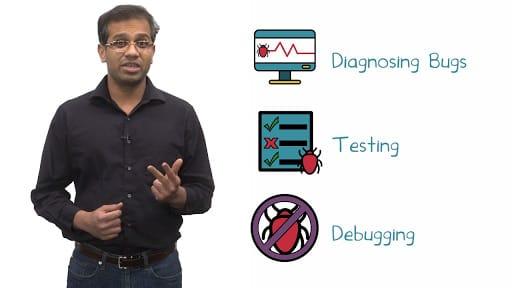
This course covers the theory and practice of software analysis, which lies at the heart of many software development processes such as diagnosing bugs, testing, debugging, and more. It presents diverse techniques, each with their own strengths and limitations, for automating tasks such as testing, debugging, and finding bugs in complex real-world programs. These techniques include dataflow analysis, constraint-based analysis, type systems, model checking, symbolic execution, and more. The course teaches the principles underlying these techniques as well as imparts hands-on experience with using and implementing tools based on these techniques.

Self Paced
Self-Paced
Product Design (Udacity) Udacity
Udacity

Product Design (Udacity)

There is nothing more powerful than an idea whose time has come. This course is designed to help you materialize your game-changing idea and transform it into a product that you can build a business around. Product Design blends theory and practice to teach you product validation, UI/UX practices, Google’s Design Sprint and the process for setting and tracking actionable metrics.

Self Paced
Self-Paced
Introduction to Automated Analysis (Coursera) Coursera
University of Minnesota

Introduction to Automated Analysis (Coursera)

This course introduces state-of-the-art techniques for automated analysis. Automated analysis encompasses both approaches to automatically generate a very large number of tests to check whether programs meet requirements, and also means by which it is possible to *prove* that software meets requirements and that it is free from certain commonly-occurring defects, such as divide-by-zero, overflow/underflow, deadlock, race-condition freedom, buffer/array overflow, uncaught exceptions, and several other commonly-occurring bugs that can lead to program failures or security problems.

Jun 15th 2026
4 Weeks
Rust Fundamentals (Coursera) Coursera
Duke University

Rust Fundamentals (Coursera)

This comprehensive Rust programming course welcomes learners of all levels, including beginners and those with some programming experience. No prior knowledge of Rust is required, making it accessible to coding novices. Throughout the course, you will gain a solid foundation in Rust programming and develop proficiency in advanced concepts, enabling you to write efficient, reliable, and high-performance code.

Jun 15th 2026
4 Weeks
Angular Fundamentals: Building Responsive Web Apps with Ease (Coursera) Coursera
EDUCBA

Angular Fundamentals: Building Responsive Web Apps with Ease (Coursera)

This comprehensive course takes you through AngularJS, delving into foundational principles, including architecture, data binding, and essential features. You'll deepen your understanding of AngularJS architecture, empowering you to initiate critical application development. Exploring advanced concepts, you'll interpret adept implementation of routing, navigation, and form controls, showcasing proficiency in data binding.

Jun 8th 2026
4 Weeks