Introduction to Machine Learning and AI (FutureLearn)

Introduction to Machine Learning and AI (FutureLearn)

Discover the fundamentals of machine learning, how it works, and learn to train your own AI using free online tools. Build your knowledge and skills in machine learning. From self-driving cars to determining someone’s age, artificial intelligence (AI) systems trained with machine learning (ML) are being used more and more. But what is AI, and what does machine learning actually involve?

Class Deals by MOOC List - Click here and see FutureLearn's Active Discounts, Deals, and Promo Codes.

On this four-week course from the Raspberry Pi Foundation, you’ll learn about different types of machine learning, and use online tools to train your own AI models.
You’ll delve into the problems that machine learning can help to solve, discuss how AI is changing the world, and think about the ethics of collecting data to train a machine learning model.
Explore the different types of machine learning
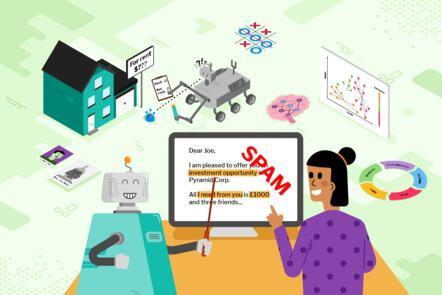
The first week of this course will guide you through how you can use machine learning to label data, whether to work out if a comment is positive or negative or to identify the contents of an image.
Then you’ll look at machine learning algorithms that create models to give a numerical output, such as predicting house prices based on information about the house and its surroundings.
You’ll also explore other types of machine learning that are designed to discover connections and groupings in data that humans would likely miss, giving you a deeper understanding of how machine learning can be used.
Use tools to develop and train your own AI
During this course, you’ll also investigate the different ways that the machine learning actually takes place.
You’ll compare supervised learning, which uses training data labelled with the desired outcome, to unsupervised learning, where the aim of the machine learning is to spot new connections.
In the final week of the course, you’ll investigate neural networks; a type of machine learning inspired by the structure of the brain that is used by many state-of-the-art AI systems such as YOTI’s age determination algorithm.

Syllabus

Week 1: Introduction to machine learning
Week 2: Solving problems using AI
Week 3: How machines learn
Week 4: Neural networks and more activities

What will you achieve?
By the end of the course, you‘ll be able to...

  • Demonstrate several working machine learning models
  • Explain the different types of machine learning, and the problems that they are suitable for
  • Compare supervised, unsupervised, and reinforcement learning
  • Discuss the ethical issues surrounding machine learning and AI

Who is the course for?
This course is designed for anyone looking to learn more about machine learning without having to understand the maths involved.
To get the most out of this course, you should already have an understanding of what a computer algorithm is.
Some of the practical tasks also require familiarity with the Scratch programming language.


Go to Class
MOOC List is learner-supported. When you buy through links on our site, we may earn an affiliate commission.

Related Courses

Artificial Intelligence (AI) for Earth Monitoring (FutureLearn) FutureLearn
EUMETSAT,Copernicus Atmosphere Monitoring Service - CAMS,European Centre for Medium-Range Weather Forecasts - ECMWF,Mercator Ocean International - MOi,European Environment Agency - EEA

Artificial Intelligence (AI) for Earth Monitoring (FutureLearn)

Explore how artificial intelligence (AI) and machine learning (ML) technologies are helping to advance Earth monitoring. Learn to use AI and ML to improve the use of big data in Earth Monitoring. This is a fast-changing and critical time for Earth Observation (EO), especially for those involved in its use for climate and meteorology.

Oct 18th 2021
5-12 Weeks
Generative AI for Everyone (Coursera) Coursera
DeepLearning.AI

Generative AI for Everyone (Coursera)

Instructed by AI pioneer Andrew Ng, Generative AI for Everyone offers his unique perspective on empowering you and your work with generative AI. Andrew will guide you through how generative AI works and what it can (and can’t) do. It includes hands-on exercises where you'll learn to use generative AI to help in day-to-day work and receive tips on effective prompt engineering, as well as learning how to go beyond prompting for more advanced uses of AI.

Jun 16th 2026
3 Weeks
Machine Learning: Classification (Coursera) Coursera
University of Washington

Machine Learning: Classification (Coursera)

Case Studies: Analyzing Sentiment & Loan Default Prediction. In our case study on analyzing sentiment, you will create models that predict a class (positive/negative sentiment) from input features (text of the reviews, user profile information,...). In our second case study for this course, loan default prediction, you will tackle financial data, and predict when a loan is likely to be risky or safe for the bank.

Jun 15th 2026
5-12 Weeks
Get ready for a Masters in Data Science and AI (FutureLearn) FutureLearn
Coventry University

Get ready for a Masters in Data Science and AI (FutureLearn)

Identify whether you’re ready for Master’s study, improve your data science skills, and get to grips with the basics of Python. Get a taste of life as a Data Science and AI Master's student. On this course, you’ll have the opportunity to explore the disciplines involved in a Master’s degree in Data Science and Artificial Intelligence (AI).

Apr 17th 2023
2 Weeks
Machine Learning: Regression (Coursera) Coursera
University of Washington

Machine Learning: Regression (Coursera)

Case Study - Predicting Housing Prices. In our first case study, predicting house prices, you will create models that predict a continuous value (price) from input features (square footage, number of bedrooms and bathrooms,...). This is just one of the many places where regression can be applied. Other applications range from predicting health outcomes in medicine, stock prices in finance, and power usage in high-performance computing, to analyzing which regulators are important for gene expression.

Jun 15th 2026
5-12 Weeks
How Artificial Intelligence Can Support Healthcare (FutureLearn) FutureLearn
University of Copenhagen,University of Groningen,University of Tartu,University Medical Center Groningen - UMCG,University Hospital Cologne

How Artificial Intelligence Can Support Healthcare (FutureLearn)

Explore how AI can be used to improve patient care and build your understanding of how to implement AI in the health professions. Understand real-life AI healthcare applications and their impact on healthcare. The use of artificial intelligence to improve efficiency is prevalent across almost every industry, none more so than the world of healthcare.

Nov 29th 2021
4 Weeks
Understanding Quantum Computers (FutureLearn) FutureLearn
Keio University

Understanding Quantum Computers (FutureLearn)

Explore the key concepts of quantum computing and find out how it’s changing computer science with this introductory course. In this course, we will discuss the motivation for building quantum computers, cover the important principles in quantum computing, and take a look at some of the important quantum computing algorithms.

Available now
3 Weeks
An Introduction to Artificial Intelligence in the Tourism Industry (FutureLearn) FutureLearn
Luleå University of Technology

An Introduction to Artificial Intelligence in the Tourism Industry (FutureLearn)

Discover how artificial intelligence is set to shape the future of tourism, in this introductory tourism management course. Get an introduction to the potential applications of AI in tourism management. We are in the midst of what commentators are calling the Fourth Industrial Revolution, or Industry 4.0.

Oct 25th 2021
2 Weeks