Introduction to Agile Development and Scrum (Coursera)

Offered by IBM,
Introduction to Agile Development and Scrum (Coursera)

After successfully completing this course, you will be able to embrace the Agile concepts of adaptive planning, iterative development, and continuous improvement - resulting in early deliveries and value to customers. This course will benefit anyone who wants to get started with working the Agile way. It is particularly suitable for IT practitioners such as software developers, development managers, project managers, product managers, and executives.

Class Deals by MOOC List - Click here and see Coursera's Active Discounts, Deals, and Promo Codes.

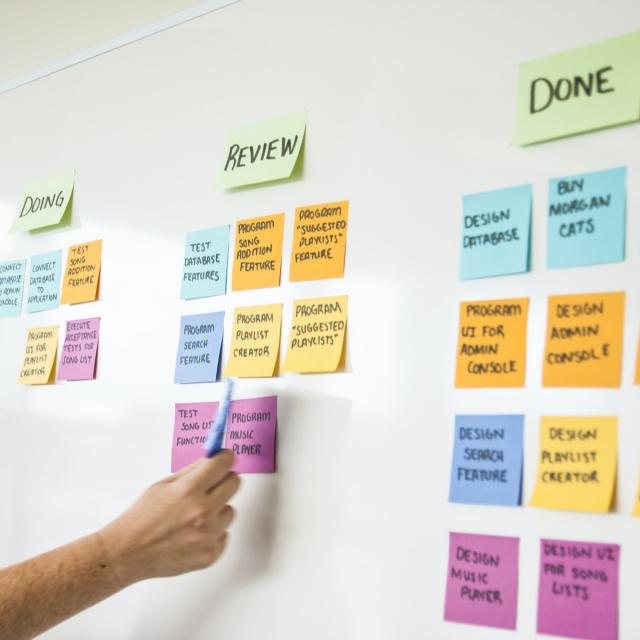
You will learn to apply Agile practices derived from lean manufacturing concepts, like test-driven development. Learn how a scrum team functions. Learn how to write good user stories and track your team’s progress using a kanban board. Create and refine a product backlog collaboratively with the team and the customer, in a flexible and blameless culture.
This approach will lead you to higher levels of efficiency, with the ability to plan and execute sprints with your development team, measuring success with actionable metrics.
This course is about more than facts and processes. It is about working collaboratively on a self-organizing team, coached by a scrum master, and building what is needed, rather than simply following a plan.
Developed and taught by an experienced Agile practitioner, the course includes hands-on practice through realistic scenario-based labs using GitHub and ZenHub.
This course is part of the following programs:

What You Will Learn

  • Adopt the 5 practices of Agile, a subset of DevOps: small batches, minimum viable product, pair programming, behavior- and test-driven development.
  • Write good user stories, estimate and assign story points and track stories using a kanban board. Incorporate Scrum artifacts, events, and benefits.
  • Create and refine a product backlog using the sprint planning process. Produce potentially shippable product increments with every iteration.
  • Create burndown charts to forecast the ability to meet a sprint goal. Use metrics to enhance performance, productivity, and client satisfaction.

Syllabus

WEEK 1
Introduction to Agile and Scrum
In this module, you will be introduced to the philosophy and characteristics of Agile. You will learn about other methodologies including Waterfall, Extreme Programming (XP) and Kanban, and how they relate to Agile. You’ll explore the five practices of working Agile. Next, you’ll get an overview of Scrum as a framework for applying Agile principles to project management. You’ll learn how Scrum benefits the project management process by advocating defined roles, events, and artifacts. You’ll learn how companies can organize for success using Agile, and how team alignment and autonomy contribute to building better systems. You’ll also learn how to recognize and avoid Agile anti-patterns and measure Scrum team health.

WEEK 2
Agile Planning
In this module, you will learn more details about Agile iterative planning. You will also learn how to create good user stories, estimate and assign story points, build and refine a product backlog, and build a sprint plan.

WEEK 3
Daily Execution
This module describes the daily workflow for executing a sprint plan, including how to determine which story to work on and how to keep the team updated on progress. You will learn what a daily stand-up is and how to run one. You’ll learn how to use burndown charts to forecast the team’s ability to achieve the sprint goal. You’ll learn how to conduct the sprint review and the sprint retrospective. And you’ll find out how to measure success and use actionable metrics to improve the team’s performance.

WEEK 4
[Optional] HONORS Project - Create an Agile Plan with ZenHub

Go to Class
MOOC List is learner-supported. When you buy through links on our site, we may earn an affiliate commission.

Related Courses

Introduction to Cloud Computing (Coursera) Coursera
IBM

Introduction to Cloud Computing (Coursera)

Start your cloud computing journey with this self-paced introductory course! Whether you need general cloud computing knowledge for school or business, or you are considering a career change, this beginner-friendly course is right for you. In this course you’ll learn about essential characteristics of cloud computing and emerging technologies supported by cloud. You’ll explore cloud service models, including Infrastructure as a Service (IaaS), Platform as a Service (PaaS), Software as a Service (SaaS), and Public, Private, and Hybrid deployment models.

Sep 7th 2026
5-12 Weeks
Software Engineering: Implementation and Testing (Coursera) Coursera
The Hong Kong University of Science and Technology - HKUST

Software Engineering: Implementation and Testing (Coursera)

Software Development Life Cycle (SDLC) is the process of developing software through planning, requirement analysis, design, implementation, testing, and maintenance. This course focuses on the implementation and testing phases of SDLC, and you will examine different software development processes for large software systems development, and understand the strengths (pros) and weaknesses (cons) of different software development processes.

Sep 14th 2026
5-12 Weeks
Reviews & Metrics for Software Improvements (Coursera) Coursera
University of Alberta

Reviews & Metrics for Software Improvements (Coursera)

This course covers techniques for monitoring your projects in order to align client needs, project plans, and software production. It focuses on metrics and reviews to track and improve project progress and software quality. What you will learn: apply techniques to measure and visualize project progress, integrate Agile review practices to increase project visibility; reflect on lessons learned in software projects through retrospective exercises; improve project and process quality through ongoing measurement

Sep 28th 2026
4 Weeks
Agile Organization (Coursera) Coursera
University of Colorado System

Agile Organization (Coursera)

The theory of Agile is simple. However, it takes experience, knowledge, and expertise to scale it successfully. In this course, you will focus on leading change at an organizational level and scaling Agile appropriately. When studying Agile application success stories and theory, it's easy to think in terms of adopting "best practices." However, what's best for one industry, company, and most importantly, culture is not always the best for another. Not every aspect of the business is suitable for the application of Agile. Not every organization will benefit from adopting Agile, and not every leader will facilitate yet another change to success.

Sep 14th 2026
3 Weeks
Agile with Atlassian Jira (Coursera) Coursera
Atlassian

Agile with Atlassian Jira (Coursera)

Agile teams use “just enough” planning and an incremental approach to accomplishing the work of the team. Every project and every team uses a custom agile methodology. This course discusses common foundational principles and practices used by agile methodologies, providing the student a flexible set of tools to use in any role (e.g. product owner, scrum master, project manager, team member) on any agile team.

Sep 28th 2026
4 Weeks
Information Technology (IT) Fundamentals for Everyone (Coursera) Coursera
IBM

Information Technology (IT) Fundamentals for Everyone (Coursera)

This course will guide you through fundamental concepts and skills to confidently navigate various aspects of IT and the digital world. You will be introduced to the vast field of IT, covering a wide range of topics to build your IT knowledge. You will delve into hardware, operating systems technology, software, programming, databases, networking, storage, cybersecurity, cloud computing, and support and operations.

Sep 14th 2026
5-12 Weeks
Modalidades organizacionales ágiles en base a la Metodología Scrum (Coursera) Coursera
Universidad Austral

Modalidades organizacionales ágiles en base a la Metodología Scrum (Coursera)

En un mundo de fuerte competitividad global, como el que atravesamos hoy en día, con entornos tan complejos y cambiantes, de alta incertidumbre y volatilidad, con fuertes exigencias en adaptabilidad de sectores y mercados; los modelos de negocios predictivos tradicionalmente aplicados en el mundo empresarial con foco de expertise en el negocio, empiezan a ser estrategias poco efectivas y flexibles para la obtención de una competitividad sustentable.

Sep 21st 2026
4 Weeks
Lean Software Development (Coursera) Coursera
University of Minnesota

Lean Software Development (Coursera)

While scrum and XP were transforming the software development industry, there were another set of ideas (derived from lean manufacturing and Six Sigma) that started to influence software development methods. These ideas around Lean Software Development forms the foundation of number of agile methods. In this course, we will explore lean concepts and cover some of the common Lean methods and techniques like Kanban, Value Stream Mapping, etc.

Sep 14th 2026
4 Weeks
Introduction to Software Product Management (Coursera) Coursera
University of Alberta

Introduction to Software Product Management (Coursera)

This course highlights the importance and role of software product management. It also provides an overview of the specialization, as well as its goals, structure, and expectations. The course explains the value of process, requirements, planning, and monitoring in producing better software. Upon successful completion of this course, you will be able to: relate software product management to better software products; recognize the role of a software product manager; reflect on how Agile principles will improve your own projects.

Sep 28th 2026
2 Weeks
Agile Project Management (Coursera) Coursera
University of Colorado Boulder

Agile Project Management (Coursera)

The goal of this third course in the Project Management Specialization examines the philosophy and process of managing projects using Agile project management. Students in this course will learn the Agile philosophy and process including the Scrum framework, sprints, and user stories. Upon completion of this course, you will be able to distinguish between predictive and agile project management methodologies and understand the benefits of delivering value early in an engineering project.

Sep 12th 2026
3 Weeks
Agile Software Development (Coursera) Coursera
University of Minnesota

Agile Software Development (Coursera)

Software industry is going crazy on agile methods. It is rapidly becoming the choice for software development where requirements are unpredictable or is expected to change over time. This course will help you gain knowledge on what is agile? Why agile is better suited for these situations? We will also cover some of the most common agile frameworks like scrum and XP in depth.

Sep 14th 2026
4 Weeks