Gathering and Developing the News (Coursera)

Gathering and Developing the News (Coursera)

Journalists develop information through interviews and sources. The most successful journalists quickly master these important skill sets. The production of journalism relies on several elements: newsgathering, interviewing sources, researching and trying to find as much information as possible. The course will also teach you how to where to find information, interviewing skills and how to process information from various sources for publication.

Class Deals by MOOC List - Click here and see Coursera's Active Discounts, Deals, and Promo Codes.

Course 2 of 5 in the Become a Journalist: Report the News! Specialization.

Syllabus

Week 1
Earning and keeping trust
How - and where - journalists obtain information can determine if their news reports will be deemed credible and trustworthy by their audience. Finding the best sources for information and quotes is a process conducted by every professional journalist. You will learn the best ways to find information and sources for your reporting.

Week 2
Types of sources
Successful journalists understand the need to bring in different types of information and voices to create a strong and accurate news report. You will learn how journalists carefully consider sourcing, and how to effectively and ethically interact with sources.

Week 3
Interviewing
The interview is one of the most powerful tools of journalistic newsgathering. You will learn how journalists use interviews, the different forms it can take, how you can best prepare for it, and how to be sensitive to those who have been through trauma. A good interview can make a news report. And a bad interview can sink it.

Week 4
Tools for finding sourcing
Technology and moving beyond typical sources is letting journalists reach more sources than ever before. You will learn how to use crowdsourcing, social media, press conferences and online resources as valuable tools to enhance your reporting.


Go to Class
MOOC List is learner-supported. When you buy through links on our site, we may earn an affiliate commission.

Related Courses

English for Journalists, Part 1 (edX) EdX
University of California, Berkeley,BerkeleyX

English for Journalists, Part 1 (edX)

Improve your English grammar, vocabulary and writing skills through exciting topics in journalism and world news. English for Journalists offers instruction in English language development for students who are studying journalism, or working journalists who want to improve their English proficiency. Students with a basic understanding and interest in journalism are encouraged to sign up.

Self Paced
Self-Paced
Space is Everywhere (Coursera) Coursera
University of Colorado Boulder

Space is Everywhere (Coursera)

You are here! Welcome to Course 4 - Space is Everywhere and the last course of this specialization. You are on the final stretch of this journey to finding your Pathway to Space. The topics of Course 4 span four weeks and nine lessons with 36 learning objectives. This course contains some of my most favorite aha moments in the the entire specialization. I hope that you find them and that they impact you in a positive way. We will discuss how space is communicated through news, art, movies, books, music and more. Space is everywhere in our lives and therefore everyone can be involved in it. So keep up the pace. You can do this. Your reward awaits you, finding your pathway to space.

Jun 22nd 2026
4 Weeks
Phishing Attacks (Totem) Totem
Totem project

Phishing Attacks (Totem)

Think before you click. Phishing happens to everyone, but most people only become aware of it once they have become a victim of an attack. Protecting yourself from phishing attacks starts with identifying an email or message as an attack before you click on the link or download the file. But even if you are careful, a phishing attack can still sometimes be successful. Don’t panic.

Self Paced
Self-Paced
Advanced Interviewing Techniques (Coursera) Coursera
University of Maryland, College Park

Advanced Interviewing Techniques (Coursera)

People interviewing for jobs today often fail because they are using yesterday's strategies. Recruiting technology has become more sophisticated, and the best employers are constantly changing the way interviews are done. This course gives you detailed strategies for handling tough competency-based, or behavioral, interviews so that you can communicate the knowledge, skills, and abilities that you have and that employers demand.

Jun 15th 2026
5-12 Weeks
Learning Online: Searching and Researching (FutureLearn) FutureLearn
University of Leeds

Learning Online: Searching and Researching (FutureLearn)

Improve your online research skills and your ability to critically analyse sources of information. In this course, you’ll explore the rich and diverse range of information available to you online, how to use search tools effectively, and the ways in which you can begin to assess information that you might want to use in your studies.

Feb 16th 2026
2 Weeks
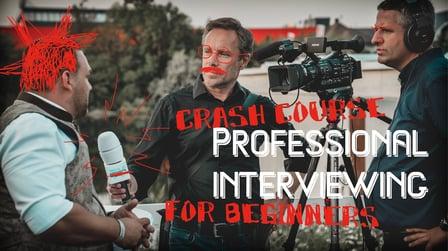
Crash Course on Professional Interviewing for Beginners (Skillshare) Skillshare
Skillshare

Crash Course on Professional Interviewing for Beginners (Skillshare)

The class: Experienced interviewer and university lecturer in qualitative interviewing Zack Koretsky guides you through your preparation for your first journalistic, blogging, podcast, academic or school interview! Filled with insightful tips and a bit of theory, it’s a perfect crash course for beginner journalists, bloggers and students.

Self Paced
Self-Paced
What is news? (Coursera) Coursera
Michigan State University

What is news? (Coursera)

This course will guide you through the basic elements of professional journalism and the news values and ethics of covering real-world issues and events. The overview and examples of the types of news coverage helps introduce the different types of journalism, such as social media, multimedia, print, visual and broadcast, and how professional journalists effectively use each format.

Jun 15th 2026
5-12 Weeks