Fixing Healthcare Delivery 2.0: Advanced Lean (Coursera)

Offered by University of Florida,
Fixing Healthcare Delivery 2.0: Advanced Lean (Coursera)

Lean or Toyota Production System (TPS) is responsible for revolutionizing the auto industry by creating highly reliable and safe cars and trucks. In this course healthcare providers, administrators, engineers, and healthcare professional students will be taught how to apply the principles and tools of Lean to health care. They will learn how to identify and remove of waste, design standardized work, apply 5S, map Value streams, create process maps, conduct rapid improvement events (RIEs), level workflow, use A3 forms and Paredo charts, apply error proofing, and create effective visual controls.

Class Deals by MOOC List - Click here and see Coursera's Active Discounts, Deals, and Promo Codes.

The instructional videos minimize Lean technical language, and include patient cases to make the lessons more appealing to students in healthcare. Acknowledging that patients are very different from cars we have carefully adapted Lean to health care and call our system: Patient-centered Healthcare Delivery System (PHDS). The name and abbreviation emphasize two key principles taught in our course: 1. Just like PhDs the scientific method must be continually applied when creating plans to improve our systems of care. 2. All improvements must be made looking through the eyes of patients. Armed with this new knowledge students will be able to design and implement sustainable healthcare delivery system improvements.

Syllabus

WEEK 1
Introduction to Applying TPS or Lean to Healthcare
Toyota Production System (TPS) or Lean has allowed Toyota to become the number one automobile manufacturer in the world by progressively improving the quality and reliability of their products. The System of Profound Knowledge developed by the American, W. Edward Deming is the basis for TPS or Lean. This system has now been adapted to healthcare by Virginia Mason Medical Center and Denver Health with exciting results. You will be introduced to the 4 principles of TPS, as well as the TPS House that illustrates how the various tools of TPS fit together to continually add value to the care of patients. The challenges faced by both health systems will be discussed and their approaches to transforming their delivery systems described. When Lean is applied to healthcare, patient care improves, and both patient mortality and the cost of care decrease. Applying Lean to healthcare systems can revolutionize how healthcare is delivered.

WEEK 2
Waste Reduction
Waste is a huge problem in modern health care. It has been estimated that 30-60% of all that we do is wasteful and is not of value. Lean has categorized 8 forms of waste allowing everyone on the front lines to recognize waste and work to remove it. 5S is a very helpful tool that can be used early in the implementation of lean and can remove clutter and quickly improve efficiency. A major form of waste is the excessive use of diagnostic tests, as well as delayed or missed diagnosis. In this session you will be introduced to the 8 forms of waste, the use of 5S, how illness scripts can be used to create a tiered diagnostic list, and how Bayes Theorem can be used to select the highest yield tests. Using this approach diagnosticians can more quickly and cost effectively arrive at diagnoses. Waste is the foundation of Lean and by removing waste we can progressively increase the value of patient care.

WEEK 3
Standardized Work and Preparing for Value Stream Mapping
Standardized work is an absolute necessity for improvement. Without standardized work there can be no improvement. This is one of the most difficult concepts to relay to those on the front lines particularly physicians, who call this "cookbook medicine". In this module the philosophy behind creating standardized work is reviewed, and the importance of everyone on the front line participating in creating and continually modifying standardized work emphasized. You will be introduced to tools that will help you to effectively design standardized work: the spaghetti diagram and the Time Observation Sheet. Lead Time, Cycle Time and Takt Time will be defined. You will learn how time the individual steps of a work process. You will also learn how to use a percentage load chart to calculate how many workers are required to meet production demand.

WEEK 4
Value Stream & Process Mapping, RIEs, and Leveling Flow
Value stream mapping is at the heart of TPS or Lean. Using the Time Observation Sheets you will learn how to fill out a Value Stream Map, including determining WIP (work in progress) depicting physical movement and process flow along with information flow, and assessing when work is value-added and when it is non-value added. Value stream maps are used to identify bottlenecks and wasteful steps in a work process and then process mapping and rapid improvement events (RIEs) can be used to remove these wasteful processes and impediments to workflow. Finally you will be introduced to the principles of leveling both under elective and emergency treatment conditions. Applying these tools can dramatically improve efficiency and productivity without increasing overall manpower.

WEEK 5
Error Proofing and Visual Controls
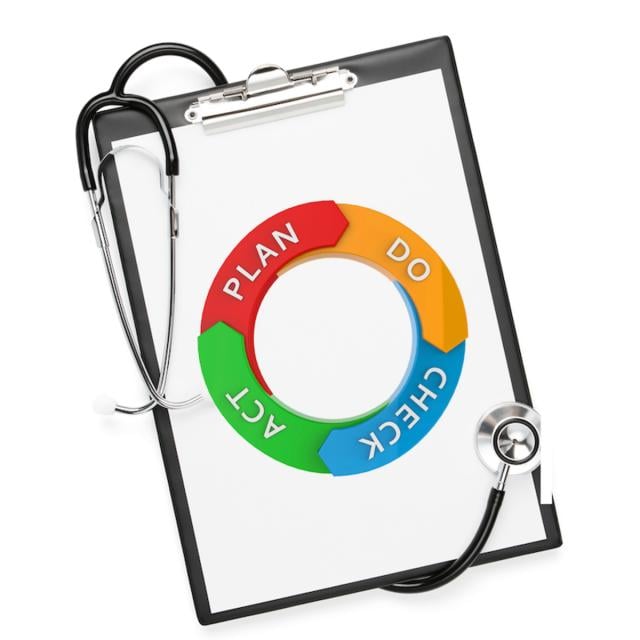
Preventable medical errors are estimated to kill 100,000 to 440,000 people per year in the U.S. and similar levels of harm due to medical errors have also been observed in other countries. In order to effectively eliminate errors, we must first be able to recognize and report them and different types of error reporting are described. Secondly there must be a culture in place that deals fairly with errors by differentiating systems errors from individual human errors. This can be accomplished by applying a Just Culture. Additional tools for eliminating errors and improving processes are introduced including: the Pareto Chart, Failure Mode and Effects Analysis (FMEA), an expanded Plan, Do, Study, Adjust cycle, and the A3 form. There are 6 levels of error proofing and their effectiveness in preventing errors from reaching patients is assessed using clinical examples. Visual controls can be helpful for reducing errors and for following the progress of work process improvements. In the final video the major topics covered in this course are summarized, and a new name for TPS or Lean adapted to healthcare is proposed: Patient-centered Healthcare Delivery System (PHDS). This name emphasizes the importance of applying the scientific method, like PhDs, to continually improve healthcare delivery while always focusing on the needs of patients.


Go to Class
MOOC List is learner-supported. When you buy through links on our site, we may earn an affiliate commission.

Related Courses

Health Across the Gender Spectrum (Coursera) Coursera
Stanford University

Health Across the Gender Spectrum (Coursera)

This course offers an intimate, story-based introduction to the experiences of six transgender children and their families. Through illustrated stories and short teaching videos, learners will gain a better understanding of gender identity and the gender spectrum. Stanford physicians, K-12 educators, and transgender faculty members offer practical tips for parents, teachers, healthcare providers and anyone who wants to help create a more gender-expansive environment - one in which all people can live authentically. As a global community of unique individuals, we can begin to build a world that is ready to nurture and love each and every child.

Jun 8th 2026
3 Weeks
Six Sigma Advanced Improve and Control Phases (Coursera) Coursera
University System of Georgia

Six Sigma Advanced Improve and Control Phases (Coursera)

This course is for you if you are looking to dive deeper into Six Sigma or strengthen and expand your knowledge of the basic components of green belt level of Six Sigma and Lean. Six Sigma skills are widely sought by employers both nationally and internationally. These skills have been proven to help improve business processes and performance. This course will take you deeper into the principles and tools associated with the "Improve" and "Control" phases of the DMAIC structure of Six Sigma.

Jun 8th 2026
5-12 Weeks
Psychosocial and Spiritual Aspects of Palliative Care (Coursera) Coursera
University of Colorado System

Psychosocial and Spiritual Aspects of Palliative Care (Coursera)

In this course, you’ll learn how serious and life-threatening illnesses often affect emotional and spiritual well-being. Illnesses can increase stress as patients and families learn to live with a “new normal” that may often focus on illness. You’ll learn how to tell when normal sadness (or grief) becomes something more serious and needs to be addressed.

Jun 8th 2026
5-12 Weeks
Living with Dementia: Impact on Individuals, Caregivers, Communities and Societies (Coursera) Coursera
Johns Hopkins University

Living with Dementia: Impact on Individuals, Caregivers, Communities and Societies (Coursera)

Health professionals and students, family caregivers, friends of and affected individuals, and others interested in learning about dementia and quality care will benefit from completing the course. Led by Drs. Nancy Hodgson and Laura Gitlin, participants will acquire foundational knowledge in the care of persons with Alzheimer’s Disease and other neurocognitive disorders.

Jun 8th 2026
5-12 Weeks
Regulated Competition in Healthcare Systems: Theory & Practice (Coursera) Coursera
Erasmus University Rotterdam

Regulated Competition in Healthcare Systems: Theory & Practice (Coursera)

In this MOOC you will learn about the theory and practice of 'regulated competition' (also known as 'managed competition') in healthcare systems. Many countries have implemented or consider implementation of regulated competition in healthcare. Examples include Australia, Belgium, Chile, Colombia, Germany, Ireland, Israel, The Netherlands, Switzerland and the United States.

Jun 8th 2026
5-12 Weeks
Six Sigma Tools for Define and Measure (Coursera) Coursera
University System of Georgia

Six Sigma Tools for Define and Measure (Coursera)

This course is for you if you are looking to learn more about Six Sigma or refresh your knowledge of the basic components of Six Sigma and Lean. Six Sigma skills are widely sought by employers both nationally and internationally. These skills have been proven to help improve business processes and performance. This course will cover the Define phase and introduce you to the Measure phase of the DMAIC (Define, Measure, Analyze, Improve, and Control) process. You will learn about Six Sigma project development and implementation, you will become familiar with project management tools, you will be introduced to statistics and understand its significance to Six Sigma, and finally you will learn about data collection and its importance to an organization.

Jun 8th 2026
4 Weeks
HI-FIVE: Health Informatics For Innovation, Value & Enrichment (Social/Peer Perspective) (Coursera) Coursera
Columbia University

HI-FIVE: Health Informatics For Innovation, Value & Enrichment (Social/Peer Perspective) (Coursera)

HI-FIVE (Health Informatics For Innovation, Value & Enrichment) Training is an approximately 10-hour online course designed by Columbia University in 2016, with sponsorship from the Office of the National Coordinator for Health Information Technology (ONC). The training is role-based and uses case scenarios. Our nation’s healthcare system is changing at a rapid pace. Transformative health care delivery programs depend heavily on health information technology to improve and coordinate care, maintain patient registries, support patient engagement, develop and sustain data infrastructure necessary for multi-payer value-based payment, and enable analytical capacities to inform decision making and streamline reporting.

Jun 8th 2026
4 Weeks
Voice Disorders: What Patients and Professionals Need to Know (Coursera) Coursera
Icahn School of Medicine at Mount Sinai

Voice Disorders: What Patients and Professionals Need to Know (Coursera)

Knowledge regarding vocal production physiology and management options for voice disorders have experienced rapid growth over the past 40 years. This growth has resulted in a knowledge gap amongst patients and practitioners. Entirely new subspecialties of laryngology under otolaryngology and vocology under speech-language pathology have developed in response to this gap. This MOOC (Massive Open Online Course) is designed to educated patients, allied healthcare providers, vocal trainers/coaches, general medical practitioners and otolaryngologists.

Jun 8th 2026
5-12 Weeks
International Hospitality & Healthcare Services Marketing (Coursera) Coursera
Yonsei University

International Hospitality & Healthcare Services Marketing (Coursera)

As the fastest-growing sectors of the current global economy, both hospitality and healthcare services sector offer tremendous growth opportunities for incumbents and entrepreneurial opportunities for new entrants. To flourish on these opportunities, one must first understand each industry's unique characteristics. This course is designed to help those who are interested in career advancement opportunities in these industries or who want to be inspired by these industries to better equip themselves with enlightened and creative management capabilities.

Jun 8th 2026
3 Weeks
Six Sigma Advanced Analyze Phase (Coursera) Coursera
University System of Georgia

Six Sigma Advanced Analyze Phase (Coursera)

This course is for you if you are looking to dive deeper into Six Sigma or strengthen and expand your knowledge of the basic components of green belt level of Six Sigma and Lean. Six Sigma skills are widely sought by employers both nationally and internationally. These skills have been proven to help improve business processes and performance. This course will take you deeper into the principles and tools associated with the "Analyze" phase of the DMAIC structure of Six Sigma.

Jun 8th 2026
3 Weeks
Population Health: Study Design (Coursera) Coursera
Leiden University

Population Health: Study Design (Coursera)

Health care professionals increasingly have to make clinical decisions in aging and diverse populations. Also, they have to deal with rising health care costs, fragmented health care supply and advancing medical technologies and IT systems. These developments go beyond every day practice and will require new skills. In this course we will walk you through key steps in designing a research study, from formulating the research question to common pitfalls you might encounter when interpreting your results.

Jun 8th 2026
4 Weeks