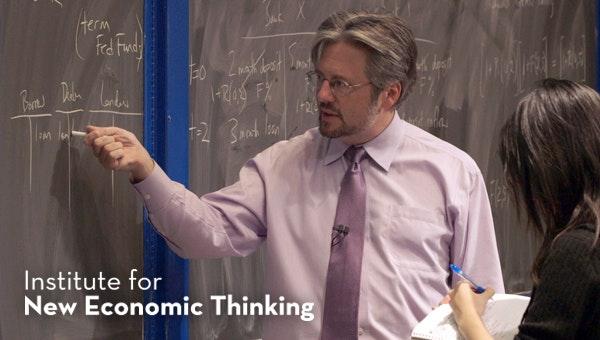
Financial Markets (Coursera)

Offered by Yale University,
Financial Markets (Coursera)

An overview of the ideas, methods, and institutions that permit human society to manage risks and foster enterprise. Emphasis on financially-savvy leadership skills. Description of practices today and analysis of prospects for the future. Introduction to risk management and behavioral finance principles to understand the real-world functioning of securities, insurance, and banking industries. The ultimate goal of this course is using such industries effectively and towards a better society.

Class Deals by MOOC List - Click here and see Coursera's Active Discounts, Deals, and Promo Codes.

Syllabus

WEEK 1
Welcome to the course! In this opening module, you will learn the basics of financial markets, insurance, and CAPM (Capital Asset Pricing Model). This module serves as the foundation of this course.

WEEK 2
In this next module, dive into some details of behavioral finance, forecasting, pricing, debt, and inflation.

WEEK 3
Stocks, bonds, dividends, shares, market caps; what are these? Who needs them? Why? Module 3 explores these concepts, along with corporation basics and some basic financial markets history.

WEEK 4
Take a look into the recent past, exploring recessions, bubbles, the mortgage crisis, and regulation.

WEEK 5
Options and bond markets are explored in module 5, important components of financial markets.

WEEK 6
In module 6, Professor Shiller introduces investment banking, underwriting processes, brokers, dealers, exchanges, and new innovations in financial markets.

WEEK 7
Professor Shiller's final module includes lectures about nonprofits and corporations, and your career in finance.


Go to Class
MOOC List is learner-supported. When you buy through links on our site, we may earn an affiliate commission.

Related Courses

The Economics of Agro-Food Value Chains (Coursera) Coursera
Technische Universität München - TUM

The Economics of Agro-Food Value Chains (Coursera)

In this course, you learn how the agro-food value chain approaches the challenge of constantly improving its competitiveness by producing high quality food and products and also aiming to attain greater sustainability. Some of the topics of this course are: the notion of quality for food and agricultural products and consumer value; how to conduct market research in this field; labelling, branding and pricing strategies, as-well as innovation in the agro-food sector; how sustainability can be used as a competitive advantage through corporate social responsibility: the role and different types of industrial standards; the different forms of coordination in the chain, in particular with regard to the retailing and distribution sector.

Jun 24th 2026
5-12 Weeks
New Models of Business in Society (Coursera) Coursera
University of Virginia

New Models of Business in Society (Coursera)

In this course, developed at the Darden School of Business at the University of Virginia and taught by top-ranked faculty, we will be discussing the emergence of a new story about business. This new story locates business within a societal framework. Almost every business creates or destroys value for customers, suppliers, employees, communities and society, in addition to shareholders and other financiers. A number of new models of business can be built on this idea such as corporate responsibility, philanthropy, shared value and sustainability. Profits and stakeholder value go together, and this course explains how. The final session explores the idea of how to become a stakeholder entrepreneur and create a business that makes money and makes the world a better place.

Jun 22nd 2026
4 Weeks
Applying Data Analytics in Finance (Coursera) Coursera
University of Illinois at Urbana-Champaign

Applying Data Analytics in Finance (Coursera)

This course introduces an overview of financial analytics. You will learn why, when, and how to apply financial analytics in real-world situations. You will explore techniques to analyze time series data and how to evaluate the risk-reward trade off expounded in modern portfolio theory. While most of the focus will be on the prices, returns, and risk of corporate stocks, the analytical techniques can be leverages in other domains. Finally, a short introduction to algorithmic trading concludes the course.

Jun 28th 2026
4 Weeks
Design Thinking for Innovation (Coursera) Coursera
University of Virginia

Design Thinking for Innovation (Coursera)

Today innovation is everyone's business. Whether you are a manager in a global corporation, an entrepreneur starting up, in a government role, or a teacher in an elementary school, everyone is expected to get lean – to do better with less. And that is why we all need design thinking. At every level in every kind of organization, design thinking provides the tools you need to become an innovative thinker and uncover creative opportunities that are there – you're just not seeing them yet.

Jun 22nd 2026
5-12 Weeks
Game Theory II: Advanced Applications (Coursera) Coursera
Stanford University,The University of British Columbia

Game Theory II: Advanced Applications (Coursera)

Popularized by movies such as "A Beautiful Mind", game theory is the mathematical modeling of strategic interaction among rational (and irrational) agents. Over four weeks of lectures, this advanced course considers how to design interactions between agents in order to achieve good social outcomes. Three main topics are covered: social choice theory (i.e., collective decision making and voting systems), mechanism design, and auctions.

Jun 22nd 2026
5-12 Weeks
Value and Business Decision Making (Coursera) Coursera
Yunus Social Business Fund Bengaluru

Value and Business Decision Making (Coursera)

This course is part of a Specialization titled “Strategy and Finance for a Lifecycle of a Social Business”. It is an introduction to time value of money and will help the learner understand the basics of finance with the ultimate goal of valuing a company from a societal lens. The beauty of the modern decision-making framework is that it can be used to understand value creation at any level – the individual, the corporate or nonprofit entity level and from the point of view of society. The applications however become increasingly complex as your lens expands from the individual to the corporate/nonprofit to the global society.

Jun 24th 2026
5-12 Weeks
Managing Project Risks and Changes (Coursera) Coursera
University of California, Irvine

Managing Project Risks and Changes (Coursera)

This course will help you manage project risk effectively by identifying, analyzing, and communicating inevitable changes to project scope and objectives. You will understand and practice the elements needed to measure and report on project scope, schedule, and cost performance. You will be equipped with the tools to manage change in the least disruptive way possible for your team and other project stakeholders.

Jun 22nd 2026
5-12 Weeks
Applying Data Analytics in Marketing (Coursera) Coursera
University of Illinois at Urbana-Champaign

Applying Data Analytics in Marketing (Coursera)

This course introduces students to the science of business analytics while casting a keen eye toward the artful use of numbers found in the digital space. The goal is to provide businesses and managers with the foundation needed to apply data analytics to real-world challenges they confront daily in their professional lives.

Jun 27th 2026
4 Weeks
Risk, Return and Valuation (Coursera) Coursera
Yunus Social Business Fund Bengaluru

Risk, Return and Valuation (Coursera)

This course is part of a Specialization titled “Strategy and Finance for a Lifecycle of a Social Business”, with a follow-on project-based course on understanding and evaluating a business focused on addressing a societal issue. The beauty of a modern decision-making framework is that it can be used to understand value creation at any level – the individual or business or societal. The applications however become increasingly complex as your lens expands from the individual to the corporate/nonprofit to the global society.

Jun 24th 2026
5-12 Weeks