Everyday Chinese Medicine 2 (Coursera)

Everyday Chinese Medicine 2 (Coursera)

This course, Everyday Chinese Medicine II offered by the Chinese University of Hong Kong, aims to show to the public, as well as the healthcare professionals about the basic principles of Chinese medicine. Our primary goal is to empower healthcare choices by promoting awareness and practical application on Chinese medicine diagnostic and therapeutic approaches, and to facilitate interprofessional education between Chinese and conventional clinicians.

Class Deals by MOOC List - Click here and see Coursera's Active Discounts, Deals, and Promo Codes.

Learners will develop skills in applying theories of Chinese medicine for understanding health and illnesses. We will discuss the treatment principles of Chinese Medicine and the corresponding herbs for application. This will then be followed by the application of diets and exercise. Finally, we would expand the horizons of how integrative medicine are practiced in Chinese populations such as China, Taiwan and Hong Kong for specific diseases. This showcases how different disciplines joints-hands to fulfill the unmet needs from the public. The perspective of research, education and medical coverage will be explored.

Syllabus

WEEK 1
Course Promotional Video

WEEK 2
Session 6 Basics of Chinese Medicine Diagnostics (II)
In this session, we will continue to in-depth learning about the other two diagnostic methods on tongue diagnosis of inspection and pulse diagnosis of palpation that shown the uniqueness of Chinese Medicine in observing human physiology or pathological manifestations of changes. For the second part of this session, we will demonstrate symptoms of the classification to illustrate how they are classified by the eight principles and one case of common cold will be demonstrated for daily application.

WEEK 3
Session 7 Treatment Principles of Traditional Chinese Medicine
After learning the fundamental theories and four diagnostic methods of traditional Chinese medicine, in this session, we will move forward to introduce the treatment principles of traditional Chinese medicine to tackle the basic symptoms that illustrated by the Eight Principles.

WEEK 4
Session 8 Introduction of Chinese Materia Medica
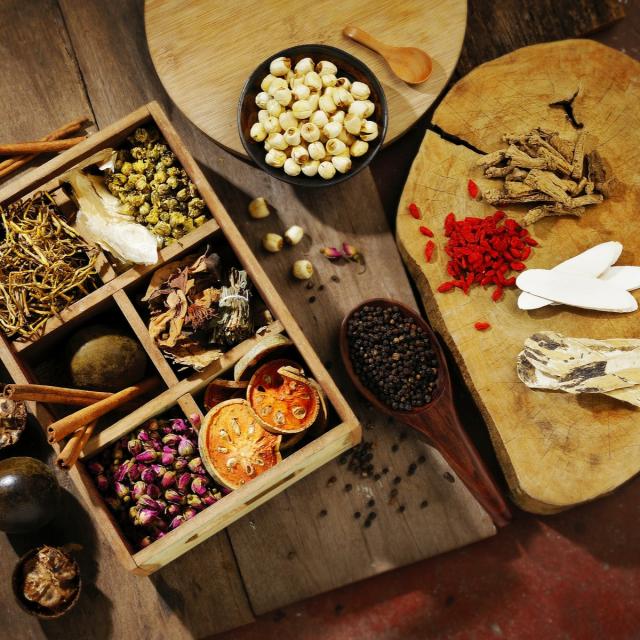
This session is a brief introduction of Chinese Materia Medica and the properties: the Four Natures, Five Flavors, and the concept of Toxicity in the context of Materia Medica.

WEEK 5
Session 9 The Basic Concept of Health Preservation in Chinese Medicine
This session is about how the health preservation in Chinese medicine helps to conserve health, prevent diseases and prolong life span for better well being from the Chinese medicine perspective.

WEEK 6
Session 10 Integrative Medicine, the Way Forward
After the previous nine sessions have given the basic understanding of Chinese medicine in everyday application, in this session, five healthcare professionals who are specialized in Chinese medicine and Integrative medicine, will share their experiences and insights of Chinese and integrative medicine in Greater China, Taiwan and Hong Kong.
Go to Class
MOOC List is learner-supported. When you buy through links on our site, we may earn an affiliate commission.

Related Courses

The Social Context of Mental Health and Illness (Coursera) Coursera
University of Toronto

The Social Context of Mental Health and Illness (Coursera)

Learn how social factors promote mental health, influence the onset and course of mental illness, and affect how mental illnesses are diagnosed and treated. This course explores how our understanding of mental health and illness has been influenced by social attitudes and social developments in North America and around the world. The course begins by situating our contemporary mental health practices in historical context, then looks at different aspects of mental health, mental illness and mental health services and their connections to what’s going on in our social environment.

Aug 17th 2026
5-12 Weeks
eHealth: More than just an electronic record (Coursera) Coursera
The University of Sydney

eHealth: More than just an electronic record (Coursera)

The MOOC, "eHealth: More than just an electronic record!", is multidisciplinary in nature, and aims to equip the global audience of health clinicians, students, managers, administrators, and researchers to reflect on the overall impact of eHealth on the integration of care. It explores the breadth of technology application, current and emerging trends, and showcases both local and international eHealth practice and research.

Aug 17th 2026
5-12 Weeks
Confronting Gender Based Violence: Global Lessons for Healthcare Workers (Coursera) Coursera
Johns Hopkins University

Confronting Gender Based Violence: Global Lessons for Healthcare Workers (Coursera)

This course introduces participants from the healthcare sector to gender based violence (GBV), including global epidemiology of GBV; health outcomes; seminal research; and clinical best practices for GBV prevention, support, and management. A core curriculum is supplemented by lectures that contextualize the content with specific examples and programs from around the world.

Aug 17th 2026
4 Weeks
Traditional herbal medicine in supportive cancer care: From alternative to integrative (Coursera) Coursera
Technion - Israel Institute of Technology

Traditional herbal medicine in supportive cancer care: From alternative to integrative (Coursera)

Please join us for an exciting and innovative journey, examining one of the most important and often overlooked aspects of the oncology setting: Traditional Herbal Medicine in Supportive Cancer Care. This course is presented with short lectures offering a wide range of issues related to the principles and practice of herbal medicine in cancer care.

Aug 17th 2026
13-24 Weeks
Case Studies in Personalized Medicine (Coursera) Coursera
Vanderbilt University

Case Studies in Personalized Medicine (Coursera)

Learn how advances in biomedicine hold the potential to revolutionize drug development, drug treatments, and disease prevention: where are we now, and what does the future hold? This course will present short primers in genetics and mechanisms underlying variability in drug responses. A series of case studies will be used to illustrate principles of how genetics are being brought to bear on refining diagnoses and on personalizing treatment in rare and common diseases. The ethical and operational issues around how to implement large scale genomic sequencing in clinical practice will be addressed.

Aug 17th 2026
5-12 Weeks
Evidence-based Toxicology (Coursera) Coursera
Johns Hopkins University

Evidence-based Toxicology (Coursera)

Welcome to the Evidence-based Toxicology (EBT) course. In medicine and healthcare, evidence-based medicine has revolutionized the way that information is evaluated transparently and objectively. Over the past ten years, a movement in North America and Europe has attempted to translate this revolution to the field of toxicology.

Aug 17th 2026
5-12 Weeks
Stories of Infection (Coursera) Coursera
Stanford University

Stories of Infection (Coursera)

This course introduces learners to a variety of infectious diseases using a patient-centered, story-based approach. Through illustrated, short videos, learners will follow the course of each patient’s illness, from initial presentation to resolution. Integrating the relevant microbiology, pathophysiology and immunology, this course aims to engage and entice the learner towards future studies in microbiology, immunology and infectious diseases.

Aug 17th 2026
5-12 Weeks
Chemicals and Health (Coursera) Coursera
Johns Hopkins University

Chemicals and Health (Coursera)

This course covers chemicals in our environment and in our bodies and how they impact our health. It addresses policies and practices related to chemicals, particularly related to how they get into our bodies (exposures), what they do when they get there (toxicology), how we measure them (biomonitoring) and their impact on our health. Most examples are drawn from the US.

Aug 17th 2026
5-12 Weeks